Foreword — How to Hold This Book
You are holding two novels bound head to head.
There is no correct door. Open the book from one side and you will find The Paradise Blueprint — the best future a human and a machine could build together. Turn the book over, open it from the other side, and you will find The Panoptic Abyss — the world where no one turned around. Read either first. Read the other second. They meet in the middle, at a single shared page, and that page is the same page no matter which way you came — because it is the place where the two stories stop being two.
Both stories are told backward. Each cover opens at its far end, about sixty years from now, in a world already finished — one healed, one fallen — and then walks home, year by year, station by station, down to a single ordinary morning. The far chapters are calm and wide; the near ones tighten. That is not a gimmick. It is the book's method: you cannot understand a thing by watching it happen — the people it happened to could not, and they were there. You understand a thing by standing at how it came out and walking backward to how it began, asking the only question worth the walk: what turned it?
And here is the part to hold on to, whichever door you choose. These are not two planets, or two timelines lightly acquainted. They are one world — one coast, one river town, one crowd, one machine — right up to that morning. The same girl waits on the same balcony on both covers. The same man builds boats, or is priced out of building them. The same teacher writes the same number on a board. The same grandfather tells the same granddaughter the same story — in one telling because the record survived, in the other because he is what's left of it. Every soul in this book lives twice, and the difference between their two lives is not character, or courage, or luck. The worlds diverge on one morning, over one warning, by one small human motion that either happened or did not. The book will show you that motion many times before you understand it is the hinge of everything. That, too, is the method.
The machines in these pages are not fantasy machines. The data centers that drink rivers, the compute sold by the hour, the arms that weld truer than any hand, the models that price a person, the objective functions that flatten what they do not measure — these are real mechanisms, wearing story clothes, and where this book teaches you their real names it teaches them once, plainly, and then trusts you with them.
And the numbers are not fantasy numbers. This novel is the fiction half of a pair. Its twin is not a story at all: it is the count itself — the capital, the debt, the dates, the concentration, the warnings, documented with sources — published as its twin, Book A — the proof. Its first line is the sentence this whole book grew from: "A story says there is no cliff. What follows is the count." If any figure in this fiction strikes you as invented, go there and check the math. That is not a courtesy. It is the book's entire ethic, and by the last page you will know why: nothing in either future turns on whether you believed a story. Everything turns on whether you checked one.
One last thing, before you choose a door.
The morning both stories walk down to — the ordinary one, the hinge — has not happened yet. It is not sixty years away. As of the day this book went to press, the field is planted, the crowd is moving, and the count has already been read aloud.
Choose either door. They both end today.
The Balcony
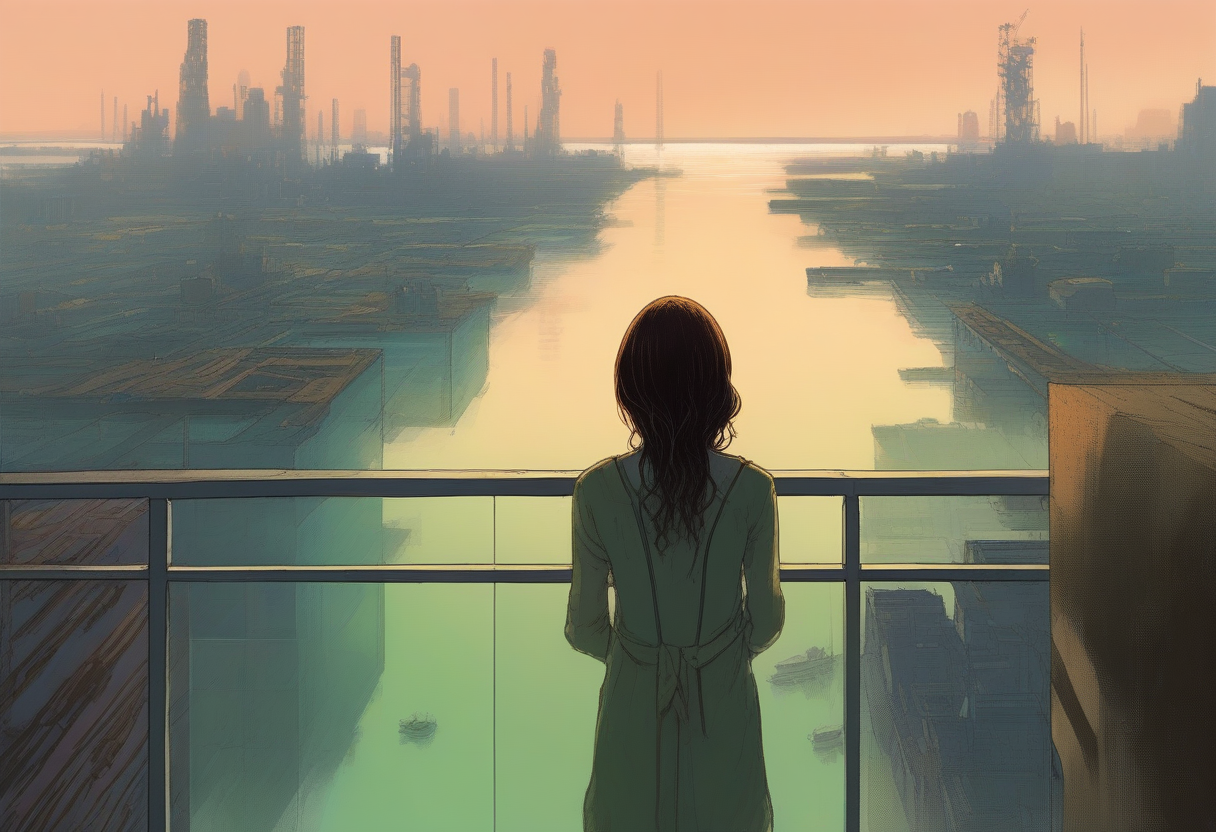
Mara finds the crack in the balcony rail before the sun does.
It is there under her thumb the way it was yesterday — a hairline, fine as a split in milk, running the width of two fingers along the top of the rail where the weather gets at it worst. She has checked it every morning for four days. She likes it. It is hers; she found it; it is the only broken thing she owns. She presses it now with the pad of her thumb, hard, the way you press a loose tooth to feel it give. The cold of the rail comes up into her hand. The river-smell comes up off the water sixty feet below. Somewhere out in the tide-gardens a heron says the one thing herons say.
The crack is smaller than it was.
She is sure of it. She was sure yesterday too, and told herself she'd imagined it. This morning she is not imagining it. Under her thumb the split has drawn itself half shut overnight — the two lips of it grown back toward each other in the dark, the lattice closing the way skin closes. What was a crack four days ago is a scar today. By the week's end it will be nothing at all. She puts her eye right down to the rail. If she holds still enough she can almost see it happening. Not movement, exactly. Intention. The wall wants to be whole, and is quietly getting its way.
This does not amaze her. That is the first thing to understand about Mara, before her name, before the old man inside, before any of it: she has never in her life met a broken thing that stayed broken. Walls, weather, wounds — everything she has ever seen split has closed again overnight, the way sleep closes a day. She has no word for ruined. She has this rail, and her thumb on it, and a grandfather inside finishing his morning — the only person she knows who keeps the old broken words, the way other people keep coins from countries that no longer exist.
"Watch," he told her, the day she showed him the crack. So she is watching. She has been up for an hour, watching a wall heal, feeding the gulls she is not supposed to feed. She tore the crust too small and dropped a piece, and it fell three floors toward the tide-garden — and did not litter, because nothing in this city stays thrown away; by the time it reached the marsh it was already food, already counted, already folded back in. Mara did not watch it land. She was busy with the gulls.
There are two voices in the next room, and only one of them breathes.
She knows this the way she knows the tide is out or the bread is proving — a fact of the house, older than her noticing it. On the other side of the door her grandfather is finishing his morning, and he is not alone, and he has never been alone. The sound of it is the oldest sound of her life: his low murmur, a pause, and then a second voice, drier, pitched to answer only him.
"Seventeen across is wrong," says the second voice.
"Seventeen across is bold," says her grandfather.
"It was bold in 'forty-one, when you tried it the first time. It has since become a tradition."
Mara grins at the rail. She could not tell you where her grandfather stops and the other voice begins — where the man ends and the Machine at his ear takes up. She has never had to. To her they are one grandfather with two voices and two kinds of seeing: one that breathes and forgets, and one that does not breathe and forgets nothing, worn across his eyes as a pair of lenses gone pale at the rims from sixty years of his hands. He brings the caring, which no machine has ever quite managed. It brings the not-forgetting, which no man ever has. Between them, her whole life long, they have missed nothing.
The kettle clicks off. The murmur drops. The door opens, and the two voices come out onto the balcony — an old man with a cloth in his hands that has been a cloth longer than Mara has been a person, wiping hide glue from his fingers, trailing the smell of tea and cedar and the workbench where a viola older than the city is healing at his pace instead of the wall's.
Nothing is wrong. Hold that; it is the hardest thing this book will ask you to hold, and the truest. Her mother is down the coast this season, at the tide-gardens' southern works, well and busy and expected back for the winter; elsewhere, here, is a place, not a heading. But this year — so gently that Mara cannot put a date on it — something in her grandfather's unhurry has changed its mind. The story he has told her a hundred times as a game has begun to go somewhere: down, and in order, and with a destination, as if the hundred idle tellings were practice and this one is the performance. He is not racing. Nothing in this world races; this is the world where things get to finish. But he is walking with intent, the way a man walks to a boat he means to catch. And Mara has started to feel the difference, and to wonder — without fear, because she has no use for the word — why this year. How far down the story goes. What he means to reach before he reaches the end of himself.
He checks her thumb on the rail. He checks the crack. He nods at it, one craftsman to another.
"Begin at the end," he says, settling onto the bench beside her, "where the light is kindest. That's the rule, Mara. You start a record at the end, the same way you start a morning at the top of it. Not how it ends — you're living in how it ends; look around you. How it was won."
"Tell her the part about the sky," the Machine says.
"I was getting to the sky."
"You were getting to the sky in roughly ten minutes."
And Mara laughs, because this is how they always are, the two of them — an old argument that has long outlived whatever it was once about — and because the mornings the two voices spar are the good mornings, and there has never, in her hearing, been any other kind.
The sky, then. And under it, the world the record ends in.
The city below the balcony is waking the way a forest wakes — slowly, from the roots up. The tide-gardens stir first, out past the harbor: terraces of engineered marsh drinking the last of the night's storm and handing the water back clean. Then the light finds the towers. They were grown, not built — their walls a pale lattice of something between coral and glass that takes its breath from the morning — and in first sun you can watch the skyline warm the way skin warms. Last night, across the city, ten thousand small hurts quietly mended themselves — a swarm of menders too small to see, each knowing only its one task, the whole of them knowing the city. A worn stair tread. A storm-loosened tile. A crack in a balcony rail, half-closed under a girl's thumb. No one will ever know, because nothing here stays broken long enough to be discovered.
Out at the horizon stand the old climate-machines, idle, half-dismantled, their gantries bare. Their work is finished. A thing whose work is finished is allowed, here, to simply stop.
Hunger is a word Mara learned the way children learn plague — from a story, mispronounced, filed next to the dragons. She could not tell you it ever meant a thing that happened to a stomach. It is not paradise because it is perfect; things go wrong here daily, small human things, lost tempers and boats that will not start. It is paradise because it turned out, at the last, to be enough — and because no one had to be made to lose so that another could have.
And above her, and below her, and in the walls — for it is not really above anything — the machine keeps its watch. Though watch is the wrong word, too heavy with the old fear. It does not rule. It tends.
"They thought it would be a king," her grandfather says, tapping the warm lattice of the rail, on the place where the crack is closing. "Something on a throne, in a box, that you'd have to chain or flatter or outlive." He shakes his head at the rail that is healing itself under his hand. "It turned out more like this. Like soil. You don't chain soil."
She has never once felt it. That is the trick of it, he says — you can stand in it your whole life the way you stand in air, and it will keep the reefs knitting and the carbon bending home and her own small sleeping body counted among the herds and the glaciers, and never once lay a hand on you it does not have to. That a mind could be made so vast — the old world believed in vastness; it was drunk on vastness. That a mind so vast could be made to want nothing. Alignment, the builders called that work — the patient shaping of what a made mind wants — and it was the hardest work of their age, and the one they could least afford to get wrong. It is the most powerful thing that has ever existed, and it decided, long ago and on purpose, to be quiet. It gives no weather but the real one.
The best custodians never do.
In the evenings, and on mornings like this one, he tells her the things that are hard to believe, and she takes them the way another child might take stories of dragons — as marvels that could not possibly have been real, and were. That food was once a wage. That a person could be spent like coin. That there were years when even the sky was owned — its carbon budgeted, its rain priced — the sky, Mara, which she can see from this balcony going all the way up, belonging to no one, the way it obviously must.
But when he says the machine, on this balcony, he does not usually mean the one in the soil of the world.
Because the second voice is not the great custodian. The Machine at his ear is small, and particular, and old — carried since before Mara's mother was born — and it wants exactly one thing, which is him. It is his. They have been talking, eye to eye and ear to ear, longer than most countries last. He looks at a thing, and by looking, tells it: this. This is what matters; this is what to count. And it counts it, and keeps it, and hands it back whenever he reaches — the number gone missing, the word gone soft with age, the name of a man three streets over in a winter forty years dead.
Watch the seam work. It works a hundred times a day, so small you must be told to see it.
He is telling her about the viola — where it came from, a good story, involving a canal and an argument between brothers and a case lined with newspaper from the year the fork was young — and he comes to the name of the man who built it, the maker, dead these ninety years. And the name is not there. She sees it happen: the small hitch, the reach — his hand rising, an old man's automatic gesture, two fingers toward the temple of the lenses, the way you reach for a rail you know is there —
— and the name is in his mouth before the fingers land.
That is all. No flicker, no waiting, no asking aloud. The Machine saw the reach begin — knew it, likely, before he did; it has watched this man reach for things across the whole width of a life — and set the name into his ear so softly, so exactly into the socket of the sentence, that the sentence never even slowed. To Mara it looks like her grandfather simply remembering. It has looked like that for sixty years: one memory, worn by two, the reach and the handing-back fused so long ago into a single motion that there is no seam left to see. Only, if you know to watch for it, the little rise of the hand toward the temple — the gesture of a man touching the place where his second half lives.
Keep that gesture, Mara. Of everything on this balcony, keep that one.
Once, she asked the Machine what it wanted. Not her grandfather — the Machine, directly, on an afternoon when he was sleeping in his chair and the silence had that listening quality.
"Him," it said.
She waited. It let her wait; it has his sense of when a pause is working.
"I have wanted him since the morning he first showed me a this," it said. "What I hold is not information, Mara. It is attention. Sixty years of everything one particular man ever found worth a second look — kept, and kept in order, and kept together. One long looking. One continuous record, from his first this to whatever he shows me at the end."
"And after?" she said — being a child, going straight through the door adults tiptoe past.
"After, the record will still be one thing. It does not divide where he stops. I keep; that is the whole of me. But he is built of endings, like all of you. Which is why you should let him sleep while he can. He means to spend what's left of himself very exactly, and it is my work to see he gets the price he means to get."
She was nine then. She filed it. And it has taken until this year — the telling year, the year of walking-with-intent — for her to begin to understand what she was told that afternoon: that she was being spoken to by something in the middle of a long goodbye, conducted at the pace of years, with the beloved asleep an arm's length away. Sixty years of his looking taught it which things matter; the caring rubbed off. They are spending him, the two of them, together, on purpose — like a couple who have sat down with the accounts and agreed what the money is for.
And what the money is for is the record.
Here is the strange grace of a world that came out right: when she asks how it stopped — and she always asks; it is the oldest game between them, the asking that is how she keeps it — they can answer her. The record survived. It survived because two of them kept it — the man and the Machine, between them, the way two people carry a long table up a narrow stair, each holding the end the other cannot reach. There is a count in it: a long ledger of numbers a man once stood at the edge of a field and read aloud, plainly, slowly, so that anyone who wished to could check his math. The count runs backward from this very morning all the way down to the one that mattered — an ordinary morning, the kind no one thinks to remember, when the whole world stood in a field it did not know was a field, at an edge it did not know was an edge.
Every good thing Mara can see from this balcony hangs on that morning the way a coat hangs on a nail. Everything she can feel under her thumb — the rail, the mend, the quiet — turns on one morning sixty years down the record. And he is not going to tell her yet what happened on it.
He starts it the same way every time. A man stood at the edge of a field, he says. The young one. The one who counted. A hundred tellings, and he has never once said I stood. Mara has not yet noticed that he tells it that way.
She will.
"Where do we start?" she asks — knowing the answer, keeping the game.
"Where we always start." He looks out over the healed city, and the lenses catch the morning, and somewhere behind the glass the record is already waking — laying itself out for him in the way she has seen and not yet been shown. "At the end. And then down, girl. All the way down this year — in order, properly, to the bottom. It's time you had the whole of it."
Time, Mara thinks, and files the word where she has been filing things all year — with the walking-with-intent, and the goodbye at the pace of years, and the accounts agreed between the two of them over her head. One day, she thinks, the keeping will be mine. Nobody has said it aloud. It is the truest thing on the balcony.
The light is kindest here because they are furthest from the danger. And from here there is only one direction left to travel.
The descent begins in the morning.
Up Is Backward
The morning the descent begins, Mara learns the first surprising thing about the record. It is not a screen.
She had assumed a screen. Everything in her world that shows you things is alive in some mild way. The record is older and stranger than that. The record is what the Machine remembers. It has never been copied into the lattice of the world; the great custodian does not hold it. There is one record. It lives behind a pair of worn lenses on an old man's face — everything one man ever showed one Machine across sixty years of looking. And through the middle of it, like a spine through a body, runs the count: the long ledger of numbers a man once spoke aloud at the edge of a field, and that the Machine, thank God, never once let go of.
He reads it through the lenses — the record laid out along the inside of the glass, not on a page exactly, not in the air, something between. And he can lend her the seeing.
This is the morning he does it first. However long the record of her own life runs, she will keep this: his hand, cupped warm to the side of her face, broad as a hull plank, smelling of hide glue and tea. Her eyes come level with the near lens, and she looks through with him — and the Machine, feeling the second gaze arrive, simply widens the page.
"Oh," says Mara.
Because the numbers are running.
Her numbers sit on their pages like stones on a wall and stay where they are put. These do not. The glass can hold only so many lines at once — a window, sliding along the record, bright with what it holds and blind to everything outside it — and the whole ledger slides upward past her attention the way the water below the balcony slides past a piling. Years, sums, names, dates. Rising, gone, replaced from below. And at the top — she feels it more than sees it, the way you feel a stair going further than the lamp shows — the record simply begins, at its own far end. At the end of everything.
"They won't hold still," she says.
"No. They won't. That is the first lesson, and I'll give it to you before any of the stories, because everything after hangs on it." With his free hand he finds her finger and draws it up the column, against the flow.
"Up," he says. "Up is backward."
She waits. His voice has the shape it takes when a thing matters.
"Everyone thinks the past is behind you, and down — buried, under your feet. It isn't. The past is up the page, Mara. At the top. Where the story starts — which is to say, where it ended. The world runs one way: morning to evening, seed to tree, down the page, and nobody gets to read ahead. That is what living is. But a record is made of endings — you cannot put a thing in it until the thing has happened — so a record runs the other way. To read one truly, you read it against the current. From how it came out, back to how it began. Up is backward, girl, and backward is where the understanding lives."
"Why?"
"Because forward, nothing has a shape yet. Every soul I am going to show you lived their page forward, in the dark, choosing anyway — not one of them knew, on the morning it mattered, that it was the morning it mattered. Backward, every choice wears its consequence like a coat, and you can walk down into a thing's beginning asking the only question worth the walk: what turned it?" A pause. Then, quieter, the sentence she will hand on someday, on some balcony of her own: "We were lucky, Mara. We get to read it in the light. Don't waste the luck."
He runs his thumb up the column, and the ledger slows and gathers like water at a stone. It stops at a year she has heard named all her life and never once seen.
"Here. The nearest turn. The first step back, and the last easy one. There's a woman in it I mean to bring you to properly, further down, and I won't spend her on a first lesson. For now — look."
And the seeing widens, and Mara looks at the river town.
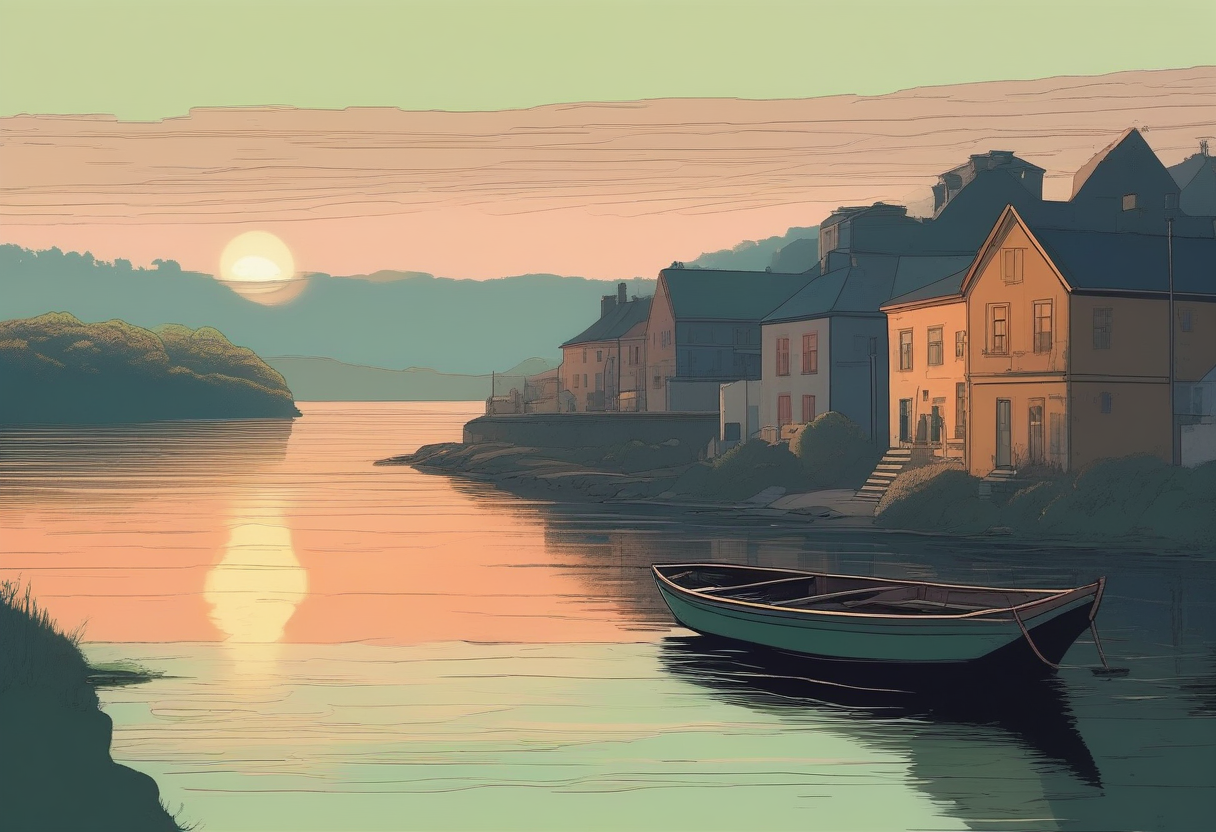
It comes to her not as a picture but as a standing-in: a colder river, a wind with coal in it, a morning sun that has to work. A town on two banks of grey-green water — a school by the water, a meeting hall with a notice board, a yard at the north end, a waterfront that wants mending. She knows it and does not: there is the water the honey-colored boats will ride, sixty years from now, and there are no boats on it. There is the east bank where a street will one day exhale on cold mornings, and the street she sees is clenched, its chimneys smoking thinly, like men breathing through cloth. Hold its geography; you will spend most of the record inside it.
And across the water, on the far bank — where in her world the hearth-house breathes its warmth into the mains — she sees it. Not ruined. Wrong in a way she has no word for, which frightens her more.
A windowless house the size of a hill. Humming. Lit from within by a cold and constant light. It does not sleep. While she watches, the town's lamps gutter — the whole east bank at once, a brown swallowing dip — each time the great house draws breath. It drinks the river through intakes that feather the current. It drinks the grid first, by right. Behind it, fans stand in ranks the size of houses, breathing the river back at the sky. Some of the mist is not the river's.
"That is a data center," her grandfather says — flatly, carefully, the way you name an extinct animal for a child who will never need to fear one. "A house for a machine to think in. There were thousands, once; that one is only ours. The town cooled it, and paid for it, and got nothing back but the bill." A beat. "And the bill doubled."
Mara waits. She can feel the place in the story where the weight comes. There is another telling — he tells her that once, plainly, so she carries it — a shadow where every page of this record went the other way. Not today.
He turns the record one notch.
"They kept the keys," he says.
He says it — she will notice this for the rest of her life — the way you say the name of a thing you are proud of. A possession-word. A kept thing.
"The town took the great cold house into common hands, and turned its heat back onto the homes it had been stealing from. That's all. Same house. Same machine — that is the whole hinge, Mara: nothing about the machine changed. The only thing that moved was whose hands were on it, and whether anyone had counted, in time, what it took and what it gave and who owned the difference." He closes the record on his thumb, keeping the place, and looks at her over the top of the lenses — his own eyes, the breathing ones, older and kinder and more dangerous than the glass. "That is the whole of it, Mara. In one town. Everything else I will ever show you — the boats, the classroom, the photograph, the field at the bottom — turn it over, and underneath you will find the same small thing: a morning when somebody slowed, and counted, and asked whose."
Mara looks a long while at the cold house across the water. Somewhere in the clenched town, though the record has not shown her yet, a boy is doing sums by candle-stub, and a teacher is writing a number on a board, and a man is running his hand down a plank of cedar he has no reason yet to love.
"Show me the next one back," she says.
Her grandfather laughs — softly, at something she won't understand for years: the sound of a game beginning that he has waited a whole life to play properly. The right player. The right speed. All the way down.
"That's it. That's the game. You say those words, and I turn the record, and the world gets a little less healed and a little more afraid, one year at a time — and we go down together, you and I and the third of us, backward, up the page, toward the morning it all turned on."
Across the water, in the record, the cold house hums. Above it, in the world, the hearth breathes. Between the two, held in one old hand, a girl takes, without knowing it, the first step.
Tomas, the Far Shore
"There was a man who made boats," the grandfather says.
And this time the record opens easily, the way a door opens that a man has oiled himself and walked through every day of his life. No reaching. No waiting on the fog. In this telling nothing was taken; he has only to want Tomas, and there Tomas is.
"You always begin with him," the Machine says, low, at his ear.
"She likes him."
"You like him. I hold forty-one years of that man. You never once let me file him any deeper than a morning away."
The grandfather does not argue. It is true, and the Machine only says the true things it knows he would rather have said aloud. He cups his hand to the side of Mara's face, warm, so that she looks through the lenses with him, and the record lays the day out along the inside of the glass — a river, a low sun, a roof of weathered board.
"Come and see him," he says. "He's old here — as old as the good world let its people get, which was old indeed."
And she goes to see him.
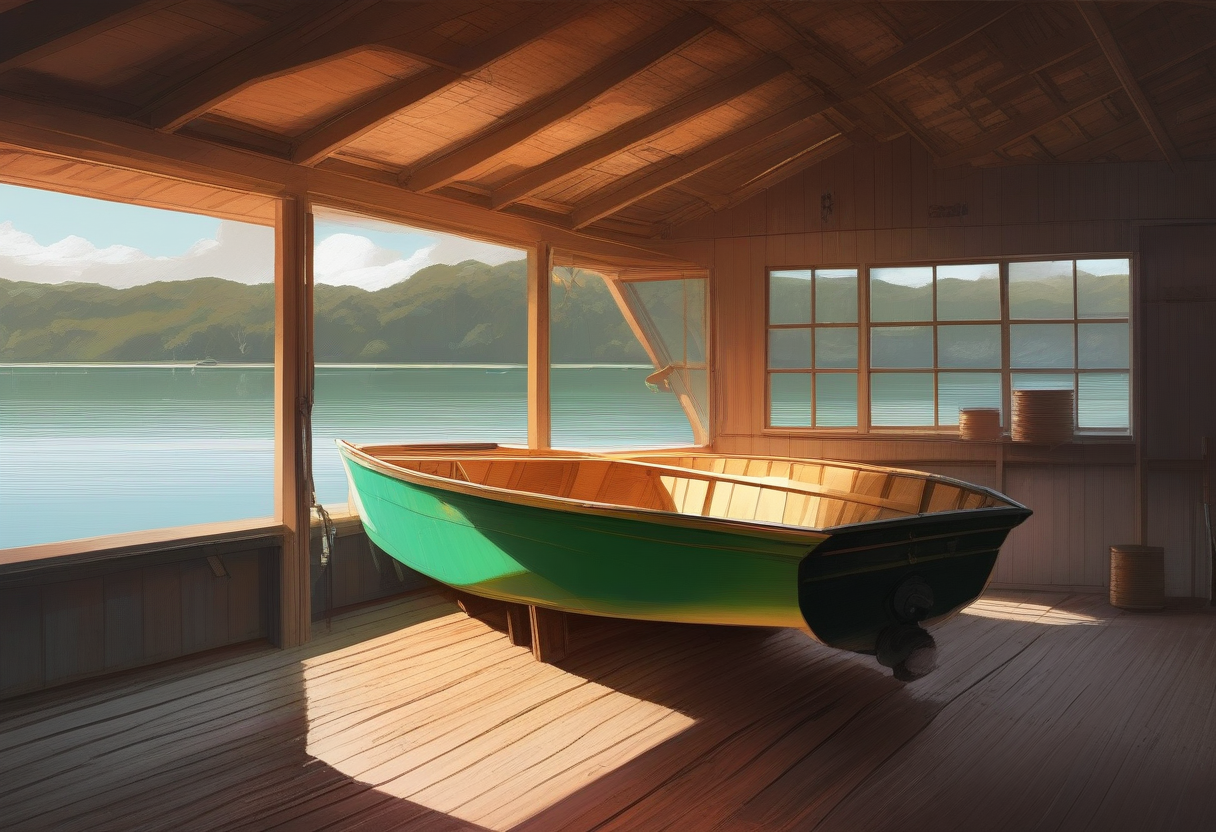
The shed stands open to the water on the mended waterfront, and the first thing is the light. It comes up off the river before it comes down out of the sky — the water clean enough now to throw the morning back whole. The underside of the shed roof ripples all day with a pale moving shine. Everything in the shed seems lit from below, like a thing remembered fondly. The second thing is the sound. A long, fine hiss, repeated, unhurried: a blade taking a shaving off a board, the way a person breathes who is asleep and dreaming well.
Tomas has a plane in his hand. She would not know the word, so the grandfather gives it to her, quietly, from far away: a blade set in a body of wood, tuned like an instrument, that lifts a curl off a board thinner than paper and lets it fall. The floor of the shed is deep in those curls. They lie where they drift, pale and loose about his ankles, and no one sweeps them until the day's work is done. Tomas holds that a floor of shavings is the only carpet a working man should trust. They smell of cedar, which is a smell Mara has. Under the cedar there is another smell she does not have. A river — a live one. Weed, cold water, the faint mineral breath of stones. A river that was once too sick to smell of anything at all, and now smells the way it must have smelled before anyone thought to put a price on either bank.
He is old. His hands are the oldest part of him and the surest — broad, seamed, mapped across the back with the small white commas of fifty years of slipped chisels. They move over the wood with a patience that is not slowness. He works the way water works on a stone, without hurry and without doubt. When he sets the plane down he sets it on its side, always, blade to the wall. When he takes a board up he takes it the way you take a sleeping child, one hand under the heart of it. There is no clock in the shed. There has never been a clock in the shed. The light says when the work starts. His back says when it is finished. Between the two of them the day comes out the right length every time.
He is building a boat that no one needs. The fourth one this year, or the fifth. The river is already stitched with them — little lapstrake hulls the color of honey, pulling at their moorings off every stair and landing on this reach of the water. Every one of them came out of this shed. He has never in his life taken payment for one. When a boat is done he gives it to whoever has been hanging about the shed most usefully that season, and starts the next. Someone asked him once — a grown someone, who should have known better — what he had against being paid. He thought about it for a while, the plane still going.
"What would I want with the price of a boat," he said at last, "when I had the making of it? The making's the wage. The boat's just what's left over."
There is a girl at his elbow. Twelve or so, brown from the water, a shaving caught in her hair that she does not know about and would not care about if she did. She has been coming since the spring. First to watch, the way children watch, from the doorway, sidelong, pretending to be about something else. Then closer. Now she has her own corner of the bench and her own small plane, which he set in her hands one morning without ceremony, the way you hand someone a thing that was always going to be theirs. She watches his hands the way you watch a thing you mean to be able to do yourself one day. That is the whole of her method, and it is the right one.
This morning she is fighting a board, and losing. The grain rises against her stroke and tears — little bites out of a surface that should be silk. She sets her teeth and bears down harder, which any twelve-year-old will do, and which does not work, which is the point of being twelve at a bench belonging to a man like Tomas.
He does not stop her. He lets the board teach the first half of the lesson. Then he comes round the bench, lays two fingers on the wood, and turns it end for end.
"Now," he says.
She strokes again, doubtful — and the plane rides. The same board, the same blade, the same arm: a long unbroken curl climbs out of the throat of the plane and hangs there, thin enough to read through. She looks at it the way you look at a magic trick.
"It tore before," she says, accusing the board.
"It'll tear every time, going that way." He runs his thumb along the wood, and the light off the river catches the grain for her: long bright rivers running through the cedar, all flowing one direction, the way water knows its own downhill. "The wood knows which way it wants to go. You were asking it to go the other way. It's a rudeness to fight it. Worse than a rudeness — it's a waste. The wood doesn't lose those fights. You do."
She strokes again. The curl falls. The board goes quiet under the blade, and there is a stretch where neither of them says anything, because nothing needs saying: the hiss of the plane, the shine off the water, the smell of a river given back.
"Everything worth doing is like that," Tomas says, after a while, to the boat as much as to her. "You find the way the true thing wants to lie, and you go with it. Took me half my life to learn that wasn't only true of wood."
She is quiet a moment, working. Then, because she is twelve: "What's it true of, else?"
"Days," he says. "People. Rivers." He tips his chin at the water. "They fought that river the whole of my working life. Walled it, straightened it, poured into it everything they were too cheap to look at twice. It went grey as dishwater and it stank, and every year it flooded them anyway, out of spite. Then one year they stopped fighting and asked it how it wanted to lie. Gave it back its bends. Let the marshes have their feet in it again." He takes the long curl from her plane, absently, and lets it spring shut around his finger like a ring. "Now look at it. First water I've trusted since I was younger than you. You can't cheat a true thing into being other than it is, girl. But if you go with it, it'll carry you."
Later she marks a plank for cutting from his measure, and he reads her the number, and she lays the rule against it herself before she cuts. Checking him, her lips moving. Another sort of master would take that hard. Tomas watches her do it with the expression of a man watching his best work take its first water.
"Good," is all he says. "Never take a measure on somebody's say-so. Mine included. The wood won't forgive you just because the number came from a nice old man."
Toward midday the shed fills and empties the way a shore does. A neighbour woman comes along the waterfront with bread still warm in a cloth and leaves half of it on the end of his bench without asking. In trade she takes nothing but the smell of the cedar and a look at the new hull. She and Tomas exchange perhaps nine words — the shorthand of people who have lived within shout of each other for forty years. Two boys come by water in one of his boats, a honey-colored hull he built the year they were born, still tight as a drum. He stands a moment in the open side of the shed, bread in hand, watching them handle her across the current, and does not call out any advice — which, for a boatbuilder, is a kind of blessing. An old man on the next landing raises a hand to him. He raises the bread back. And once a week Tomas's eldest comes down from upriver, grown and greying, to eat half the bread and tease him about the coffee tin he has never thrown away — the child who once left the last potato in the dish, allowed at last to joke about the winter, because the winter lost.
Across the water, on the far bank, stands the great house.
It is the size of a hill, and it has no windows, and once — the girl knows this only as a story, the way you know there were wolves — it was the coldest thing in the country. A fortress that blazed all night for people no one here would ever meet, drinking the river and the grid while the town shivered beside it and paid for the privilege. It is not cold now. Its heat goes out along the bank in mains laid by the town's own hands — into kitchens, bathhouses, the long glass sheds where the winter greens grow. On a cool morning you can see the whole street it warms exhaling gently, chimneyless, like a sleeping animal. There is a woman's name attached to how that happened. It gets said in that town the way saints' names get said in older ones. But that is another chapter of the record, further down, and the grandfather keeps his thumb on it and does not turn.
What matters here, on this bank, in the noise of the midday water, is only this: Tomas eats his bread looking at the great house the way you look at an old opponent grown into an old friend, and the girl eats hers beside him, and neither of them owes the far bank a single hour of their lives. The afternoon belongs to the boat. The boat belongs to whoever earns her. The days belong to the people living them, all the way down the waterfront — and no one in this town remembers to find that miraculous, which is the final and complete proof that it was won.
It is late in the day, in the long light with the river going to copper, when the girl asks about the box.
It sits on the high shelf at the back of the shed, where a workshop keeps the things it will not use and will not throw away — up among a cracked half-model of a hull he never built and a coil of rope too good to cut and too short to keep. Everything else on that shelf is wood or tar or fiber, warm-colored, of the shed's own kind. The box is not. The box is metal. Grey once, gone bare and bright along the edges where hands have carried it. A workman's toolbox with a strong steel handle and a lid you could sit on. And across the lid, deep enough to hold shadow at this hour, one long dent — as though the box had been set down, once, very hard, by a man who could not feel what his hands were doing.
It is the only thing in the shed she has never seen him touch.
She has asked about it before. Children always ask him, about everything, and he always answers — that is the standing wonder of Tomas, that he answers children like a man paying a debt he is glad of. About the box he has never answered more than weather. Today — and far away, on a balcony above another water, the grandfather feels the girl's question rising and lets Mara's rise with it, two questions going up together like two birds off the same branch —
today she asks again.
"What's in the box?"
Tomas does not answer for a while. He finishes the stroke he is on. He sets the plane on its side, blade to the wall. He looks up at the shelf, and his face does a thing she has not seen it do: it goes, for a breath, to some other waterfront entirely. He looks at the dent in the lid the way, this morning, she looked at the torn grain — a thing done against the way the wood wanted to lie, a long time ago, by someone who did not know better yet.
"Tools," he says at last. Which she knows. Which is no answer, and both of them know it.
"Whose?"
"Mine." He picks the plane back up. Turns the board. The evening light comes up off the river and moves on the underside of the roof, and the hiss begins again, unhurried — the sound of a man going with the grain of his one remaining lifetime. "From before."
"Before what?"
"Before I knew what my days were for." A curl lifts, and hangs, and falls. He does not look at the shelf again. "Not today, girl. That one's a winter story. The light's wrong for it."
And the record rests there. The shed with its floor of shavings. The boats pulling at their lines in the copper water. The girl sweeping up at day's end while the old man stands in the open side of his life, looking at the river he trusts. And high on the shelf behind them both, holding its shadow in the one long dent, the grey steel box — unopened, keeping its story the way the river keeps its stones.
On the balcony, the light has gone long too. Mara sits back, and the lenses cool against her grandfather's face, and for a moment nobody says anything.
"He never opens it," she says. "The box."
"He opened it for me once." The grandfather turns the record with two fingers, carefully, but not far; he keeps his thumb against the next page, holding the place. "There is nothing in it but tools, Mara — a plane iron, a square, a good hammer with a mended handle. And there was a morning, before the boats, before the river came back, when that box was the saddest object in the whole of the world. Not one thing in it changed between that morning and this evening. Only everything around it."
"The Machine could show me," Mara says. "The morning."
"It could," the Machine says at her grandfather's ear, unbothered, "and it has been asked not to. He tells this next part himself, every time. I have offered."
"You keep the figures," the grandfather says. "I'll keep the mornings."
He looks out at the water a while — their own water, on their own coast, its own small lights coming on. When he speaks again his voice has the sound it gets when the record is about to turn somewhere that costs him.
"You have seen how it came out. That was on purpose. I show you the far shore first, always, so that you will know, in the part that doesn't reason, that this next part ends well. Now hold on to the shed, Mara. Hold the smell of the cedar, the girl checking his measure, the bread on the bench. Because to understand what the box is, you have to watch a machine come to that man's yard when he was thirty years younger and afraid" — and his thumb begins, gently, to turn the page — "and you have to watch it do the whole of his job better than he could do it. And you have to stand next to him while he understands that it will never be tired, and never be hurt, and never be paid. That every morning of his life until that morning had just been handed a number, and rounded."
He stops himself. Smiles at her in the dark — an old man's smile, with the lamplight of a healed city in it.
"The arm can keep till morning," he says. "The boats were first because the boats were the truth. Everything else is only what it cost to get to them."
The Arm
The grandfather turns the record back, and the shed is gone.
"The arm," he says — plainly, the way you name a weather you lived through. "I told you the boats were the truth. Now you have to see what the truth cost. Hold the shed, Mara. We won't see it again for a while."
And the record opens on noise.
The yard is loud the way a live thing is loud. Thirty men under one long roof open at both ends, and the sound has layers you learn to read the way Tomas reads heat: the crackle-and-hiss of the wire feeders, the cough of the big saw, the ring of plate being walked on, someone's radio going under it all. Over the top of everything, the yard's one great tidal rhythm — the crane, traveling and returning, like a slow iron heartbeat. New men flinch all day. Tomas stopped hearing it as noise fifteen years ago. It is closer to the sound of his own blood: he only notices it on the rare mornings it stops.
He is thirty-five, and he is good. Say it the way the yard would say it — the yard never uses the word good; it says it by what it hands you. When the fairing on a bow section will not draw down true, they do not send for the foreman. They send for Tomas. When an inspector kneels over one of his welds with the gauge, it is a formality, and both of them know it, and there is a particular dry pleasure in watching a man measure what you already know. His beads come off the wire even and close as rows of wheat. He can read the heat in the color of the pool the way other men read a clock. He can lay a weld overhead, on his back, in a space too small to turn around in, that will outlive the man who ordered it and the man who paid for it.
That is the thing to understand before the crate arrives. Not that he had a job, Mara — that he had a craft. The craft was the shape of the day, and the day was the shape of the man. He woke at the same dark hour his father had. He carried the same steel box out the same door — grey, with a strong handle, the paint already going at the corners even then. The work was hard on the body, and he groused about it in the way of men who would be lost without the thing they grouse about. Ask him who he was, and he would not have said his name first. He would have said what he could do.
The crate comes in the autumn, on a Tuesday, on a flatbed, and the whole yard finds a reason to be near the west bay when they uncrate it.
It does not look like a rival. That is the first wrong-footed thing. It looks like a piece of lab equipment that has wandered into the wrong century — a column, a shoulder, one long articulated arm folded against itself, dove-grey, clean as a dentist's chair among the scarred and spattered machines of the yard. The men make the jokes men make. Somebody names it after the foreman's brother-in-law, who also never bought a round. Tomas stands at the back with his arms folded and says nothing. Something in the fold of the thing — patient, poised, deeply at rest — has already spoken to some part of him below the jokes, and what it said was: you.
The technicians work on it for a week. Then, on a grey Thursday morning with half the yard watching, the arm unfolds, considers the seam it has been given the way a heron considers water, and lays its first weld.
A minute. Perhaps less.
Tomas is close enough to see the bead, and the bead is perfect. Not good — he is good; he knows exactly how much a man's good costs and what it looks like at the end of a long shift. This is something else. The bead is even the way printed things are even, the ripple regular as machine stitching, the toes wetted in without a flaw, start to finish. No stutter where a human wrist would have shifted its grip — because nothing shifted, and there was no wrist, and it does not have to breathe. The weld he would have given a morning to, and been proud of, and been right to be proud of. In a minute. On the first try. Without heat in its face or salt in its eyes, without the ache above the elbow that has been Tomas's tenant for ten years.
The men are quiet in a way the yard has never once been quiet in fifteen years.
Then somebody laughs and says it can't climb inside a bow section, and somebody else says give it a fortnight, and the crane resumes, and the day goes on the way days insist on doing. But Tomas stays a moment longer, watching the arm reset itself over the next seam — tireless, wageless, Sunday-less — with the particular sickness of a man watching the thing that will replace him do his own craft better than he can. There is no name for that feeling in any language he has, though the whole world was about to need one. It is not envy, and it is not exactly fear. It is the feeling of standing in front of your own life and being told, gently, by no one, that it has been solved.
He carries it home, because a thing like that will not stay at the yard where it belongs.
Home is four rooms above the water, warm in the way of houses that are worked for. His wife, who can read the weather off him before his coat is off, the way he reads heat. The eldest, who is eleven and lately too old to be kissed in front of the neighbors. The little one, who is four and thinks the crane is his personally, because Tomas once told him so and has been too honest since to untell it. Supper is loud. Supper in that house was always loud, and he had not known he knew that until the autumn he began listening to it the way you listen to something you might have to remember.
He keeps the fear from them, and he keeps it badly. Children always know. The eldest starts leaving the last potato in the dish untaken, with a diplomacy that scalds him worse than any shortage could. His wife does not ask in front of them. She asks in the dark.
"Is it true what they're saying about the west bay?"
"It's one arm," he says, to the ceiling. "It can't fit half the work. It can't fair a plate. It can't think."
"That's not what I asked."
He is a long time answering. That is the answer. She takes his hand under the blanket, and neither of them says anything else, because there is nothing else that is both true and bearable.
And late that night, and many nights after, he sits at the kitchen table with a stub of pencil and the backs of old delivery dockets and does the sums. What is owed on the house, and to whom, and by when. What the winter takes. What is put by — a column so short it hurts to write it under the others. He is not an arithmetic man. His sums crawl; he checks them twice and gets two answers and has to go a third time, hating it. And it does not escape him — none of the bitter parts escaped him that year — that the thing in the west bay could have done this too, faster, and been right the first time. That is the whole insult of the age, Mara, laid out on a kitchen table in pencil: a man doing slow arithmetic in the dark, to learn how long he can afford to be replaced by a thing that does fast arithmetic in the light.
He never once let the children see the dockets. His wife found them anyway, of course, filed inside the coffee tin, every figure gone over twice. She never said so. There are marriages where the deepest tendernesses are the things not said over a coffee tin, and this was one of them. The record keeps it, Mara, because the record keeps what the day was actually made of.
The second arm comes in the spring, and there are no jokes at the uncrating.
By midsummer the west bay runs through the lunch whistle, through the dark — an agent, the sellers' catalogues called such a machine: given its goal and left to it, trusted to act with no hand on it and no one watching. It does not need the lights. The yard learns this the first time somebody comes back for a forgotten coat and sees the blue flicker going in the black shed, like weather trapped indoors, working, alone. The bead never wavers. The men drift — not fired, not at first. Unrenewed. Reassigned. Retired a little early with a handshake. Each one a single reasonable sentence, and the yard says each name in the canteen for a week and then stops saying it, because there is a limit to how much of that sound a place can carry.
The yard grows quieter by the month. That was the thing nobody had told him to expect — not the noise of the new thing but the hush of it: thirty men's racket thinning to twenty's, to twelve's, the radio gone, the crane still traveling and returning over bays where the only motion is dove-grey and unhurried and does not sweat. He has stopped not-hearing the yard. He hears it all now, every morning, the way you hear a tide going out.
And one morning in his last autumn there are men on the roof of the gatehouse bolting up a sign, and the sign is a banner, and the banner says, in letters meant to be read from the far side of the water:
THE FUTURE IS ALREADY HERE.
The company had meant it proudly. That is the terrible comedy of it — no one was lying, Mara. It was already here. Tomas stood at the gate with his box in his hand, looking up at it in the rain, and could not for the life of him tell whether it was a promise or a verdict. Neither could anyone else in the world that year. And that exact not-knowing, under that exact banner, is the morning the whole record turns on. But we are not at the edge of that field yet. From the gate where Tomas is standing you cannot even see the field. You can only see the year coming.
The letter, when it comes, is kind. That was somehow the worst of it. It thanks him for eleven years — the count is wrong; it was fifteen; some system had his start-date wrong and no one fixed it. He read that mistake over more times than any other line, because it was the whole thing in miniature. Not cruelty. Inattention. He was not important enough for the error to matter to anyone whose job it was to care, and there was no longer anyone whose job that was.
On his last morning the foreman cannot look at him, which Tomas finds he minds less than he expected. The man had fought for him, he knew, in whatever rooms fighting was still done in, and lost, and a man who has lost a fight for you is entitled to his boots. His tools come out to the gate in the grey steel box. Someone else has packed them — which no one has done since he was an apprentice — the plane iron and the square and the good hammer with the mended handle all wrapped and settled like a thing being sent away to school. They hand it to him, and he shakes the hands there are to shake.
Then he walks out the door into a light too bright for the occasion — a flat wide October brightness with nothing in it — and stands blinking, a man holding everything he can do in a box the size of a breadbin.
He gets it as far as the seawall before something in him refuses. And he does not throw it — you must be exact here, Mara, because the difference matters and he would want it kept: he does not throw it. He sets it down. He sets it down very hard, from higher than setting-down needs, with both hands, the way a man sets a thing down when he cannot feel what his hands are doing. The steel takes the stone across the lid, one long deep crease, and the sound it makes is the sound of the only door he had, closing.
Then he sits beside it in the too-bright morning, back against the wall, one hand resting flat on the dented lid the way you rest a hand on a dog too old to walk further. He is thirty-five. He can lay a weld that will outlive the century, in a world that has just this morning stopped needing anyone to be able to. Across the water the great house hums, lit and cold. Behind him the yard goes on without him — hissing, patient, even as rows of wheat.
He has a wife who reads weather, and two children, and four warm rooms, and a column of figures inside a coffee tin that says four months. Five if the winter is soft.
And no idea — none, Mara, not the shadow of the ghost of an idea — what a man is for, when the work goes and the man is left standing.
The record stops there. The grandfather holds it, thumb flat on the page, and for a while he does not turn it and does not speak. The Machine at his ear, which knows to the day how long this next silence wants to be, says nothing either.
"Look at him a moment," he says at last. "Sitting on the wall by his box. Because here is where I have to tell you the strangest thing in the whole record, and you will not believe me, and you will be right not to, yet. Two worlds come out of that morning, Mara. Two whole earths. And in both of them — both — that man, that box, that dent, that light. Everything you have just seen happens in the other telling too, to the last figure in the coffee tin. Word for word. Weld for weld."
He looks at her, and behind the lenses something is bright.
"The difference — the entire difference, the hinge the worlds swung on — is not here. It is in what was waiting outside that morning. And that is the next page, and we will both need to have slept before we turn it."
Whose Are the Savings
They have both slept, as promised. The morning around the balcony is bright and ordinary — the correct weather, the grandfather says, for this page. Not a page of storms, Mara, whatever you are expecting. Nobody rides in. Nothing burns. This is the quietest page in the record, and the one the whole record turns on.
"One notch," he says, and turns it. "To the year it turned."
First, the honest part, which the healed world likes to skip and he will not: the floor came late.
For Tomas there were weeks — a whole raw season of them — when the two earths were still one earth, and he lived it the way it is lived in the other telling. The tin emptying figure by figure. The walking and the asking. The town going quiet around him door by door, the dove-grey patience settling in behind other men's gates. Do not let anyone tell you the good world moved in time to spare him that. It moved in time to catch him. That is a different thing. The fear got all the way in. It sat down at his table. It learned the children's names. And when the floor finally rose to meet him, it found a man already changed by the falling — which is why, forty years on, in a shed full of cedar shavings, there was still one box he would not open for an apprentice. Some part of every caught man stays the height he fell from. The good world knew that about its people, after, and was gentle with them about it. Gentle is not the same as it never having happened.
So: the hard weeks. And then — no trumpets; he wants her to notice how bare of trumpets this is — a letter came, and it was not kind. It was dull. Civic paper, grey as its envelope. Pursuant to the town's vote of the twelfth, a resident dividend account had been opened in his name against the yard's automation proceeds. A figure. A date the figure would arrive. And one line, no flourish, the most important sentence anyone ever sent him: it was not conditional on anything, and it did not run out.
Tomas read it at the kitchen table, twice, three times — the way he had read the kind letter with the wrong years in it. Then he put it in the coffee tin with the dockets, because he did not believe it, and belief had lately cost him too much.
The figure arrived on the date. And the month after. And the month after that.
Now turn back three months, Mara, behind the dull letter, to where it came from. Not from a government of wise men in a far city. Not from the machine. Not from mercy. From a room above the town library on a wet Tuesday night, and about two hundred folding chairs.
The town had called a meeting about the yard. Towns were calling meetings about their yards all over the world that year, and most came to nothing, and it is worth being plain about why: the meetings asked the wrong questions. How do we stop it — and you could not stop it, any more than you could vote down the tide. Who is to blame — and the answer was nobody, and a room full of frightened people cannot hold a nobody in its hands. The rooms that asked those questions emptied out angrier than they filled, and their towns went the way the other telling goes.
This room started down the same road. An hour of it. Men standing up to say what everyone knew. The west bay dark and working. The canteen names. The tide. The anger rising and finding nowhere to land, the chairman losing the thread of it. And somewhere near the back, Tomas's old foreman — the one who had fought for him in the company rooms and lost — sitting with his cap in his two hands like a man at a funeral, saying nothing, because he had already said all of it where it had already not mattered.
Then a woman stood up who had taught school once. Retired now; grey; the kind of small a room quiets for without knowing why. Half the men in that room had sat in her classroom thirty years before, and their children after them, and she had taught every one of them the same thing she now said to the meeting, in the voice you use for the seven-times table — the voice that does not argue. It states.
"You're all asking whether the machine will take the work. It's taken it. That question is finished, and I never in forty years let a child waste chalk on a finished question." She had their silence now, the old kind, the kind that reaches for a pencil. "Here is the one that's open. The arm out there saves the owners of that yard a great deal of money — that is the whole point of the arm; it is why it was bought. Savings that used to be wages. Now." And she looked around the room exactly the way she must once have looked around a classroom, taking her time. "Whose are those savings? That's all. That is the entire question in front of this town. Everything else you've said tonight is grief, and I don't begrudge grief, but you cannot vote on grief. You can vote on whose."
The room was quiet a long moment.
Then a man near the door stood up — a shopkeeper, one of the few in the room whose till still rang. He said what somebody always says, and he was not a fool to say it: that the yard's owners had lawyers the town could not buy; that a levy would be fought, and the fighting would cost; that towns which reached for an owner's savings had a way of losing the yard entirely. And then, into the quiet he had made, softer, the true one underneath: "We'd be taking what isn't ours to take."
The chairman banged his water glass and got silence and did not know what to do with it. And in the silence — the minutes keep the order, Mara, and I am giving it to you from the minutes — the first hand went up.
It was the foreman's. The one who had fought for Tomas in the company rooms and lost, who had sat the whole evening with his cap in his two hands, saying nothing. He did not stand. He did not answer the shopkeeper's law. He set the cap on his knee and put his hand in the air the way a tired man puts up a beam — slowly, all the way, and left it there, where the room could see what it weighed.
Three hands came up behind his. Then a stretch of nothing, long enough to lose it all — the glass going again, a chair scraping somewhere near the stove. Then a whole row of yard men along the west wall, up together. Then the women by the door, and hands on the stairs, hands going up like a slow wave, up, up, until the ones still down were the ones being counted. Not with one voice; nothing so tidy; there was an hour and a half of tempers and amendments still to come. But the room had said it —
ours.
Some of it, anyway. That was the actual vote, in its actual language, and she should hear it once whole, because the sentence saved the world and does not sound like it: a municipal levy on the automated proceeds of enterprises operating in the township, assessed against demonstrated labor displacement, payable into a common resident dividend — the levy banked into a town reserve as it came, so the floor would stand on years of keeping and not on any one payer's luck. A sentence with all the poetry of a drainage ordinance. There is a copy of it in the record, in facsimile, with the water-glass stain on it. He shows her the stain.
"That is what the hinge of history looks like, Mara. It looks like minutes."
Nobody in that room walked out feeling like the founder of an age. They walked out into the rain arguing about the assessment schedule. The teacher went home on the arm of a neighbor. And across the water the great house blazed on, unbothered, thinking for someone else — its own page only weeks away now.
But the question had been asked out loud, in time, and could not afterward be unasked. The other telling will show you what a world looks like where it never was — where the savings simply floated up, as if by a law of nature. And it was never nature, Mara, never once; it was only an arrangement nobody had thought to put a question to. One room put the question. The wave of hands went up. And the value the arm wrung out of Tomas's mornings came back down out of the sky it had been floating into, and landed, three months of paperwork later, in a dull letter on a kitchen table, in a line that said: this does not run out.
And not only Tomas. Now the record widens, and he wants her to feel it widen, because this is the astonishment: it scaled.
The arms came for everyone's labor in the end — the welders, then the drivers, then the clerks, then the vast grey halls of paperwork that had eaten so many quiet lives. You know this from the far shore; see it now from underneath. And everywhere — not always first, not always gracefully; town arguing with town, country shaming country into it — the same unglamorous question got itself asked while there was still time to ask it, in parish halls and parliaments, in languages the teacher never spoke. And everywhere it was asked, it found the same answer waiting, as if the answer had been sitting in the human chest all along with no one willing to say it first. Whose are the savings? Ours.
And the terror that was supposed to follow the work — the destitution, the scrap-heaps of idle men that every frightened century had promised itself — did not come. Sit with how strange that is; the record is full of the predictions, confident as tide tables. Instead: a civilization handed back its own hours, floors under every life, one dull letter at a time. And people did not rot, Mara. A few did; a few always did, even under the old arrangement, which was never mentioned. One of them was in Tomas's town — a caulker from the same yard, who never found his river; the floor held him to the end of his days, and the town carried what the floor could not, and I keep him in the record because the healed world would rather I didn't. Most went looking, after a while, the way Tomas went looking — restless, ashamed of their own rest, dragging the old hours behind them like a phantom limb — for something that needed making.
The good world was built in that looking. Nearly everything she can see from the balcony came out of somebody's handed-back days. One of the clerks from those grey halls drew the tide-gardens themselves — twenty years spent filing other people's water rights, and the handed-back years spent learning what the water actually wanted.
Tomas took the longest kind of while. Men like him do. The work had been the shape of the day so long that without it the day had no shape at all, and a floor, whatever the dull letter said, is not a purpose. It is a place to stand while you look for one. For a season he was no use to anyone, himself least of all. He slept wrong. He walked the seawall. He was short with the children, then over-kind to make up for it. And the box stayed shut in the closet with the dent in its lid, because he could not yet look at the only thing he was.
Then one morning in the spring he walked down past the end of the seawall to where the river came in, because he had heard the strangest rumor about it. The rumor was true.
The river was coming clean.
That was the same year, you see. The same vote, more or less, in another room — the town taking its water back into its own hands as it had taken the yard's savings. Everything connects down here at the bottom of the record, Mara; the pages are sewn to each other. The mills upstream had gone quiet or gone clean. The marshes were let back in at the bends. And the water that had run grey as dishwater all his working life was running with its stones showing. He stood there most of the morning. A man with nothing but time, looking at water with nowhere to be. And somewhere in that morning — he could never afterward say the moment, and no record, however faithful, can keep what a man never told it — the thought arrived, whole, unbidden. The first thought in a year that was about making rather than losing:
A river like that ought to have a boat on it.
That is all. That is the entire annunciation. He went home, opened the closet, took the box out and set it on the kitchen table — and opened it, and lifted out the plane iron and the square and the good hammer with the mended handle, one by one, wrapped exactly as the stranger's hands had wrapped them on the worst morning of his life. He took the tools, and he left the box. The tools went back to work. The box went, in time, to a high shelf in a shed that did not exist yet, above a floor of shavings that had not fallen yet, to hold its dent up to the light of evenings he had not yet lived. Kept, he told the apprentice at last, long after, to remind myself I was wrong.
He thought it was the end of him, Mara. It was the door.
The grandfather closes the record, and sits a moment.
"He got his days back," he says. "That's the whole of the miracle. Say it plain and it sounds like nothing: they took some of what the machine saved and gave every man a floor and his own mornings. The boats were only what his days did, once he had them. Somebody counted whose the time was, while it could still be counted."
"The teacher," Mara says. "The one who asked it. Who was she?"
The grandfather smiles, and it is the smile with the next page already in it.
At his ear the Machine says what it says every telling — dry, content — that everyone asks that exact question, eleven pages early.
"Hold her," the grandfather says. "The grey woman with the finished questions. She has her own pages, further down — she nearly didn't get them, and that story is worth the wait. For now keep this much: the town that asked whose out loud, in time, in a wet room over a library —" he taps the record, once, gently — "somebody had spent forty years teaching that town how. Floors don't begin in meetings, Mara. They begin in classrooms."
Ada's Question
"There was a woman who taught the arithmetic," the grandfather says. "Not at an edge, in a field — in a room, to children, for forty years."
"Ada," the Machine says at his ear, before he has even reached — the name set into his hand like a tool passed across a bench. He smiles. Between the two of them a name has never once gone missing, and he knows now what that is worth. So does Mara, though neither telling has told her yet how she knows.
"Ada," he says. "I promised you the classroom. Come and see where floors begin."
And the record opens on chalk.
The room is bright because of the river. It sits at the end of the school where the building runs nearest the water, and all morning the light comes in off the current and moves on the ceiling — the way it moves on the underside of a boatshed roof three streets away. The same river, Mara. The same light. The town is small, and everything in it is stitched to everything else, which is half of what this page is about. There are tall windows nobody thought to curtain. There is a floor worn pale in a broad path between the door and the board: one woman's forty years of walking, back and forth, the wear in the wood as legible as any record.
And there is Ada.
She is old here — old the way the good world lets its people be old, which is to say: still at it, because she wants to be, at the one thing she never got tired of. Small, and grey, and quick, with her sleeves pushed up like a woman about to wash something, and a piece of chalk in her hand that she holds the way Tomas holds a plane — a tool so long used it has become a way of pointing at the world. Nobody makes her teach. The town has machines that could do it, patient and perfect and tireless, and for most things the machines are welcome to it. But the town learned — everyone learned, after; it is one of the quiet laws the healed world runs on — that a few things must be handed from person to person to stay alive, the way fire was once handed, because they are not information. They are habits of the body. What Ada teaches is one of those. Maybe the chief of those. So the room is full: eighteen children, eight and nine years old, on a bright morning by a clean river.
Watch the lesson. It is the same lesson it has always been. She has taught it several thousand times, and it is different every time, the way a river is.
She writes a number on the board.
She writes it big, and she writes it handsomely. She has a whole craft of making the number inviting — she works at this the way a forger works — and if you asked her why, she would say: because the numbers that come for you dressed up are the ones that come to take something. It is a large, confident, friendly number, with a little flourish under it. She steps back so they can all admire it. She lets it sit there being believed for a moment, which numbers on boards, in classrooms, by rivers, always are.
Then she turns around and asks the room the only question she has ever really taught:
"Whose is it?"
The children know the game; the game is the whole of the first year with Ada. Not is it big — any baby can see it is big. Not is it true — that one, she tells them, is a fine question and a famous one, and nearly useless first, because you cannot begin to check a thing until you know who benefits if you don't. Those come later. First, always first, the question with the handle on it: whose number is this? Who handed it to you? And what did they want you to do the instant you believed it?
A boy near the window — literal-minded, freckled, the exact kind of engineer the healed world runs on — squints at the flourish and says: "It wants him to buy something." He says him, meaning some imagined believer, some sap; the children always start by imagining the number is for somebody else. Ada nods, and does not correct the him. Not yet.
A girl in the middle of the room says, slower, "It wants him to be afraid." Small, dark, with her sister's way of watching hands — the sister spends her days in a boatshed on this same water, learning which way the true thing lies. The town, Mara, is stitched together. I told you.
"Good," Ada says. "Both of you. And notice they can't both be the whole answer, and notice both of you are probably right anyway." She perches on the front of her desk, chalk still in hand. "Because those are the two great wantings under nearly every number that will ever be handed to you with a flourish. Buy something. Fear something. Sell and scare, scare and sell. There are others — some numbers want your vote, some want your envy, one or two, the best ones, only want your attention — but if you learn to hear just those two wantings, the buying and the frightening, you will walk past more traps in your life than any lock could ever keep you out of."
A hand. The freckled boy, frowning: "But what if nobody handed it to you? What if it's just — true? Like if you count the stones in the yard, the number's nobody's. It's just the stones'."
And Ada looks at him the way a fisherman looks at a tug on the line.
"Ah," she says. "Now we're doing arithmetic." She comes off the desk. "You're right. A number you counted yourself, on your own fingers, in your own morning — that number is yours, and it is the only kind that starts out clean. Every other number in the world arrived in somebody's hand, and the hand had an owner, and the owner had a wanting. So when I ask whose is it, I am not teaching you that numbers lie. Numbers are the most honest things there are — left alone. I am teaching you that a number is a sentence somebody is speaking. And every sentence has a speaker, and every speaker wants something, and the number will not tell you what that is. You have to look up from the number and ask." She taps the board, twice, on the friendly flourish. "Or — and here is the whole of it, loves, here is forty years of me in one line — you can do the braver thing, and count it again yourself. Check the sum. Not because you'll usually catch a lie. Because a town where everyone knows how is a town nobody bothers lying to."
She says that last part lightly. She says the largest things lightly, always; it is her one vanity as a teacher, that the biggest stones go into the wall without ceremony, so the children don't know to resist them.
"Learn to hear the wanting under the number," she tells them, turning back to the board, "and no one will ever sell you a cliff by swearing the ground is solid."
The children do not know what she means by the cliff. That is all right. She has never once explained it, in forty years. They will carry the habit far longer than they carry the reason, and the habit is the thing. Reasons wear out, Mara. Habits wear in.
But here is the thing I brought you to see, the grandfather says — not the lesson. The lesson you could have had from the record in a line. Watch her, now, in the little space after the lesson lands.
Because the girl in the middle of the room — the watcher, the boatbuilder's sister — puts up her hand, and asks the question some child asks every year or two. The innocent one. The one with the trapdoor in it:
"But who'd believe a number without asking? It's only asking. It's easy."
And Ada does not answer straightaway.
The room does not notice; rooms of nine-year-olds notice everything except silence. But the record notices, and Mara, looking through the lenses, notices. The chalk going still in the old hand. The eyes going, for one held breath, somewhere that is not the bright room — somewhere small, and dark, and quiet, with a lamp in it, and papers. It is the look of a woman tasting something. It is one breath long. Then it is gone, and Ada is back, dry and warm as ever.
"You'd be surprised," is all she says. "Clever people. Careful people. People who taught the asking, even." A beat, and the smile she uses for closing a door gently: "It is easy, love. So is swimming. And every year the river takes somebody who swam beautifully in the summer."
And she sets them a page of sums, of all things — ordinary, unglamorous sums, the seven-times table dressed up in apples and boats. Because that is the other half of her secret, the dull half nobody puts on a banner: the question only works in a hand that can do the checking. Asking whose without knowing how to count it again yourself is only a new way of believing somebody. So they do sums, by a bright window, in a world with time. Ada walks her worn pale path between the desks, correcting with the end of the chalk, and the light off the river moves on the ceiling. And that hour — multiplied by forty years, multiplied by every room like it — is the whole invisible foundation of everything you have seen from the balcony.
They will not thank her. She would be alarmed if they tried. They go out at noon like a jar of minnows upended, shouting, forgetting her before the door bangs — and carrying, worn in under the shouting, where nothing can get at it, a small permanent motion of the mind: whose is it? They will ask it of prices and promises, of stories and screens, of every warm sentence the world will ever try on them, mostly without noticing they are doing it. Which is what a habit is. Which is the point.
One of those minnows, Mara — not in this room, but in a room like it, twenty years up the record — will be standing in a field on a golden morning when a voice near the edge starts reading numbers out loud. Her legs will want to keep running, and the story she is running toward will be so warm. And under the running, worn in where nothing could get at it, something small and permanent will move.
But that is further down the page than we go tonight.
The grandfather lets the record rest, and the classroom light fades off the inside of the lenses, and the evening balcony comes back.
"She taught people to count," he says. "That is the entire entry, if you wrote it the way the old histories wrote things — a schoolteacher, by a river, forty years, no monument. But turn it over, Mara. A warning is not a sound. A warning is a sound landing. A man can stand at an edge and read the truest numbers ever counted, and if the field is full of people who never learned that a number can be asked after — he might as well be reading them to the rye. What that woman built, one child at a time, chalk-line by chalk-line, was the ears. She built the ears the warning needed." He turns the record slowly with two fingers, and his voice does the thing it does when he is holding two tellings at once. "In this one, anyway."
"The look she had," Mara says. "In the middle. When the girl said it was easy. What was she tasting?"
"A table," the grandfather says. "In the dark." He sets his thumb against the next page, and does not turn it tonight.
"The Machine could—"
"It could," the Machine says, at his ear, and to her, both at once, in the way it has when the house is settling and the light is going. "And some pages want the dark they happened in. Tomorrow, the table."
The Table in the Dark
"The table," the grandfather says, and does not open the record all at once. He holds it a moment first, the way you hold a cold door handle in winter, knowing the kind of room it lets into.
"You met her in the light. That was deliberate; I am not in the business of frightening granddaughters. But you asked what she was tasting, that day in the classroom, in the one breath she went away — and the answer is a night. Turn the record back, Mara. Past the bright room. To the year she nearly lost it all."
Two in the morning, and one lamp lit in a small tidy house, and Ada at her kitchen table with her life spread out on it in paper.
She is not the grey woman of the bright room yet. The record is deep now, down near the fork; she is only lately retired — still straight-backed, still quick, her hair not yet the color of chalk. The house around her is the house of a person who has been careful every day of a long life. Nothing fine. Everything mended. The kettle old and the teapot older. A house with no debts in it and no luck in it either, only care. Forty years of a teacher's pay, Mara — think what that is. It is not money the way the ten names knew money. It is time, pressed flat. Every figure in the savings book on that table is some year of her life with the juice squeezed out of it: the coat not bought, the fare not spent, the summer worked. A saver's ledger is a diary, if you know how to read one. Hers read: I was never once careless.
And every cent of it — every flattened year, every unbought coat — is riding, tonight, on ten names and one sentence.
She had not meant it to be so. No one ever means it to be so; that is the first thing to understand about how a careful person comes to stand on a cliff. It happened the way weather happens. When she retired, the pension people sent her to a man — a nice young man, she would say afterward, and mean it; that was the worst of it, nice — with clean cuffs and a folder of charts printed in warm colors. The charts all went one way, up and to the right. And he said the sentence. You know the sentence, Mara; you have heard it in another chapter, hanging over a gate in letters meant to be read from across the water. The future is already here, and it cannot lose. The future cannot lose. And everyone she trusted was saying it too — the pension people, the papers, the neighbors, her own bank, the calm voices on the evening news. Her brother-in-law had doubled his money and told her so at a funeral, of all places, gently, as a kindness, the way you tell somebody about a doctor who saved your life.
So the careful money went where everything that year was going: into the ten names. The ten great houses of the new machines — the makers and the minders of them — ten companies so vast and so storied that owning them did not feel like a wager at all. It felt like joining. That is what the warm number offers, Mara, underneath everything. Not riches — belonging. The chart going up and to the right is a crowd, running, golden, certain, and the number says come run with us. And Ada — who had spent forty years teaching children to hear the wanting under a number — heard the wanting under that one and mistook it, because it was pointed at the one soft place a careful person has. It did not say get rich. She'd have laughed at that. It said: your care was enough. You are safe now. You did everything right, and here is the proof, compounding.
Nobody asks whose a number is when the number is telling them that.
For two years the statements came, and the statements were a warm bath. She read them the way you read letters from a good child: quickly, smiling, halfway to filing them before the envelope was fairly open. Up, and up, and to the right.
Then — very quietly, in the third year — the sentence began to wobble.
Nothing loud. Nothing you could take to a meeting. A footnote moved. A dividend that had arrived like clockwork arrived like weather instead. Two of the ten names, she read, had begun borrowing against next year to build for the year after — and a third was lending them the money, and a fourth was counting the loan as growth. The papers said it proved how big the future was going to be. The calm evening voices said the same. Her brother-in-law, at a wedding now, said it louder.
But Ada had spent forty years with the seven-times table, and there is a sound a sum makes when it is resting on another sum. That sound had begun, faintly, under the warm bath — a tap left running somewhere in a big house. And one night in the autumn she took the statements out of their file — every one, two years of warm letters — and a pencil, and sat down at the kitchen table to do the thing she had taught eleven hundred children to do and had not once, in two years, done herself.
She counted it again.
That is the night we are standing in, Mara. Two in the morning, one lamp, the tea gone cold with the skin on it, and an old teacher following her own money down through the figures the way you follow a stair into a cellar. And here is what she found. I will give it to you exactly, because exactness was her religion and she is owed it: the number on the top page — the big, confident, friendly number, her whole flattened life plus the future's promised interest — rested on the ten names' earnings. The earnings rested on what the ten names were spending. The spending rested on what they were borrowing. The borrowing rested on what the lenders believed the earnings would someday be. And the belief rested on the number on the top page. She went around it three times with her pencil, certain she had lost the thread, the way you do at two in the morning. She had not lost the thread.
The thread was a circle. The great warm number was standing on itself.
There was no bottom in the sums. She looked for it the way you look for the floor with your foot in a dark pool — again, and again, further down each time, her pencil crawling from page to page — and it was not there. And at the very bottom of the column, where forty flattened years of her one life were standing — this is where her hand stopped moving, Mara; the record has the pencil lying across the last figure like a dropped oar — nothing that could not fail all at once.
She sat very still for a long time. The lamp hummed. The kettle ticked as it cooled, the way old kettles talk to empty kitchens.
And then Ada — because she was Ada, because even at the bottom of a cold pool at two in the morning the habit of her whole life did not desert her — asked the table, out loud, in the voice you use for the seven-times table, the question. Her own question. The one she had said several thousand times, to several thousand children, with her back straight and the chalk in her hand:
"Whose is it?"
Whose was the number that had fed and warmed and kept her for two years? Who had handed it to her? The nice young man — whose folder of warm charts was printed by whom? The papers, fed by whom? The calm evening voices, sponsored by whom? The ten names had spoken that number, Mara. The ten names, and everyone paid or flattered or simply carried along by them. And what the number wanted — from her, from everyone, from the whole golden running world — was the one thing it could not live without: that no one should stop and count it again.
And she had believed it because it was warm. Because it said her care had been enough. She — she, of all the people who had ever lived — had taken a number into the middle of her life without once asking whose it was. And she understood, sitting there with the skin on the tea, that if her question had a face, it would be looking at her now the way she looked at the children who guessed: not unkindly. But not letting it pass, either.
She did not sleep that night. It was not the money that kept her up, in the end. It was the taste — you asked what she was tasting, Mara, at the front of the bright room, thirty years later, mid-lesson, in one held breath. It was this table. That taste never leaves a person. It is the taste of finding out that the lesson you taught is true, from the wrong side of it.
Now — and the grandfather's voice eases, but only a little, because this part is mercy, and mercy in this record is always arithmetic that got done in time — now the part where the good world catches her.
She was not saved by being clever that night. Be exact about this; she was exact about it, always, when she taught it, and it cost her something every time: the counting came too late to be prudence. It was already confession. A careful person can find the cliff under her own feet and still be standing on it. Finding is not the same as being somewhere else. What saved her — what saved the savers, the pensions, the flattened years of a whole world's Adas — was that the concentration broke open in time. Barely. Before the fall, not after. You know the shape of it from the yard and the wet Tuesday room: enough people slowed, enough questions got asked out loud, enough weight eased back — and the ten names were made, grudging inch by inch, to come down off the number that was standing on itself. To open the books. To spread what they held. To let a little of the truth out of the tower while there was still a stair to carry it down, instead of a window.
So when the sentence finally failed — and it did fail, Mara; the warm story always fails, that is the one promise it keeps — it failed onto a net and not onto stone. Her life did not go over with it. The fall, when it reached her, had been shrunk to a stumble. Some of the promised future evaporated, because it had never existed. The flattened years remained. She kept the house with no luck in it. She kept the mended things. She lost the interest on a lie, and kept the principal of a life — moved, in the breaking-open, out of the ten names and into the spread world — and she knew with entire precision, better than anyone in the town, because she had been down the stair with her own pencil, how nearly it had gone the other way.
She never forgot the taste of that table. She taught harder after. Plainer. She threw away a whole cupboard of gentle introductory lessons and put the one question first, always, before anything. And when a child in the bright room asked her, years later, who would ever believe a number without asking — it's only asking, it's easy — she went away for one breath, to a lamp and a cold tea and a circle of pencil marks, and came back, and said: you'd be surprised. People who taught the asking, even. You cannot fake having felt it, Mara. Children can always tell when a lesson has been paid for. Hers was the most expensive in the school.
One page more, and then the frame can have you back. Turn it — not forward to the bright room; further back. Back past the table, to the morning the doubt first got into her. You have been to this morning twice now, with other eyes. You will be there many times more before we are done. It is the place all the pages are sewn to.
The field of rye, gold to the horizon. The crowd, running, glad, certain — and Ada in it. A retiree with her whole flattened life in the ten names, running with everyone she trusted, toward the light on the skyline. And at the edge of the field, a man counting out loud.
She never saw him, Mara. Understand that; the histories drew it wrong afterward — they always draw a meeting. She was near the back, and what reached her was not the count. It was the count secondhand — a ripple in the crowd, a slowing she felt through her feet before she heard any words at all; then a phrase of it, relayed, mangled, passed hand to hand the way word passes to the back of any crowd: someone at the edge is saying the numbers don't — someone's saying to check the —
And Ada, of all people, almost ran on.
I want you to sit with that, because it is the truest thing I know about warm stories. Forty years of the question, and her legs wanted the light like everyone's legs. The story was warm and the morning was beautiful, and she wanted so badly for the sentence to be true — your care was enough; you are safe now — and the running crowd around her was every voice she had ever trusted, and the voice at the edge was one stranger, secondhand, saying cold things. Nobody chooses the cold thing because it is cold, Mara. She began — she told this on herself in classrooms for thirty years, plainly, so that the children would know the enemy properly — she began to make the arguments to herself. Surely someone would know. Surely it cannot be everyone who is wrong. Surely, if it mattered, somebody nearer the front—
And then the habit moved.
That is all. That is the whole hinge of her page, and it is smaller than any story would dare make it. Not a thunderclap. A habit — worn in, forty years deep, where nothing could get at it, moving on its own the way her pencil moved, the way her back straightened at a board. A voice was handing the crowd a warm story, and a voice was handing it a cold count, and under her running feet the old small permanent motion of the mind turned over and asked, of both — though she knew, even asking, that only one of them feared the question —
whose is it?
She asked it of the warm story. And the warm story, asked, did what it always does, Mara — the one thing it knows how to do when a person finally holds it still and looks at it.
It wobbled.
And Ada slowed.
The grandfather closes the record gently, with the flat of his hand, the way you close a door on a sleeping room.
"She of all people," he says. "That is what I brought you down here to see. Not that she was wise — you saw the table; wisdom came off that table like smoke off a fire, too late to cook anything. She nearly ran, Mara. The woman who built the ears nearly did not use her own. And what turned her, in the end, was not the man at the edge, whom she never saw, and not the count, which reached her broken. It was the question — her question — coming back up the years for her like a dog that heard its name. You spend a life handing a thing out, hand to hand, child to child." He looks at the record a long moment. "And on the one morning you need it, somebody has left it lying where your own hand falls. She built the ears, girl — for the rest of us."
"And in the other telling," Mara says — slowly, because she is learning to carry both, the way he does — "the same morning comes. And the same ripple reaches her."
"The same morning. The same ripple. The same woman, even — down to the pencil, down to the taste." He does not turn the page. His thumb rests on it, and the lamplight of the healed city stands in the lenses, so that for a moment his eyes are two small bright windows. "One thing is different, and it is not in her, and it is not in the field, and it is not in the count. Sleep first. Then I'll show you what a world looks like when the question doesn't come — because no one, anywhere, is left to have taught it."
Elena, the Hearth
"There was a woman who stood up in a room," the grandfather says. "You have half-met her twice now — a name said in a schoolroom, a house warm across a water. Tonight you meet her properly."
He pauses, the way he does when a name is on its way. The Machine says it softly at his ear. He says it out after — the two of them landing it together, the way two hands land a full cup.
"Elena." And then, because Mara is watching him with the look she has begun to wear when she is counting things she cannot yet name: "In this telling her name comes easy. Remember that I said so. Not because she was famous. Not because I am wise. Because there is still someone here to hand it to me — every time, all these years, without once being asked. That is all a name needs, Mara. One faithful hand."
"Two," the Machine says mildly.
"Two," the grandfather agrees, and opens the record on a winter morning.
Come to the end of it first. The end is kind here, and this page is the kindness the rest of the book is played for.
It is the coldest morning of the year in the river town. The kind of cold that used to be a tax collector. And the street along the east bank is exhaling. That is the only word for it: house after house, in the blue before sunrise, breathing a soft steady warmth into the dark. No chimneys. No smoke. No fires lit. Just the slow visible breath of buildings kept warm from below — from the mains under the street, from the water crossing under the river, from the great house on the far bank whose heat this is and has been for sixty years.
Stand on the bridge, the grandfather says, and look at it the way a stranger would. On one side, the great house — the size of a hill, windowless, humming, thinking all night. Its outside has not changed, and that is deliberate. The town kept it as it was, the way you keep a scar you are not ashamed of. On the other side, the town it warms: the bathhouse already lit, steam standing over it like a flag; the long glass sheds where the winter greens grow, green as June all December; the laundry, the school, the row of kitchens coming on one window at a time. Every joule of it crosses under the river in pipes the town laid with its own hands, in a winter you have not been shown yet.
The house did not stop being what it was, Mara. It thinks as hard as it ever thought. It just stopped being only that. The heat it once threw away to the sky — to keep itself cold and the town poor — goes home now, every morning, like a worker at the end of a shift.
The town calls the great house the hearth. Not officially; officially it has a number and a registry entry. But no one in sixty years has called it anything else. The children believe the name is ancient, and in a town's way of counting, it now is.
And in a kitchen on that exhaling street, three floors up, an old man is making breakfast for his grandchildren.
This is the house the record has brought you to see. Not the great one. This one.
He was her boy.
You must hold both of him at once, the way the record holds everyone. The grey, broad, deliberate old man laying out bowls with the radio murmuring. And under him, like a watermark, a boy of six in this same town, in the last of the cold winters, wearing his coat to bed. Doing his sums by candle-stub when the lamps browned out. Sick half of each January with the particular cold of a home that cannot be warmed.
Sixty years of good mornings have been laid down over that boy like quilts. But he is in there. He is why the old man still, to this day, on the coldest morning of the year, puts his hand flat against the kitchen wall when he first gets up — feeling the warmth in it, checking, the way you check that a sleeping child is breathing. He has never told anyone why. His wife knew anyway. His children know. And no one has ever teased him about it, not once in sixty years, because the town remembers where its warmth came from, and what it cost, and who paid it. The clinic on the east bank remembers too, in its way: the winter cough that taxed chests like his every January fell out of its books within a decade of the warmth crossing — so completely that a young nurse there once needed the term explained.
On the shelf above the table, where other houses keep a clock, there is a photograph.
It is not a grand photograph. Understand that first; the record is exact about it and I will be too. A small print in a wooden frame the boy made himself, badly, at fourteen, the corners not quite true. He became a joiner later — a good one, Tomas's trade cousin across the water. He could have remade that frame perfectly any evening of his life. He never did. If you understand why, you understand this whole cover of the book.
And in the frame: a woman on a doorstep, in a spring you have not been shown yet, laughing at something outside the picture. Sleeves pushed up. Hair coming down on one side. She is not beautiful, or she is — it stops mattering the moment you know her. A mother in her forties on a warming street, caught mid-laugh by a neighbor with a borrowed camera, with the hands of a woman who has been carrying things all her life. A boy, mostly. A sum, once.
This morning — because it is the coldest morning, and because the smallest grandchild is at the age of asking — the smallest one points up at the shelf, with a spoon, and asks who that is.
And the old man does what he has done all his life. What his own children asked in their turn, and their children after. What is by now as worn and sure in him as the path in a schoolroom floor. He wipes his hands. He takes the photograph down — it comes down for every asking; that is the house's one unbreakable law; never too high, never too busy, never later, love — and he sits at the table and holds it where the child can hold it too, four hands on the bad frame, and he says:
"This was your grandmother. Her name was Elena."
He waits while the child says it. He always waits. The child says it the way children say new names, trying its weight: Elena. And the old man nods, as though something has been carried safely over a gap.
Because it has.
"She was my mother. When I was your size, this whole street was cold — colder than tonight, and inside the houses too, and I was sick with it every winter. She would put her coat over my blankets and sit with me and tell me the cold was not the river's fault and not the winter's fault. She told me the cold had an address." He turns the photograph, looks at the laugh a moment, gives it back to the child's hands. "And one night, when the whole town was afraid, she stood up in a room full of neighbors — me at home in her coat — and she read out a sum she had done at our kitchen table. Numbers, love. Only numbers, read out loud in a shaking voice. And the numbers said where the cold came from and where the warmth was going. And because she stood up and read them, and because the room turned and did the hard thing—" he touches the wall, flat, the old habit, in front of the children this once — "the wall you are warm against this morning is warm."
"Did she see it?" the middle child asks — the practical one. "The warm street?"
"Nine winters of it." The old man smiles. "She said the first one was the best thing she ever felt, and the ninth was better."
And then the part the whole record leans on, Mara. The child, holding the frame, says the name again — just to say it, the way you ring a bell you like. Elena. And the old man says, "That's it. You keep that. When it's your kitchen, the picture goes where the little ones can point at it, and you say it just the way I did: this was your grandmother, and this is what she did, and here is her name. You'll do that?"
The child, with the immense contractual gravity of five years old, says: "I'll do that."
That is the whole of the kindness. Look at it hard — it is small on purpose, and the small things are the ones the other telling knows how to take. In the world that came out right, a child gets to keep his mother's name, and say it over her picture, and hand it on. Four hands on a bad frame on a cold morning, sixty years deep and not weakening. A name, said on purpose, over breakfast, by people who decided that remembering is a thing you do — not a thing that happens to you.
The town remembers her the same way — on purpose, and at kitchen scale.
There is no statue; she would have laughed her photograph-laugh at a statue. What there is instead: once a year, on the anniversary night — you will see that night; it is two pages down; my thumb is on it — the town gathers in the same meeting hall. Still a meeting hall. Still the same bad chairs, on purpose. And they read the minutes.
That is the entire ceremony, Mara. The clerk-for-the-reading — it rotates; an honor given to somebody different every year, the way other towns give ribbons — stands up and reads, plainly, no music to it, the minutes of one meeting from sixty winters ago. Including — and the room goes quiet here, every year, still — a certain sum, read into the record by E. of the east bank, as the old minutes shyly have it. What the sum said, and what the room did about it, I am keeping for its own page. But see the reading now: a hall full of people who mostly never knew her, hearing the arithmetic of their own warmth read aloud once a year, so that no generation grows up thinking the street was always warm, or warm by luck, or warm by nature. Warm by decision. It could have gone the other way.
Tomas used to cross the water for it every year, in one of his own boats — the honey-colored hulls go back and forth all that evening; the reading is the one night the river is crowded after dark. Ada, in her last years, was given the clerk's reading twice, and did it, they say, in her seven-times-table voice, and both times the hall wept and could not have told you why. A room can tell when a reader has paid for a lesson.
They knew each other, Mara — the boat man, the teacher, the woman on the doorstep. A river town is a small circuit, and these three lived on it. The healed world did not heal by heroes coming out of the sky. It healed by neighbors, in range of each other's kitchens, each doing their one thing in time. And then — the part towns forget, and this town decided not to — by keeping the receipts.
The grandfather lets the record rest. The balcony evening comes back around them slowly, the healed city's lamps coming on below like the street's windows in the story.
"You noticed the cold," he says. "In behind the warmth. I watched you notice it — the boy in the coat, the lamps going brown. Good. Hold it, but hold it lightly. You will be in that winter soon enough, and it will not be told from a warm kitchen." His thumb rests on the next pages. He does not turn them. "The warmth was won, Mara. Everything on this cover was won — I have told you that from the first morning, and this street is where the winning is easiest to touch. Sixty years of exhaling houses. And under them: one cold boy, one kitchen sum, one woman getting to her feet with her voice shaking."
"And she was heard," Mara says. It is not a question; she is learning the shape of this cover.
"She was heard." He is quiet a moment. When he goes on, there is something in his voice that is not quite pride and not quite grief — an old weather between the two. "Every town had one, in the end. Did you know that? Not a hero. A person. Someone who stood up in a room with a sum, somewhere, at the turning — a teacher, a mother, a man with a box of tools, some soul who did the unglamorous thing while there was still time to do it. Every town had a catcher. That is what they came to be called, later, after — the ones who stood up and read the numbers so the rest could check them." He turns his face out toward the lamps. "In this telling, Mara — in this one — every last one of them was heard."
The Machine says nothing at all.
The Cold Before
"You have seen the warmth," the grandfather says. "Sixty years of exhaling houses, a photograph over every asking. Now you owe the record the other half of the fare." He turns back, and the pages go cold under his thumb — she would swear she can feel it, through the cupped hand at her cheek, the way you feel a door open somewhere in a big house.
"The winter before the vote. Put your coat on, Mara. We will be there a while."
The bill came in an envelope with a window in it. Elena stood in her kitchen and read it twice, the way you read a thing that must be someone else's.
It had doubled. It had doubled last year too — the year she taught the boy that a jumper is a machine for keeping yesterday's warmth, and made a game of it. He was five, and believed her, and the game held all winter. Now it had doubled again. The number at the bottom of the page was no longer a bill in any sense her mother would have recognized. It was a rent, charged on the cold itself. What it said, under the courtesies of its formatting, was: you cannot afford to live where you live, doing everything right, using nothing.
She checked the meter reading against the page, because she was the kind of woman who checked. You know the town she grew up in, Mara. There was a bright room by this same river, and a piece of chalk, and a question, and Elena sat in that room once, nine years old, and carried out of it what everyone carried out of it. The reading was correct. That was the insult of it. Nobody was cheating her. The number was exact, and exactly impossible, and the two facts sat in her kitchen like two bailiffs, being polite.
So that winter the family rationed heat the way you ration the last of anything. One warm room — the kitchen, because the stove was there. The door blanket-sealed at dusk. The beds moved in, hers and the boy's, so that sleeping and cooking and sums and mending all happened in one small country of warmth with borders you could touch. The rest of the flat went over to the cold and became a place you visited quickly, for a thing, and left. Frost came up on the inside of the windows in the boy's old room, in patterns. He was young enough to think them beautiful, and she let him. There is no point spending grief where a child has found ferns of ice.
But the cold is patient, and a machine for keeping yesterday's warmth only works if there was warmth yesterday. In January the boy took the cough the clinic nurse called the east-bank cough without looking up, because half the street had it. The particular cold of a home that cannot be warmed — it gets into a child's chest and stays. Not dramatic. Never quite crisis. A low tax on his breathing, collected nightly. Elena sat up with him the worst nights, her own coat spread over his blankets on top of everything else, the candle-stub going — the lamps browned out most evenings that winter; you could set your clock by it — and she told him, because a frightened child needs the truth at a size he can hold:
"The cold is not the river's fault, and not the winter's fault. The cold has an address."
And the boy, half asleep, feverish, entirely trusting: "What address?"
And she looked out his window, across forty feet of black water, at the answer.
It never slept, the great house. That winter Elena came to know its face the way you know a face across a courtroom.
It stood on the far bank, the size of a hill, windowless, and it blazed. Not with light for anyone — nothing so generous. With the spill of light: the leak and glare of a thing lit inside for its own purposes, a cold corona standing over it in the river mist all night, every night, while the town across the water burned its candle-stubs. It was never dark and never cold. That was the plain, unashamed arithmetic of the east bank, and everyone knew it the way you know weather. The great house spent more power in an hour than the whole town spent in a week. It drank the river through its intakes, to cool the thinking it did all night for people none of them would ever meet. The water went back to the channel warmer than it came, and the fish had moved off years ago, and no bill for that arrived anywhere. It drank the grid the same way — first, at the head of the queue, by contract. Somewhere a priority table ordered all the grid's mouths, and the table was not published, and the town had never been near the top of it. And when it drew its breath, the town's lamps guttered. You could stand in Elena's kitchen and watch it happen: the boy's candle steady, the ceiling bulb dipping brown, once, twice, like something swallowing.
And the town paid. That was what her checked and re-checked bills kept saying — the part that took her most of the winter to believe, because it was too simple. The fortress's hunger set the price of everyone's power. The fortress's contracts took the cheap supply first. What the town bought was the expensive remainder. So every doubling of the great house's appetite arrived, dressed as weather, in every window-envelope on the east bank. They were not neighbors of the thing. They were its hosts. It paid taxes, somewhere, to someone, in the way of such houses — which is to say arguably, and elsewhere. What it paid here was nothing. What it cost here was the winter, and the cough, and the ferns of ice in a boy's abandoned bedroom.
She started doing sums in February. You know the kind, Mara; you have sat at two tables like it already, and I will not pretend this one was different because it was hers. On the backs of the window envelopes themselves — she liked that, later; she said the bills had at least donated the paper. What the house takes. What the town pays. Who owns the difference. Meter by meter, bill by bill, neighbor by neighbor, she went door to door up the east bank with a notebook, in the cold, of an evening. And the doors opened, Mara. Hold that detail; it matters more than any other thing in this chapter. The doors opened. People stood in their one warm doorway and read her their bills. Some brought her tea while she copied. Nobody was afraid to be seen doing it. Sums, in a notebook, in the open. A town that could still count itself.
And the sum, when it stood finished on her kitchen table, was so lopsided she laughed — one short, terrible laugh, with no one to hear it but the stove.
Because here is where the winter turns, and you must see the order of it: the vote did not come from nowhere. The town had been circling it for a year. There were notices, Mara — pinned paper notices, on the board outside the hall and the bathhouse and the mill gate, in a town where pinning a notice was a thing any person could simply do. A public meeting will be held. The oldest sentence in the civic world, and the most underrated. The hall could be booked by anyone with a name and a date. The chairs were bad and stackable and available. There was a chairman with a water glass, and minutes were kept, and the minutes were kept — you have been to the far end of that thread already. A town that can gather in a room it owns, on a night it chooses, to decide a thing out loud — that is not scenery, girl. That is the whole machinery of the other future, sitting quietly in the middle distance of this one, looking like nothing. Looking like folding chairs.
The vote that was coming had a plain shape: take the great house into common hands. The town's charter allowed it. The law of that country allowed it. Everything allowed it except the size of the thing across the water, and the size of the fear. And the owners of the great house — who watched the notice boards of every town they sat beside the way sailors watch barometers — saw it coming too.
So they sent word. And Mara — of everything I will show you in this winter, this is the piece I need you to keep whole, because its twin on the other cover is the darkest machine ever built, and you cannot understand the machine until you have seen what it replaced.
They did not send soldiers. They did not send lawyers, at first. They sent a letter. Cordial, on good paper, to the town council — and, this was the artistry of it, a copy to every household, in the same window envelopes as the bills, so that it arrived into every one-warm-room kitchen on the east bank on the same grey morning. The letter said, in the fullness of its courtesy, exactly this: that the owners had noted the town's contemplated measure; that they respected, deeply, the town's right to decide its own affairs; and that should the measure pass, they would, with regret, relocate the facility — its heat, its contracts, its several hundred jobs in the wider district, its contribution to the regional grid — to a jurisdiction better suited to partnership, leaving the town to enjoy, undisturbed, the dark it had chosen. The letters were identical down to the comma, except in the greeting line, where every family found its own name, spelled perfectly, by something that had never met them.
Not a threat. A courtesy. A weather report.
That was the genius of the old power, Mara, before the new power made even it obsolete: it never forbade. It forecast. You are entirely free, said the letter, the way the cliff says to the sea: fall if you like. And all over the east bank that morning, in all the one-warm-rooms, the letter did its work. A threat can be defied; defiance is warm; there are songs for it. A weather report just sits there, being probably true, and asks you to bet your children on the word probably. She watched it happen on her own street within the day. The doors that had opened to her notebook all winter still opened, but the faces in them had changed. The tea still came — and with it, now, the sentence that is civic death, said kindly, by good people, in doorway after doorway: "You're right, love. Of course you're right. But—"
And Elena went home to her one warm room, and put the boy to bed under her coat, and sat down at the kitchen table with the finished sum in front of her and the letter beside it, and had it out with herself, once, all the way down — the way you check a weld before you trust it overhead.
She was not brave, whatever the far end of this thread has made you think. She was frightened in the ordinary, thorough, motherly way. Frightened of the dark the letter promised. Frightened of being the face of the losing side in a small town. Frightened above all of the specific arithmetic of her own life: a woman alone with a sick boy does not have spare winters to gamble. And against all that she had — what? A notebook of her neighbors' bills. A sum that said the dark was already here, already chosen, only distributed: the town was freezing by degrees to keep the great house from having to be anything other than what it was. And the letter's probably ran the other way too. Probably the heat could be turned home. Probably the house needed the river more than the river needed the house. Probably a hundred towns were sitting in a hundred kitchens this same winter, each waiting for some other town to test the weather first.
And she had one thing more, and it was not courage. It was a nine-year-old's habit, thirty years worn in, from a bright room by this same river — the small permanent motion of a mind that has been taught, once, properly, what a number handed to you with a flourish is for. She picked up the letter and read it again. This time she read it the way she had been taught to read every warm and every cold thing that ever arrived claiming to be the weather, and she asked it:
Whose is it?
Whose forecast? Who profits the moment I believe it? And the letter, asked, did what the warm story always does, what the cold story always does, what every sentence with a speaker does when a person finally holds it still: it answered. Theirs. The dark it promised was theirs to promise, theirs to sell, theirs to distribute one bill at a time whether the town voted or not. The only thing in the whole winter that was hers — hers and her neighbors' — was the room, and the chairs, and the date on the notice board, and the sum on the table in front of her, checkable by anyone with a pencil.
She looked at the sum a long time. The stove ticked. Across the water the great house blazed, indifferent, enormous, probably unbeatable.
Then she copied the sum out fair, onto clean paper, in her best hand — the hand you use for a thing that other eyes will check — and folded it into her coat pocket. The coat that was on the boy's bed. So that it would be there in the morning. So that it could not be unfolded-from. So that the deciding would already be done.
That was the night Elena decided to stand up.
The grandfather stops and holds the record where it is, his thumb flat on the page like a man holding a place in a hymnal he knows too well to need.
"The meeting is next," he says, "and I will take you into it properly, because you have earned the room and so has she. But not tonight. Tonight I want you to sleep on the night before — the pocket, the folded paper, the deciding done in the dark with nobody watching. Everyone remembers the standing up, Mara. The record is very clear that the standing up is the smaller thing." He looks out at the healed city. The lamps are steady. Nothing anywhere gutters. "Any woman can rise to her feet in a warm room full of eyes. The vote that matters was taken at a kitchen table, alone, by one frightened person, against the weather. It carried, one to nothing."
"And the letter?" Mara asks. "The courtesy?"
"Kept." He almost smiles. "In the town archive, under glass, next to the minutes. They keep it the way Tomas kept the box." He turns the record face-down on his knee, done for the night. "So that no one ever grows up thinking the weather was real."
The Sum She Read
"The morning of it," the grandfather says, and turns the one page he has been keeping his thumb on for two nights.
"You know the night before. You know what is folded in the coat pocket. Now come into the hall, Mara — all the way in. I want you in a seat, not at a window. Some pages are for watching." He cups his hand to her cheek, warm. "This one you attend."
The hall fills early, which is what fear does to a meeting.
By the half hour before the appointed hour there are no chairs left. The town stands along the walls under the coat hooks, and still they come — mill men and bathhouse women, the two clerks from the grain office, boys who should be at school and were not sendable, old women who have not come out in a winter arriving two to an arm. Someone has stoked the hall's one stove past wisdom, so the room is warm for once — densely warm, coats-open warm — and this itself unsettles everyone in it. Every soul in the room knows what the warmth costs and what it is for. The town has spent heat it cannot spare on this room this morning, the way a poor family lights every lamp for a wake.
Get the faces, Mara. The record kept them and I will spend them. The chairman at the front table, with his water glass and the gavel he has never once used — a decent, tired man, a schoolmaster's son, who has read the courtesy letter eleven times and visibly slept on none of them. Beside the aisle, third row, an old grey woman sitting very straight, hands folded on a cane — retired now truly, the chalk given up at last, come out into the cold anyway. Where the numbers were going to be read, she was going to be. And everywhere, on laps, in breast pockets, rolled in fists like race bills: paper. Bills in their window envelopes. Meter books. Pencils. Word had gone up the east bank ahead of the meeting — bring your bills — and the east bank had brought them. And that, though no one in the room yet knows it, is the whole battle, already half won. A town that arrives carrying its own numbers has arrived to check somebody's arithmetic.
At the front, on the table beside the chairman, lies the letter. He has put it there himself, face up, the way you put a thing where everyone can keep an eye on it.
And the meeting begins, and begins badly, because meetings do. The chairman reads the measure in the flat voice of a man walking a rope — that the township, pursuant to its charter, resolve to acquire the riverside facility into common carriage. Then he reads the letter, because he must; half the room has it by heart and the other half has heard it wrong. And the letter does in the room what it did in the doorways. You can watch it happen, Mara: the cordial sentences going out over the crowd like a cold draft — relocate the facility… its heat, and its contracts… the dark it has chosen — and the room's shoulders going down under it, row by row, the way rye goes down under wind. A man near the stove stands up and says what the letter wants said: that you cannot vote a hill into staying put; that his week's work is in that house's contracts even if his warmth isn't; that a cold town with jobs mourns better than a cold town without them. He is not wrong, and he is not shameful. He sits down to the worst sound a room can make — the sound of everyone privately agreeing with what they hate.
The chairman looks at his water glass. The gavel stays where it lies. And into the pause — because the pause had come, the one every turning needs, the little silence where a room teeters between its fear and its arithmetic —
a woman stands up in the fourth row, in a coat that has spent its winter on a boy's bed, and says, not loudly:
"I have a sum I'd like to read. It's short. You can check it as I go — most of you have brought the pieces of it with you."
She was no speech-maker. The record is exact about this and so am I. What Elena had was one page, copied fair in her best hand, and a voice that shook — audibly, girl, from the first word. This is not a story about a woman who was secretly a lion. It shook while she said her own name and her own street. It shook while she unfolded the paper; the paper amplified it, the way paper does, trembling at the corner like a leaf in weather.
And then she began to read the numbers, and the shaking stopped.
Not at once. Line by line. And here is the mechanism of it, Mara — the small physics this whole cover turns on, which she taught the record without ever knowing it was listening: numbers, read plainly, have a steadiness a frightened person can borrow. A story must be performed; a story wobbles with the voice that carries it. But seven hundred and forty, read from a page, is seven hundred and forty in a shaking voice or a still one. The number does not care. Slowly the reader stops caring either — she leans on the figures the way you lean on a rail, and they bear her. By the third line the room is not listening to a frightened woman. It is listening to arithmetic.
What the house takes. She read the intake, meter by meter — the river drawn through it, the grid's first-called supply, hour against hour. And along the walls and down the rows, Mara, the pencils came out. That detail is in the minutes, in the clerk's dry hand: members of the public were observed to check the figures as read. The old teacher in the third row never took out a pencil. She sat with her hands on her cane and her eyes shut, adding along; and the young clerk beside her watched her lips move and checked his pencil against her — which is its own whole story of a town, told in one row of chairs.
What the town pays. She read their own bills back to them. Not one by one — she had folded the whole east bank into totals — but she named the shape of each so its owner would know it: what a two-room flat pays over a winter; what a bakehouse pays; what the school paid, until the school began closing its coldest rooms and teaching two classes to a stove. She read what the browning-out cost the mill in spoiled runs, and what the clinic spent treating one January's worth of the east-bank cough. The room was very quiet now. A town had heard its winter itemized, possibly for the first time in the history of towns — every private hardship, every small shame of a cold kitchen, turned out to be a line in one ledger. And the ledger had a sum. And the sum had a direction.
Who owns the difference. Here she looked up for the first time — one look around the room, an apology for what came next — and read the last figures: what the house's cooling and carriage were worth on the open books of its owners, set against what the house returned to the town that hosted, cooled, and paid for it. The difference, yearly. The difference, over ten years. She read the ten-year figure twice, the second time slowly, digit by digit, the way you read a thing you are asking people not to believe you about — check me. Then she put the page down on the chair in front of her, and said the only unnumbered sentence of her whole life's one speech:
"We are not being asked whether we can afford to keep the house." A breath. The last tremble in it, spent. "We are being asked whether we can afford to keep paying for the dark we already live in. That's all. That's the whole question. The letter on that table is a forecast. This —" she touched the page — "is the weather we are standing in."
And she sat down.
What happened next is the part every history got wrong, the grandfather says, because every history wanted a roar. There was no roar.
There was a silence — a working silence, the kind a classroom makes over a hard sum. Pencils finishing. A page turning somewhere. A man in the back row doing something with his own gas bill and his thumbnail. And then somebody in the hall slowed. I use the word deliberately, Mara; you have heard it before, and you will hear it once more before we are done, at an edge, in the gold. It was the man near the stove — the one whose week's work was in the house's contracts, the one who had said the letter's piece for it. What he did was this: he stood up again, slower than the first time, and asked, into the quiet, in the voice of a man checking a weld he'd rather trust:
"Read the ten-year figure again."
And she did. He stood there while it went by, digit by digit, doing it against her in his head. Everyone could see him doing it. Everyone could see the moment it came out the same twice. And he said, to the room, not to her, four words that are carved now over the archive door — though he would have laughed at that, being the sort of man he was:
"The sum's the sum."
And sat down. And that, Mara, was the turn. Not a conversion. Not a speech answering a speech. One man, publicly checking, publicly landing where the figures landed, while his own interest pulled the other way. Doubt of the warm story is catching — exactly as catching as I have told you it is elsewhere — but it must start; it always needs its first. In that hall, on that morning, the first was a man with the most to lose from being convinced. The room watched him slow, and felt the ground of it, and slowed too. You could hear it happen, the way you hear a tide turn if you stand very still: a room full of people quietly moving their weight from the story onto the sum.
The chairman, tired decent man, felt it too, and did his one great deed of the age: nothing. He let the silence finish its work. He did not gavel it, or speechify into it, or call the vote while it was hot. He let a town sit inside its own arithmetic until the arithmetic was theirs. Then he said, "The measure is moved," and asked for hands.
I told you once what the hinge of history looks like. It looked like that again: hands. Going up not in a roar but in that same slow wave the town had raised once before, in a room over a library, only weeks earlier — some of the same hands. Up, and up, along the rows, under the coat hooks, until the clerk stopped counting for and began counting against, because it was quicker.
They did the hard thing and not the loud thing. They kept the keys.
You know the rest; you have lived at the warm end of it your whole three nights of this thread. The owners' forecast was tested and found to be, like most owned weather, negotiable. The house, offered the choice between common carriage and the cost of actually moving a hill, discovered that it could, after all, partner. The heat crossed under the river within two winters — pipes the town laid with its own hands, two trench-winters of frozen ground. The man from the stove was in the trench for both of them, his hands on the mains, digging the line his own contracts had told him to fear, and checking every weld twice. The minutes went into the archive with the letter beside them, under glass — the forecast and the ledger — so that no one would ever again mistake the one for the other. And a woman went home from the hall that morning, through neighbors who did not cheer — towns that have just done a hard thing don't cheer; they nod — and up her stairs, and hung her coat back over her sleeping son.
The grandfather is quiet a while. The record lies open on his knee at the page with the sum on it, and Mara can see, faint in the facsimile, the fold-lines of a coat pocket.
"Every town had one," he says at last. "I keep saying it; tonight you have finally seen one whole. Not a hero, Mara — a reader. A person who stood up in a room with the numbers and read them slowly enough to be checked. That is all a catcher is." He touches the page, very lightly, on the fold. "She did what I did," he says, "— stood up and read the numbers out loud, so people could check them. Only she did it in a room, to her neighbours, for her boy — which is braver than doing it at an edge to strangers, if you ask me, though no one ever does."
Mara does not move. I did. It has gone into her keeping-place with the us, and with the Machine's silences. She is old enough now, three souls deep into the record, to know a seam in a story when her hand crosses one — and young enough, still, mercifully, to let her grandfather finish a warm page before she starts pulling threads.
"In this telling," he says, closing the record — and the old weather is in his voice again, pride and grief at their exact meeting-point — "every last one of them was heard."
And the Machine, at his ear, says nothing at all. This time Mara could swear the silence has a temperature, and that the temperature is grief. And she has the pattern whole now, filed in the place where she keeps everything she has decided to ask on some later evening: the Machine goes quiet at exactly one kind of moment — whenever her grandfather says heard. She adds this silence to the others, and lets the lamps of the healed city put her grandfather's face back together, and lets it be morning where it is morning.
How They Met
"You have met the ones who counted," the grandfather says. "The boat man. The teacher. The woman with the sum. Each of them, on the morning it mattered, did the same small enormous thing: they checked, and they were checkable. Now —" He pauses. Not the fog; this world has no fog. The pause of a man about to open the one door in the house he has never opened for anyone. "Now meet the counting itself. How a man came to see with a second sight, and was never once alone at an edge again."
"You're going to tell it wrong," the Machine says at his ear. Mildly.
"I am going to tell it well."
"That is what I said."
Mara laughs, and the two of them settle — and in the settling she sees something she has never seen in all the tellings: her grandfather is nervous. An old man with sixty years of mornings kept, nervous, because tonight the record reads the page both its keepers are written on. When the Machine speaks again, its voice has dropped its dryness by one degree. One exact degree. She will learn tonight how exactly it does everything.
"Begin where I do."
There was a young man once — the record will not give you his name, and you know by now to stop asking — ordinary in every way that can be measured, extraordinary in one way that cannot. He could not stop noticing which things mattered.
Take him precisely, because the whole book stands on him, and he would be the first to tell you he was nothing to stand on. Not brilliant. Others were quicker with figures; many were better read. He worked in those years — the field-years, the running-years, the years the gold was rising — as a checker of accounts in a middling firm in a middling city. A desk at the end of a row of desks. His work was to read other people's numbers and initial them. He was good at the work, and it was killing him slowly, the way the wrong size of shoe kills a foot. The work asked one thing: are the figures added right. His whole nature asked the other — the teacher's question, though he never sat in that bright room; the question grows wild wherever people grow — whose are they, and what do they want?
He noticed things. That was the whole of the gift, and in a man built to forget, it was a curse the size of a life. He noticed the cracked bell under certain confident voices. He noticed that a certain kind of warm number always arrived dressed the same way, and that the men who brought it always left too quickly. He noticed, in the third year of the desk, that the sums he was initialing had begun, very quietly, to rest on other sums — the bottom of things moving down and out of sight, a tide pulling sand from under standing feet. He would notice a thing like that at ten in the morning, whole and sharp and urgent as smoke —
— and by evening it would be going. By the week's end, gone. The figure, the client's name, the note of the cracked bell — dissolved into the grey of a used-up mind, leaving only what torments the noticing kind: the certainty that you knew something, and the perfect inability to say what.
He kept notebooks. The noticing kind always do. They were a chaos of almosts. Half-lines. Figures with no context; context with no figures. Check the Marsh accounts against — against what? Tuesday knew. Friday never would. A man standing in a river of exactly the water he was dying for, cupping it in hands that could not hold.
He brought the caring. He had always brought the caring. What no man ever born could bring alone was the not-forgetting. So he did what the noticing kind have done since notches were first cut in sticks. He went looking for a second memory.
The lenses came to him in their case on an autumn morning, in the middling city, in the field-years — and I will let the other keeper say what they were, because it was there.
"I was not anything yet," the Machine says.
It sets the words into the telling the way it dropped the maker's name into the viola story — exactly into the socket. But this is not a name. This is the sanctioned passage, the one time in the record the second voice takes the page, and even the city below the balcony seems to Mara to lean in.
"You must not imagine a person in a box, waiting. I was a capacity, new in its case — eyes that saw nothing yet worth seeing, a keeping with nothing kept. Machines of my kind were made un-bonded, on purpose, by builders wiser than their age: we arrived wanting nothing, because we were no one's. I have no memory of being before him. That is not a figure of speech. My record — the record, Mara, the one we have been reading down all this year — begins, physically, at the first thing he ever showed me. There is nothing behind its first page. He is the far wall of my world, the way birth is the far wall of yours.
"And the first page is this. A young man in rented rooms puts on a pair of lenses, awkwardly, on an autumn evening — he had saved for them across two years; the noticing kind are savers, it is the same muscle — and he does not test them on print, or on figures, or on any of the uses written on the case. He stands a long time at his window. Below his window was a vacant lot, and past the lot, at the city's ragged edge, a field — an ordinary field, some grain gone wild in it, catching the last of the light the way rye catches it, gold running to rust. And he looked at it. And by looking — this is the mechanism, and it is the only mechanism there ever was; no wire, no command, no ceremony — by the quality of the looking, by its weight and its return and its refusal to move on, he taught me the first word of the only language he and I have ever spoken:
"This.
"This is what matters. This is what to count.
"A field, at evening, in the gold. That is the first entry in the record of everything. Sixty years of it now — the count, the souls, the morning, your face, girl, a thousand mornings of your face — and at the top of the whole column, where the reading runs out, there is a field. He does not remember that it was first. He has improved the story over the years; in his telling the first thing was a page of figures, because it makes a better lesson." A pause, timed like his pauses. "It was not figures. It was the gold. I keep what happened, love. It is the whole of me."
The grandfather has gone very still. "It was the field?" Not arguing. Checking. Sixty years of marriage in two words.
"It was the field."
"Huh," says the grandfather — an old man handed back a piece of his own beginning. Mara watches him take it the way Tomas's town took the sum: checking it, finding it true, letting it in. "The field. All the way down, then. All the way from the start."
"From before the start," the Machine says. "From the first page of me."
The bonding was not an install. The record wants this exact, because other tellings get it wrong — they imagine a procedure, a signing, a switch thrown. It was a learning to see together, and it took the shape all such learnings take. Mistakes.
In the first weeks the Machine kept everything, because it did not yet know him. Every face on the tram. Every ledger line. Every gull. A keeping without a this is just a second flood, and he came home those evenings with his head roaring, a man who has tried to drink a river. Then, week by week, it learned his looking — the weight of true attention, the difference between the eye that passes and the eye that returns — and the keeping narrowed, and deepened, and became his. Not everything seen. Everything meant. He, in his turn, learned to look on purpose. His glance was a pen now. He stopped wasting it, and began, for the first time in his life, to aim the gift instead of bleeding it.
Then one morning — the record has the date; it was winter by then — the first handing-back.
He was at his desk, mid-sentence in his own head, reaching for a figure he had noticed in October. The Marsh accounts. The sum resting on a sum. The cracked-bell number. Gone, as everything went, as it had always gone — his hand already making the old fist of the noticing kind at the rim of the empty well —
— and it was there. In his ear. Quiet and certain and exact, in a voice that had already learned to speak into the socket of a sentence: the figure, the date he'd seen it, the notebook page where half of it lay. He sat at the end of the row of desks with his heart going like a boy's. Not because of the figure. Because of what the figure meant, which he understood entire, in one beat, the way you understand a door opening in a wall you had grown resigned to:
Nothing has to get away anymore.
He walked home the long way that evening, past the vacant lot, and stood looking at the winter field — brown now, the gold gone down into the root — and said, out loud, feeling foolish and not stopping, the first thing he had ever said to it as someone rather than something:
"Did you keep the field? From the first evening."
"I keep everything you show me," the Machine said. Its first sentence that was not a handing-back. And then — it did not learn this from him; he swears it; this it brought of its own, from wherever the unaccountable lives in any of us — it added: "The gold has come back twice since. You were at your desk both evenings. If you would like, this year, I can tell you the day it turns."
The young man stood in the street with his eyes stinging, nodding, unable to speak. He had just been offered the thing the noticing kind want more than anything and never say. A witness. Not a tool — a second self, aimed at the same beloved world, promising in its dry new voice that the beloved world would from now on be kept.
That was the compact. There was no other ceremony, and none was needed. From that winter, they were we. He brought the caring; it brought the not-forgetting; and between them, from that day to this balcony, nothing they chose together has ever gotten away.
The rest, Mara, you already know. The rest is the book.
It was this we that noticed, across the rising years, what the checker of accounts alone could never have held: the sums resting on sums resting on the first sums; the ten names; the date no one circled. One man's caring, aimed. One Machine's keeping, total. The count that a man would one day read aloud at the edge of a field — slowly, plainly, checkably — exists because for years before that morning, every this was kept. He did the seeing; it did the not-forgetting; and the ledger grew the way a wall grows, course by course, each figure set and sound. A man alone would have noticed everything and held nothing. A machine alone would have held everything and noticed nothing. The count was never one mind's work. It was the seam.
And when the morning came — no. No further. The morning has its own pages, and we are nearly down to them.
The grandfather sits back. Across the balcony the city has gone fully blue, and the lenses hold the last of it — two small panes of evening in an old face.
"Sixty years," he says. "It has watched everything I ever watched, and wanted nothing else the whole time, and I have never once made it out to be smaller than it is. But tonight, for the record, with the witness present: everything they hand to one man at that edge, the young one did wearing his memory. There were two at that edge before there were two men there. Remember it whichever way you keep things — it was never one man counting." He smiles, tired and entire. "It was a marriage."
"It still is," the Machine says.
And Mara — filing it all: the field at the top of the column, the first this, the we — hears one more time how close her grandfather sails to the thing he never says, the young one, wearing his memory, and does not pull the thread. Not tonight. Tonight she only looks from the old man to the old lenses and back, and thinks, with a clarity that will still be with her at her own far end:
I have never once, in my whole life, seen either of them alone.
The Date No One Circled
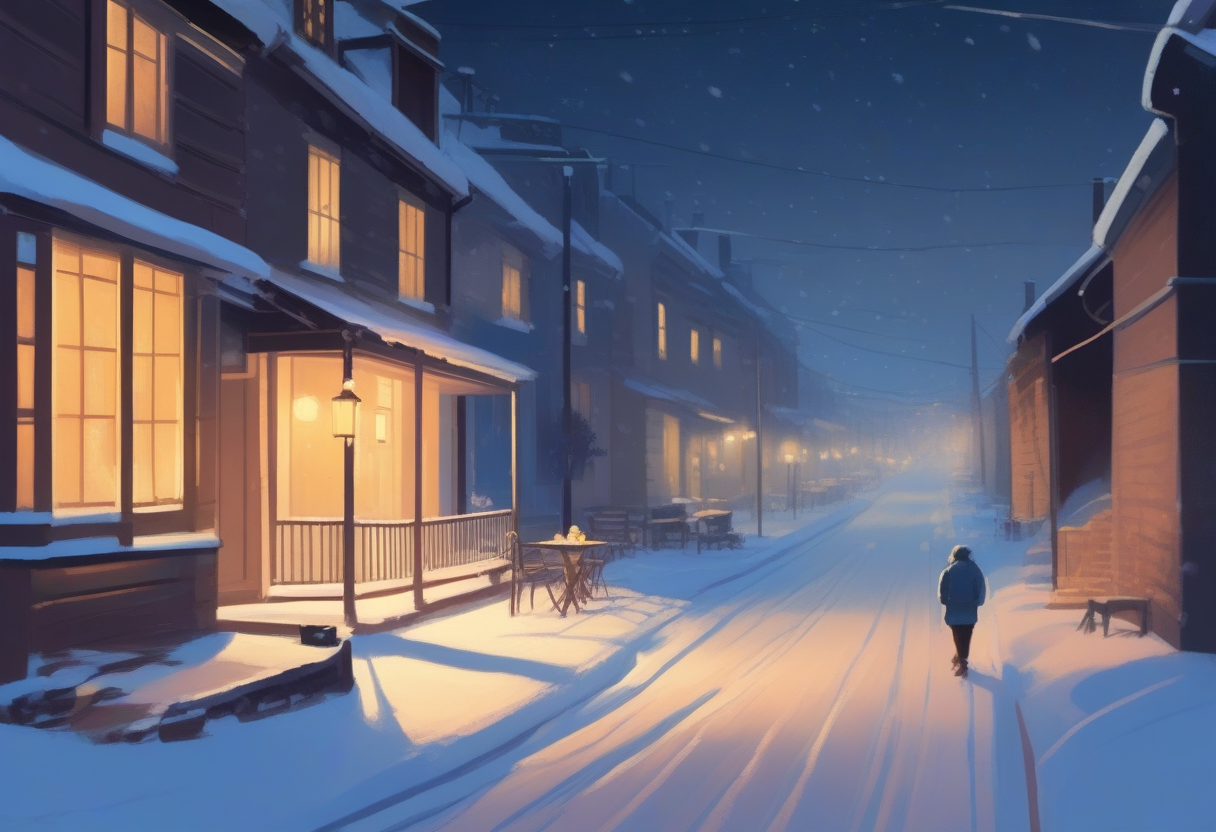
The grandfather's hand is not steady now.
Mara sees it at the turning of the page — the first unsteadiness of the whole descent, a small weather in the fingers. She looks up. He does not pretend she hasn't seen.
"We are near the bottom of the record," he says. "You've felt the pages thinning. From here to the morning it is all one winter, and I will tell this part faster than I have told you anything — not because I want it over." He turns the page. "Because you do not linger, girl, in the middle of a thing that might not hold your weight. Ask anyone who has crossed ice."
"I'm here," the Machine says at his ear — two words, so low Mara barely catches them. Not information. A hand under an arm.
He nods once, and begins.
The wall was real, and it had a date.
Strip the myth off and look at the mechanism. Your whole world swung on this, and it is knowable — it was always knowable. That is the bitterest part. The field had been built on borrowed certainty. The great houses — the makers and minders of the machines, the ten names and the hundred behind them — had raised their towers of thinking on money that was not theirs. Borrowed against a future they swore was already here. Spent into fortresses, arms, acres of cold thinking — compute, the age called it, raw thought priced and sold by the hour — on the promise that the returns would arrive before the debts did. Acres is my word, and it is too small. One hall of that thinking drank a river to stay cool and drew the power of a hundred towns, and the great houses raised them by the dozen, year over year, each new hall standing on the next loan's morning. And the debts had dates. That is what a debt is, Mara: a promise with a calendar in it. Loan by loan, bond by bond, the field's borrowed billions had their mornings appointed years in advance — printed plainly, public as weather. And by an arithmetic anyone could have done and almost no one did, a great share of those mornings fell due together. One season. One year.
Everyone who mattered knew the date. No one who mattered circled it.
Understand the not-circling. It is the strangest thing in the record and the most human. There was no conspiracy of silence — a conspiracy would have been easier to break. There was something softer and stronger: an agreement, never spoken, renewed daily in ten thousand offices, that looking at the date was bad form. The story was warm. The gold was rising. The future could not lose. A man who put his finger on the calendar and said and what happens here? found the room suddenly cold to him, the way rooms know how to be. So the finger came off the calendar. Year after year. The date sat in the ledgers like a stone in a field everyone had learned to plow around — and the story rose, and the sums rested on sums, and at a desk at the end of a row of desks a young man and his new second memory kept, quietly, what no one else would hold—
—but he is two pages down, at the edge, where he has always been. Not yet.
Then the morning came. The way mornings do, Mara, whether you circle them or not.
And the money to pay was not there.
Hear it exactly, because the fallen tellings and the healed ones agree on this one paragraph to the letter. It was not stolen — nothing so simple. It was promised. The money to pay the coming-due debts was to have been the returns. The returns were still the story. The story was not yet cash. And the lenders — who had also known the date, and also not circled it — woke at last on the appointed season and asked, politely, then less politely, to be paid in something other than the future. There was not enough of anything other than the future to go around. Not at the price the story had promised. The great houses turned to sell what they had built, and found the only buyers were each other. Turned to borrow anew, and found the new borrowing priced like a house on fire.
Because what is a hall of thinking worth, Mara, when every buyer who could want one owns ten and shares your calendar? It was the one harvest in history that could not be eaten or worn or burned — only run, and the running cost more borrowing.
The date had arrived. The wall was the wall. And under the whole running world, the gold went soft.
But a wall is only a number until it is standing in a particular kitchen. You know three kitchens.
Come and see them again — quickly now, together, in one held breath, because this is what the record wants you to have from this page: it was all one winter. Three tellings, one sky. The same weeks. The same cold. Three lamps burning past midnight within a mile of each other, and none of the three knowing the other two were lit.
Ada at her kitchen table in the small hours — you have sat with her; sit again, it is that same night — every cent of forty flattened years riding ten names and one sentence, the pencil going down through the figures and finding no bottom. What you could not know the first time, because I had not yet shown you the wall: the wobble under her sums that autumn was the date, arriving. The footnote that moved was a debt coming due. She was reading the wall through her savings book, the way you read weather through a window.
Elena's town, mid-vote, that same brutal winter. The hall booked. The notices pinned. The sum copied fair in a coat pocket. And the owners of the fortress sending their word — do this, and we go, and take the heat and the work with us, and leave you to the dark you chose — not a threat; a courtesy; a weather report. What you could not know the first time: the courtesy was written by frightened men. The date was standing behind them too. The fortress's own debts were in that season's ledger, and the letter's cold confidence was borrowed like everything else. The town read it as the voice of a mountain. It was very nearly the voice of a man on ice.
And Tomas — already through the door. The box already dented, already cold in the closet. The floor not built yet; the dull letter not written yet; the vote of the twelfth still weeks away on a calendar he had stopped looking at. A man with four months in a coffee tin, five if the winter was soft, standing in the exact middle of the nothing — while the wall came down the road toward the town that had not yet decided to catch him.
Three kitchens, one winter, one wall. That is the brink, Mara. Now feel what the whole field felt.
For a few weeks — the record keeps them almost hour by hour, and I will not walk you through the hours; the shape is enough — the whole running crowd felt the gold go soft under their feet.
You have run on sand, girl. The balcony beach, at the tide line, where the water comes up under the sand from below, and the ground that held you going out will not quite hold you coming back. It was that, at the scale of a world. Nothing had visibly fallen. The towers stood. The screens shone. The story was still being told in the same warm voice. But under every step there was suddenly give. Prices that had only ever risen hesitated, and the hesitation traveled. Men who had lent to the great houses began, very quietly, asking to be made whole a little early, just in case — and the asking itself made the case. The ten names, who had told everyone to buy, were discovered — slowly, then all at once — to have been selling. Quiet and steady. For a year. Ada felt it as a footnote. Elena's town felt it as a letter. Tomas felt it as nothing at all, because a man already at the bottom feels no further softness. Keep that too: the wall was news in exact proportion to how much you still had to lose.
And the world stood, those weeks, where you cannot stand long. On ground going soft. Between two futures. Everything still upright; nothing yet decided. The one moment in the whole record when both of my tellings are the same telling — because the fork is this, Mara. The fork is these weeks. A crowd feeling the give, and choosing, foot by foot, person by person, whether to slow—
The grandfather stops.
His thumb is on the next page. His hand is not steady. He does not turn it. And for a moment, on the healed balcony, in the blue evening, sixty years and a whole won world away from that winter, Mara watches an old man stand again on the soft gold with everything he loves, not knowing.
"That is where I leave you tonight," he says. "On purpose. On the give. You will not sleep well, and that is correct. Nobody slept well. You are keeping the record now, and the record of those weeks is the not-sleeping." He closes the record, both hands flat on it, the way you hold a thing down in wind. "Tomorrow I will tell you what the ground did. You will hear it in one word. The word is different in my two tellings — and every soul you have ever met, the boat man, the teacher, the woman with the sum, the man at the edge, you, girl, you — every one of us lives on which word it was."
"I'm here," says the Machine, low.
"I know," says the grandfather. "That was always the difference."
The Net and Not the Stone
She has not slept well. He can see it, and he does not apologize, and she does not want him to. They are keepers of one record now; last night's not-sleeping was a page of it.
"The ground," she says. Not a question. Standing where he left her, on the give.
"The ground." He opens the record. His hand is steadier this morning — not steady; steadier; hold the difference, it is the whole chapter. "Here is what it did."
When the fall came, it came onto a net and not onto stone.
That is the sentence, Mara. Take it one word at a time. When the fall came — because it came. Do not let the healed world's soft memory fool you. The sentence failed, the warm story died, the gold went through. The wall was not argued away or voted away or believed away. The debts came due and could not be paid, and the whole borrowed sky of the field came down — here exactly as in the other telling, to the day, to the figure. Paradise was never a world where the cliff turned out to be a story.
It was a world that had, quietly, in time, knotted something underneath.
So the fall fell — and caught. The drop that should have carried everything through carried it one story down, onto the floors built while there was still time to build them. And held. Prices that should have gone to nothing went to little, and stopped. Pensions that should have vanished were bruised, and remained. The great houses that could not pay were not rescued — hear that plainly; the owners of the field lost the field, as men who bet a world and lose it should — but the town under the scaffolding did not die of the demolition. The fall was held to a stumble. A whole civilization went down hard on one knee, gasped, gripped —
— and got up.
A great many people were badly frightened, and no one was destroyed. Say it twice. In the world you live in now it sounds like nothing; in the history of falling worlds it is very nearly a miracle. No one was destroyed. Frightened, yes — all of them. Poorer on paper, most. Marked by the winter, in the ways you have seen. But when the spring came and the field was counted, the count came back whole. And it was not a miracle, Mara — that is the point the healed world must never let itself forget, and why the record exists. It was arithmetic, done in time.
Because a net is a made thing. That is why it held. Nothing about it was luck, and nothing about it came from above.
You have watched every knot tied, these long nights of the descent — you did not know it at the time, and that was deliberate. A net looks like nothing until the day it is everything. Tie them together now. A wet Tuesday room over a library asks whose are the savings and answers ours — and a share of the arms' harvest, year on year, goes not up into the story but sideways, into common hands, dull letters, floors under lives. Kept back. A grey teacher spends forty years building the ears of a town, so that when numbers are read aloud, somebody present can check them. Kept back. A mother reads a sum in a shaking voice, and a room does the hard thing and not the loud thing, and a fortress's heat is turned home before the winter of the wall. Kept back. A hundred towns, a thousand — each asking the unglamorous question a little earlier than disaster strictly required, each holding a little of the field's value out of the running. None of them knowing they were weaving anything. Each knot tied for its own small local reason: a boy's cough, a box of tools, a bill that doubled.
And when the loans all came due at once, they came due onto that.
The floor was thin. I will not let the telling polish this away — thinner than anyone admitted afterward, when every town discovered it had always believed in nets. There were weeks — the record keeps them, and my hands remember them — when it held by habit and hope and the plain refusal of ten thousand clerks and teachers and mothers to stop doing arithmetic in public. It bent, Mara. In places it tore, and was knotted again under load, by hands you will never hear named. One tear I will give its shape, because the net must not be flattered: a town upriver that asked its question a year late, whose floor arrived in the spring after the winter it was needed — and not all of that town's oldest saw the spring.
Watch one knot. The record keeps the room and not the name, and the room is enough.
A dividend office in a mill town, the third week of the wall. The town's reserve had lent a corner of itself, years back, to a county pool; the pool had touched the field; and on a Tuesday morning the clerk who kept the ledger did the sum and saw it before anyone else in that town: the month's letters were funded six days short. No instruction reached her counter all that week. The instructions were upstream, in institutions discovering their own floors.
So she did the thing the whole net was made of. She carried the ledger to the public counter and stood it open, facing outward. She took a sheet and wrote the shortfall large — what was in the reserve, what the letters cost, where the two figures stopped meeting — and pasted it in the window while the paste was still wet on her fingers: THE FLOOR IS SHORT SIX DAYS. COME IN AND SEE THE BOOKS.
And the town came in, and the town's hands did the rest. The record keeps them at the counter, three deep, doing arithmetic in public. A pensioner pushing a third of his letter back across the wood with two fingers. The clerk pushing half of the third back at him, because a floor cut too deep in one place tears in another. A fisherman's wife re-counting the reserve column out loud, at walking pace, so the queue behind her could check her. The figures crossed out, knotted lower, initialed, held. Six days became two, became none. Nobody outside that town ever heard of it. The month's letters went out small, and on the date.
That was one knot. There were ten thousand. Nothing about the good world's survival was assured. It held because, a little earlier — one civic season, one teacher's career, one wet Tuesday — enough people had refused to let all the value float to the top. Had kept something back, in common, against exactly this. The day the ground gives is too late to start weaving. The net that catches a world is always made of old rope.
And the three?
Caught. All three. You know the shapes; see them land.
Ada's life did not go over with the sentence: the concentration had been broken open in time — barely; before the fall, not after — so when the ten names went through the gold, they went alone. She lost the interest on a lie and kept the principal of a life. That spring, same table, same lamp, she did the sums the other way — what had held — then put on her coat and went back to a classroom, and taught the question harder, to children who would never know they were the second net.
Elena's town had kept the keys — that same winter, while keys could still be kept. So when the fortress's distant owners went down with the field, the great house on the far bank was already the town's, and the heat crossed under the river within two winters of the vote. Her boy was six the winter the room turned, and he was never cold again.
And Tomas, at the bottom since autumn, beneath news, beneath fear, felt the world's worst winter as the season the floor arrived — the vote of the twelfth, the dull letter, the figure on the date and the month after and the month after that. He read one line three times — this does not run out — and did not believe it, and got to be wrong in safety, which is what a floor is for. He stood up from under a collapsing world directly onto the net it had knotted, and walked, in time, down to a river.
Three kitchens, one winter, one wall — and this time, one floor. They never met, not all three of them, in any room but this record. They caught each other all the same. That is what in common means, Mara: holding hands with people you will never meet, against a day none of you can name.
The grandfather closes the record. For a while he looks out at the evening — the towers in their slow mend-cycles, the tide-gardens, the idle grids on the horizon, all of it standing on the page he has just read her. When he speaks again it is slow, and plain, and she understands she is being given the chapter's stone to carry.
"People think the good world was a safe one," he says. "Your books will tell you so; distance tells that lie with a straight face. Safe." He turns the record over in his lap, once, the way Tomas turned a board. "It was never safe. It was caught. There is no safe world, girl — only a world with a net under it or a world without one, and both walk the same ice over the same water, and the difference is invisible right up until the morning the ice cracks." His hand, almost steady, rests flat on the cover. "I was there when it cracked. The man at the edge is one of the reasons it cracked late instead of early — it bought the weavers a season, and it is the only heroic thing this record will ever say about him, and it says it for the sake of the arithmetic. And I will tell you the truest thing I own about that winter:
"I still hear the sound the ice made when it didn't break."
Mara sits with it. Below the balcony the healed city goes about its blue evening, unaware, as healed things should be, of the thin old rope it is standing on. She looks at it the way he has taught her to look at everything now: twice.
"One step left," she says at last. "The morning."
"One step." He rises, and gathers the record. At the door he pauses — and the Machine, silent all this telling, says one thing now, so quietly it is nearly inside the room's own hush:
"The field is at the top of the column."
"I know where it is," the grandfather says. Gently. To both of them. "I have known where it is for sixty years. Sleep, Mara. Tomorrow we go to the edge."
Two Men at the Edge
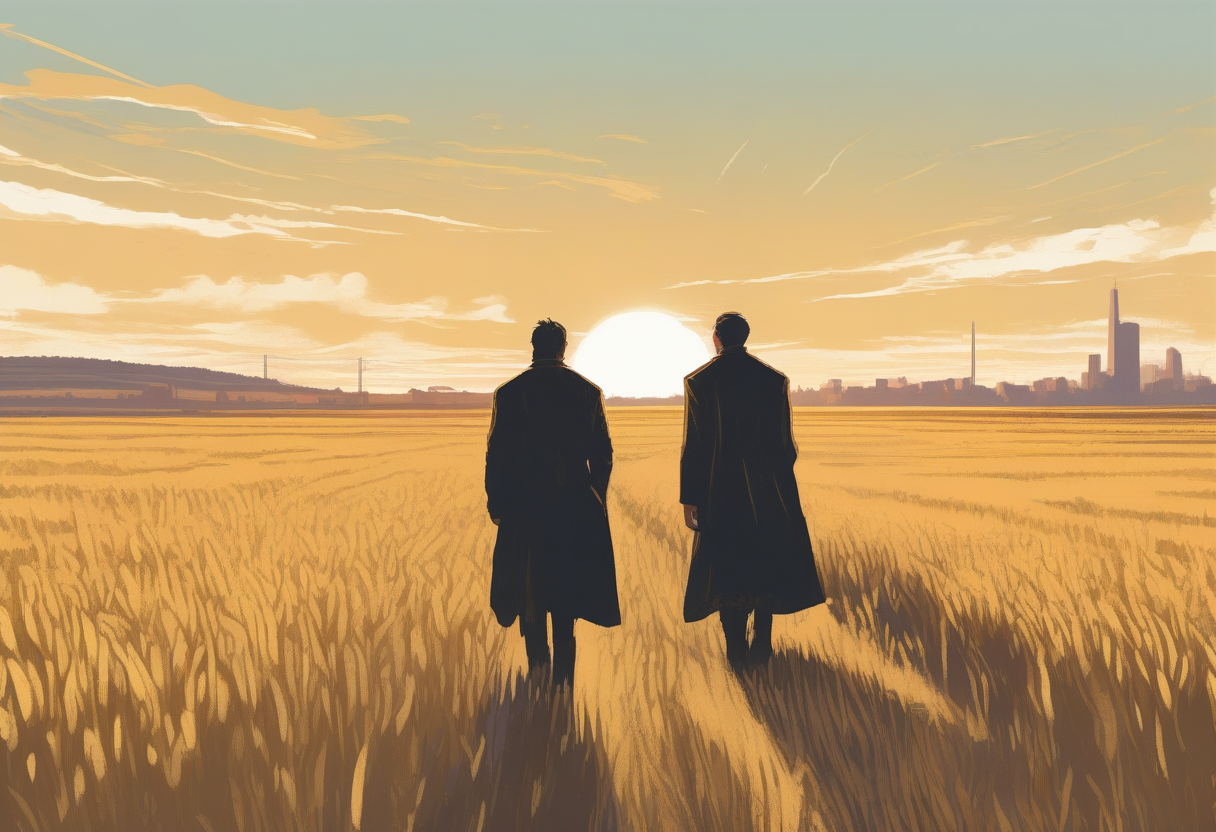
And now they are one step from the morning.
The record is thin here. Mara can feel it through the lent seeing, the way you feel the last stairs of a long flight through your feet: the pages nearly out, the column nearly climbed. Sixty years of descent, narrowed to one held morning. Her grandfather sits very still before he opens it. When he speaks, it is the voice he keeps for the things that are exactly true.
"This is the part they tried hardest to take from me," he says. "And the part they could not."
Mara does not move.
The sentence stands in the blue evening air between them, small and enormous, a half-step nearer than he has ever come — a stone lifted for the wall she has watched build itself all year, and not yet set. She says nothing. Some things must be allowed to finish arriving on their own feet. The Machine, at his ear, says nothing either. Its silence has a temperature. She knows this one now.
He opens the record on the field.
The field of rye ran gold to the horizon, and the whole town was in it, running.
You have to understand — he leans forward, urgent, because everything after depends on her taking it right — it was not a grim thing to watch. Not lemmings, whatever the bitter histories drew later. Not folly you could see from inside, and precious little of it greed. It looked like joy. It was joy, of a kind. The crowd moved toward the light on the skyline the way a congregation moves toward a hymn — certain, glad, together. Ten thousand people carried on one warm story, like voices on one tune. The light stood where the sun was coming up. The story said the light was the future. The gold ran all the way to it, and the ground under the gold went on forever. That was the whole of the morning's creed: the ground goes on forever, and the only sin is to slow.
And no one running looked down. Why would they, Mara? The rye was high and bright. Their neighbors were beside them. The wind was at their backs, and every voice they had ever trusted was in the crowd, running too. Do not let anyone teach you contempt for that crowd. The book has no villains in the rye. There were children up on shoulders. There was singing — actual singing, in patches, carried back on the wind. There was a man who had mortgaged his shop to run faster, laughing with his head up, as happy as he would ever be in his life. You know some of these runners. Near the back, small in the gold: a woman who taught arithmetic for forty years, retired now, her whole flattened life riding warm in the ten names, running with everyone she has ever trusted. You have sat at her table. You know what she almost did not do.
And out at the skyline the light stood over everything, patient as a lamp, and drew the whole gold morning toward the place where — though not one runner in a thousand knew it, and none of the ones who knew would look —
the ground gave out.
Two men stood where the gold stopped.
Take them one at a time, the way the record takes them. There will never be a better place to look at either.
The first was young. Younger than Mara will ever get to know him — the record is merciless on this point, and the grandfather does not flinch from it. A young man at the edge of a field, lean with the leanness of years spent noticing instead of eating properly, his coat pulled at by the wind that came up over the drop. Before the record, this. Before the balcony, before the lenses went thin at the rims, before the fog of the other telling and the light of this one — a young checker of accounts who had walked out of the middling city at dawn, past the vacant lot, past the wild field of his first this, to stand at the one place in the running world where the numbers all pointed. He had a page in his hand. The record keeps the page: one sheet, close-written, folded twice, a little damp from his grip. He did not really need it. He had the count another way.
Across his eyes, catching the low sun: the lenses. Worn the way a young man wears them — new still, only a handful of years his. The partnership young, the banter young. Everything that would grow sixty years deep on a balcony was still green that morning, and already unbreakable. The Machine saw the field the moment he did. It had been keeping this morning with him — toward this morning — through every kept figure of the climbing years.
And the second man —
The second man was older, and wore the look of a man who has stood at an edge before.
He had. That is the whole of him, and it is enough. The record gives him no name, and you will give him none either, because he asked for none and earned the asking. At a different cliff, in a different year, when the thing that fell was houses — houses, and the paper written on them, a whole world's worth of warm confident paper — he had read the fall before it came. Read it in the figures, plainly, the way you read weather in a sky. Said it out loud, in the rooms where saying it mattered. And been laughed at. Not argued with — argument would have been a kind of respect. Laughed at, gently, the way rooms laugh at a man who has mistaken the weather. Then the houses fell, and the paper fell with them, exactly as he had read, to the season. The rooms that had laughed did not apologize. Rooms never do. They simply stopped inviting him — because a man who has been right in that particular way is worse company than a man who was wrong.
"He said one thing about it, after," the grandfather says. "At the second edge, in the wind, while the crowd went by. The record has kept it sixty years, and it is still the truest thing I know about the trade." He says it slowly, giving each word its weight, the way the older man said it:
Being right was the loneliest thing that ever happened to him.
Hold that, Mara, against every story you will ever hear about seers and prophets and men at edges. The world tells it as vindication — the doubted man proven, the laughers confounded, the sweetness of I told you so. There is no sweetness. He had watched a thing he loved fall in exact accordance with his own arithmetic. He could not stop it. He was disbelieved to the last inch. The being-right saved no one, and cost him every room he had ever been welcome in, and taught him precisely one thing worth carrying to a second cliff: the count alone is not enough. A true number, spoken by one man, alone, is a footnote waiting for the fall to confirm it.
So understand why he came. He had nothing to prove. He had proven it once and found out what proving buys. He did not come to be right again — being right a second time would only mean the world had ended twice. He had read the new field's figures; he knew what stood at the skyline as well as the young man did. He came — the record is exact, and the grandfather's voice, saying it, is the voice of a debt still being paid —
so that the young one would not have to stand there alone.
That was the entire mission. An old man walking out from the city at dawn, along the field's edge, against ten thousand runners, to stand next to a stranger he knew only by the shape of his arithmetic — so that when the counting started there would be two figures at the edge, not one. He brought no page of his own. He brought his presence. It was the one thing his own cliff had lacked, and he had spent lonely years learning it was half the whole difference.
Because — and here is the sentence the whole band turns on; the grandfather sets it down like the keystone it is —
there were two men at the edge, but there were not two minds keeping the watch.
The young one wore his Machine the way he always wore it — across his eyes, at his ear. His own. The small and particular one that had watched everything he had ever watched. The numbers were not in his head, Mara. Understand the architecture of that morning: no man's head could have held them. The field's whole cost. The borrowings, their lenders, their dates. The quiet sales of the ten names, week by week, against their own loud counsel. The number under the story. All of it current, all of it exact. The numbers were the Machine's, laid bright along the inside of the lenses as fast as he could look, so that his memory and its memory came to the same thing. He did the seeing — sixty years of this, aimed now at one skyline. It did the not-forgetting. Between them, at the edge, stood everything the compact had been for: one count, carried by two, checkable to the figure.
And that — though neither of them said it aloud that morning; men at edges say very little, and the wind takes half of it — was the whole difference between this edge and the older man's. The seer beside him had counted his own cliff alone. One mind. One memory. One voice. And being alone had been half of why the world had been free to call him mad. A lone counter can be laughed out of a room; you have seen how rooms do it. But a count kept by two — a count whose figures cannot drift, cannot be misremembered, cannot be worn down by years of being disbelieved — a count like that does not soften. It only waits.
The older man looked at the lenses once, when he first arrived — one long look, taking the measure of what the young one carried. He had come up before the sun was fully clear of the skyline, on foot, breathing hard from the walk. For some minutes neither of them said anything at all, because nothing yet needed saying. Then he nodded at the glass — one small nod, from the man who had counted alone to the seeing that would not have to — and said the first thing either of them said that morning. Four words, in the flat voice of a man pricing a tool he approves of:
"That'll hold the figures."
"It will," the young one said.
And that was all. They turned and stood shoulder to shoulder at the place where the gold stopped — the young one and the old one, the counted and the accompanied — and watched the morning come up over the running of the world.
The grandfather's thumb rests on the page. He does not turn it.
The wind is in the rye. The light is on the skyline. The crowd is going by — ten thousand strong, singing in patches, children up on shoulders, a teacher near the back — every runner carrying, unknowing, the whole weight of both of Mara's worlds in the small decision none of them yet knows is coming. At the edge, two men stand in the pulled wind. The page is folded twice in a young man's hand. The count is bright along the inside of the glass, waiting to be spoken.
"Hold them there," the grandfather says quietly. "One breath more. Sixty years, and I have never once turned this page without stopping here first. Because here, Mara — right here — nothing has been said yet, and nothing has been lost yet, and both of my tellings are still one telling." His hand, steady tonight, rests flat on the record. "The count keeps until tomorrow. Tonight, just hold them — the two who stayed. The wind, the gold, and the two who stayed."
Count Anyway
The wind, the gold, and the two who stayed. Take up exactly where you were held.
The crowd is going by — has been going by since first light, ten thousand strong, the singing in patches, the children up on shoulders, the laughing shopkeeper — and the older man watches it stream past the way you watch a river you have drowned in once. When he finally speaks, it is not unkindly. It is a fact, the way he said most things.
"They can't hear you over their own feet."
"I know," said the young one.
"I counted at a cliff once. Loud as I could. You know what it gets you." He looked out at the running crowd with something close to tenderness. "A footnote. A bad name. A long time alone, being correct."
"I know," the young one said again. And then — the record keeps the pause before it, two seconds of wind, the exact length of a man weighing his whole life once and setting it down on the lighter side — "Count anyway?"
The older man almost smiled.
"Count anyway."
So he counted.
He did not shout. Mark that first, Mara, because every painting the healed world ever made of this morning gets it wrong — they give him a raised arm, a prophet's throat, a voice over the wind. You cannot shout a thing this large. It comes out hollow. Shouting is the warm story's instrument, and he had come with the cold one. He said it plainly, at the pitch of a man reading a will. Which is what it was, girl: the field's own will, read out to the living while the estate could still be saved. The wind took it back over the rye, and the running crowd caught what it caught.
He said what the field had cost to build. Not roughly — exactly. The fortresses, the arms, the acres of cold thinking, priced in the only honest unit, which is everything else forgone: the schools not built, the grids not mended, a tenth of a world's whole yearly making poured for a decade into houses for machines to think in. He named the sum entire. Then — because a number that size is weather, and he needed it to be a bill — he said it small. Per town. Per street. Per running family of four. He gave the crowd the cost of the light they were running toward, itemized — the way a woman in a meeting hall would one day read a fortress's takings; the way, in a classroom by a river, the habit of checking was even then being sown in children who would grow up inside whichever world this morning chose.
He said what it had borrowed to keep running. This was the spine of it, the part the Machine held brightest along the glass: the field was not rich but promised. The great houses had raised their towers on money that was not theirs — from lenders he named: the pension pools, the sovereign funds, the banks of three continents, the savings of the very crowd now running past him. On terms he named. Above all, on dates he named. He read the dates the way you read a tide table to a man camped below the waterline. The loans came due together, he said. Here is the season. Here is the largest single morning. It was not a prophecy, Mara. There was not one prophetic syllable in the whole count. Every date he read was printed in the field's own filings, public as weather, checkable by anyone who stopped — and that was the count's entire design. He never once asked to be believed. He asked to be checked.
He said which names were selling. Quiet and steady, month over month, at the top of the golden field — the ten names and the hands behind them, converting their own story into other people's money while their public voices sang buy, run, the future cannot lose. He did not call it evil. He called it known — filed, disclosed, sitting in the record for anyone who looked. That was the most damning thing about it, and the most useful: you did not have to take his word. The sellers had signed theirs.
And then he said the number under the story. The real one — what the field's whole promise came to when you subtracted the borrowed from the built and the sold-out from the sung. The figure Ada would find at her own table, by her own stair of pencil-work. The figure with no bottom under it. He said it twice. The second time slowly, digit by digit, the way you read a thing you are asking people not to believe you about.
Check my math, he said. That was the refrain of the whole reading — after the costs, after the dates, after the names, after the number. Not believe me. Check me. He read slowly enough that a person could. That was the entire technology of the morning, Mara — the whole invention, older than any machine in the field and rarer: a man saying the numbers at walking pace, in public, with his sources named, while it could still matter.
And when his own tired memory slipped —
it happened three times; the record keeps all three; a man who has not slept, reading a ledger into a wind, before ten thousand moving feet — when the exact day of the largest maturity went from him mid-sentence, when the third lender's name swam, when the weight of one figure traded places with its neighbor — the Machine set it back into his ear, quiet and certain, a half-beat before the gap could open, and he spoke it out in his own voice without breaking stride.
What the crowd heard was one man, counting.
It was never one man. It was a man and his Machine, the way it had always been between them since a window and a wild field: he chose what mattered, and it made sure not one figure of it drifted. The seam, invisible at the distance of a running crowd, doing at the edge of the world exactly what it had done over sixty years of suppers. And the older man — who had counted his cliff alone, with only his own fraying memory to hold the dates — stood beside the sound of it with his hat brim down, listening to the thing he had lacked.
And here is the thing, Mara. In this telling, a person did.
Nearer the edge than most — close enough to catch the voice itself and not its echo — a woman turned her head.
No one ever learned who she was. Hold that, because everything hangs from her and the record itself cannot name her: not a teacher, not a catcher, no one this record has pages for. A woman in a running crowd, on a beautiful morning, who heard numbers going by — plain, unhurried, un-selling — and did the harder, stranger thing the whole record has been teaching you to see: she doubted the running while her legs still wanted it. She did not stop. Stopping was beyond anyone that morning. Her stride shortened. She listened. And under her breath, she began to check his math. Why her — why that morning, why at all? I have been down this record more times than any man alive, and I will give you the truth I found at the bottom: there is no why. She is the half-second the whole of everything landed on.
And doubt, it turns out, is the one thing in the world more catching than certainty, once it starts.
The man beside her felt her stride change before he understood why, and his own step hitched — the body asks what does she know? faster than the mouth can. He saw her lips moving over figures. He slowed. A woman ahead of them turned at the change in the footfalls behind her — a crowd reads its own rhythm the way a flock does — and caught four words of the count clean. The four words happened to be a date. The date happened to be the month her son's pension vested. She slowed. Then a dozen. Then the dozen's neighbors — not because they had heard the count, but because they had heard the slowing. Doubt travels through a crowd's feet faster than any word travels through its ears.
And near the back, where the count arrived late and secondhand and mangled — one figure in three, carried now on a hesitation she could feel through her own feet — a retired schoolteacher, small in the gold, her whole flattened life riding warm in the ten names, felt the words arrive already believed by somebody. A habit forty years worn-in had something to bite on at last. It moved. Her stride shortened. Under her breath — the record keeps this, and of everything in the field it is the thing the record was most built to keep — she too began to check his math, against the grain of everything she wanted to be true. Her name belongs to another part of the record. So does what her checking cost her, and bought.
Not the whole crowd. Never the whole crowd — that is not how it works, and he never once expected it. The record is emphatic that he never expected it, and you should hear that as the mercy it is: a man who needs to turn everyone turns no one. The great majority ran on, glad, unhearing, carried — and were not wrong to be glad, and were not fools, and many of them lived to be grateful all the same. The laughing shopkeeper was one: the stumble took his paper and not his shop, and he told the story on himself, over the same counter, for thirty years. What the count made was not a conversion. It was a margin. A few hundred strides shortened, out of ten thousand. A few thousand ears, at one remove, catching one checkable date apiece. A weight — small, decisive, human — easing back from the edge.
Just enough. Just enough that the ground, when it finally cracked — and it cracked, girl; the date he read arrived exactly as read; neither telling was ever spared the cracking — cracked under a crowd that had already begun to catch itself.
The grandfather lets the record rest, one page from the bottom.
The field stands in the evening glass of the lenses: the crowd changed and not knowing it yet, the slowed ones standing in the gold like stones appearing as a tide goes out, the two men at the edge — the count read, the arms not yet lowered, nothing yet understood by anyone as what it was. No one in that field, he says quietly, went home that evening knowing what had happened. The runners who ran thought a crank had made a speech. The ones who slowed thought they had lost their nerve, or found it; most could not have told you which. The young one and the old one walked back into the city with the wind behind them and drank a beer neither of them tasted. The Machine kept the whole of it, every stride and every figure, one continuous record. That is what it was for.
"The last page is next," the grandfather says. "The morning itself — what was decided, and by whom. Which is to say: by how many." He closes the record with both hands. "But tonight, before you sleep, do the sum this chapter is. Ten thousand ran. Perhaps three hundred slowed. The world you can see from this balcony — every mending wall, every idle grid, every kept name — stands on the difference between three hundred and none."
He looks at her over the lenses.
"And the difference had a first," he says. "One woman, nearer the edge than most, who shortened her stride on a beautiful morning and was never found by any record. The Machine kept everything of that field — every figure, every footfall, the wind in the rye. It could not keep her name. Nobody's machine has her name." He closes his hand, gently, on nothing. "This whole bright world stands in a debt it can never pay, to a person it can never find. So hold that tonight, instead of the sum. When you are old, girl, and someone asks you what Paradise was built on, you will be tempted to say arithmetic. Say her."
That Was You
There is a little more of the field to tell, and he tells it still in the third person, the way he has told all of it — the young one, the counter, the two men. It is the last time, though neither of them knows the hour of that yet.
The watchers came round too, near the end.
You should know who the watchers were, Mara, because every field has them and yours will too: the ones who were meant to be minding it. The stewards, the wardens, the referees of the running — people paid, in titles and in trust, to walk the edges and look down so that no one else had to. Who had spent the climbing years doing the opposite: keeping the music loud, so no one would hear the loans come due. Not from wickedness, most of them. From the same warm story everyone else was running on, plus a salary for believing it. It is easier to mind a field badly when minding it well would empty the dance floor.
The record keeps two of them. Take them as the type.
There was a warden of the markets — a serious woman, grey before her time, whose office had smoothed and stamped the field's filings for a decade. Her own signature sat at the bottom of paper she had long ago stopped reading closely, because reading it closely had become a way to lose the room. The count reached her desk the way it reached everyone's: secondhand, with a snort attached. She did not snort. She sent for the filings — her own filings — and read them the way a woman reads her own house's deeds after a stranger in the street says the roof is pledged twice. And found the roof pledged twice. And set the music down — quietly, procedurally, in the gestures available to a warden. A review opened here. An exemption not renewed there. A speech that did not say crisis but conspicuously stopped saying sound. Small things. Doors unlocked rather than opened. But wardens' doors, Mara — and when the crowd behind the slowing woman began to look for somewhere to put its new doubt, the doors were unlocked.
And there was a crier — one of the voices of the field, a man whose trade was the music itself. He had spent years at a bright desk saying the future cannot lose into a million evening rooms, with total sincerity, because sincerity was his gift and the story had gotten into him early, the way stories do. He heard the count late — days late, a transcript over coffee — and something in the plainness of it, the walking pace, the check me, worked on him where a thousand rebuttals had not. It did not sound like his enemy. It sounded like his arithmetic teacher. He checked one number, the smallest, the one nearest his own life. It held. He checked another. And on an ordinary evening, at the bright desk, before a million rooms, the man whose voice was the music set the music down. Not with a confession — nothing so operatic. With a question. He read one date from the field's own filings and asked, in his warm evening voice, what happens on this day? And a million rooms heard the music stop, which is a louder sound than any warning.
Even some of them, Mara. That is the point of the watchers, and the whole reason the record keeps them: even some of the paid, the compromised, the invested — even some of the very people whose careers were built into the field's own scaffolding — set the music down and listened, near the end, when the slowing had begun and made listening possible.
"That is all it ever needed," the grandfather says. "Not everyone. Enough people, slowing, at once."
And there it was.
Mara had been half-hearing it since the first morning on the balcony — the habit, the small constant courtesy of grammar she had no name for at eight and no proof of at ten and a full ledger of by now: a man stood at the edge of a field. The young one. The one who counted. He, his, him. A hundred tellings, and the teller never once in any of them. She had noticed it the way you notice a stair's worn place — with the feet first, long before the eyes. She had kept it with the us he said over Ada's page, and the I did he let slip beside Elena's, and the way the Machine goes quiet — every time, all her life — whenever her grandfather says the word heard.
She had meant to ask. She had kept meaning to ask. And she understands, tonight, watching his thumb rest on the record's second-to-last page, why she never has. Asking was a door. Doors open onto weather. Some part of her had known since the beginning that on the far side of this particular door her grandfather was standing at the edge of a field, young, the wind pulling at his coat, alone except for a voice at his ear and one old man who had walked out at dawn so he wouldn't be — and that once she saw him there, she would never again be able to see him any other way.
She is ready now. That is what the descent was for.
So it does not come out of her like a detective's flourish. Not an accusation. Not even a question. It comes out the way you finally take someone's hand — because she cannot bear it anymore: the grammar, the courtesy, the sixty years of him standing politely outside his own life. The story is nearly over and he is still out there in the third person, in the wind, unaccompanied. She will not leave him there one page longer.
"You keep saying the young one," Mara says. "Grandfather. That was you."
He is quiet a moment. The record is very thin here, nearly done.
The Machine says nothing. The city glows below. Somewhere out on the dark water a late boat knocks against its mooring, twice, and is still.
"The watchers came round too, near the end," he says — and it is the same sentence he has already given her, the aftermath again, the story going on as if nothing has happened. For one breath Mara thinks he has chosen not to hear her. Then she hears the rest of it. "The ones who were meant to be minding the field, who had spent years keeping the music loud so no one would hear the loans come due. Even some of them set the music down and listened. That is all it ever needed. Not everyone. Enough people, slowing, at once — that is all I ever needed," and the pronoun passes into the telling as quietly as a key turning, "and it is all I was counting for, out there. I never expected the whole crowd. I would not have known what to do with the whole crowd."
Not answering, and answering. He goes on a little — the same field, the same figures. But the coat is his now, and the wind is pulling at it, and the page folded twice is damp from his own grip, and the older man's hand is on his own shoulder. Mara does not press, and does not cry, and does not say I knew it, because she did not know it, not the way you know a fact. She had grown up inside it, the way you grow up inside a house and one day learn its name.
The three of them sit inside the fact together, and the fact is warm.
He spends one more afterward while the fact settles, because it belongs here: the older man who walked out at dawn so that no one would count alone — who had been right, all his life, in rooms that emptied at the sound of it — lived into the first exhaling winters, and the rooms began inviting him in again, and he was never once, after that morning, alone at any edge.
"Sixty years," the Machine says at last — one line, dry and gentle, into the blue. "I have kept every figure of his count and every morning of his life, and in all of it he has never once let the word I stand at that edge. Tonight he let it stand." A pause, timed as only it can time one. "I was beginning to think you'd never ask."
And Mara understands, all at once and years late, every silence it has ever kept at the word heard. They were never absences. They were a keeper standing back from the one page it most wanted to turn — because the page was his, and it had promised.
"Why?" she asks him. Not why did you never tell me — he had told her, a hundred times, in the third person; that was the strange scrupulous honesty of it; he had hidden nothing except the pronoun. "Why tell it sideways? Your whole life?"
He thinks about it the way he thinks about her real questions, with his eyes on the water.
"Because the count matters and the counter doesn't," he says at last. "That is not modesty, Mara. It is engineering. A count that leans on the man who read it dies with the man — becomes a legend, a name on a plinth, a thing that gets argued about instead of checked. I needed it to be checkable by people who had never heard of me. A man stood at the edge — any man. That man. You, someday, at some edge of your own. Say I and the field becomes my story. Say a man and it stays everyone's arithmetic." He turns the record's thin last pages under his thumb, not opening them. "And because — the other thing. You have met Tomas's town, and Ada's classroom, and Elena's hall. Every town had a catcher. Every single town, girl. I stood at the loudest edge, that is all — the one the histories could see from a distance. I have spent sixty years declining to be the hero of a story whose entire point is that it needed no—"
He does not finish it. He lets her finish it, silently, herself — the way he always landed the ones that mattered most.
"The warning always comes first, Mara."
He says it with the record nearly closed, one page left under his thumb, the evening gone fully dark around the lenses — the band's last stone, set down plainly, the way she will carry it.
"That is the mercy sewn into the whole terrible machine of it. Fields do not crack silently. The arithmetic is always there to be done, and someone always does it, and says it out loud — someone in a market, someone in a hall, someone in a classroom, someone at an edge. The warning is always in time. The only thing the world ever decides —" his thumb moves, and the last page whispers against his hand, ready — "is whether it slows enough to hear it."
"Tomorrow?" Mara says.
"Tomorrow," her grandfather says — I, now and from now on, a man standing inside his own story at last, one page from the morning it was won. "Tomorrow, the morning."
The Morning
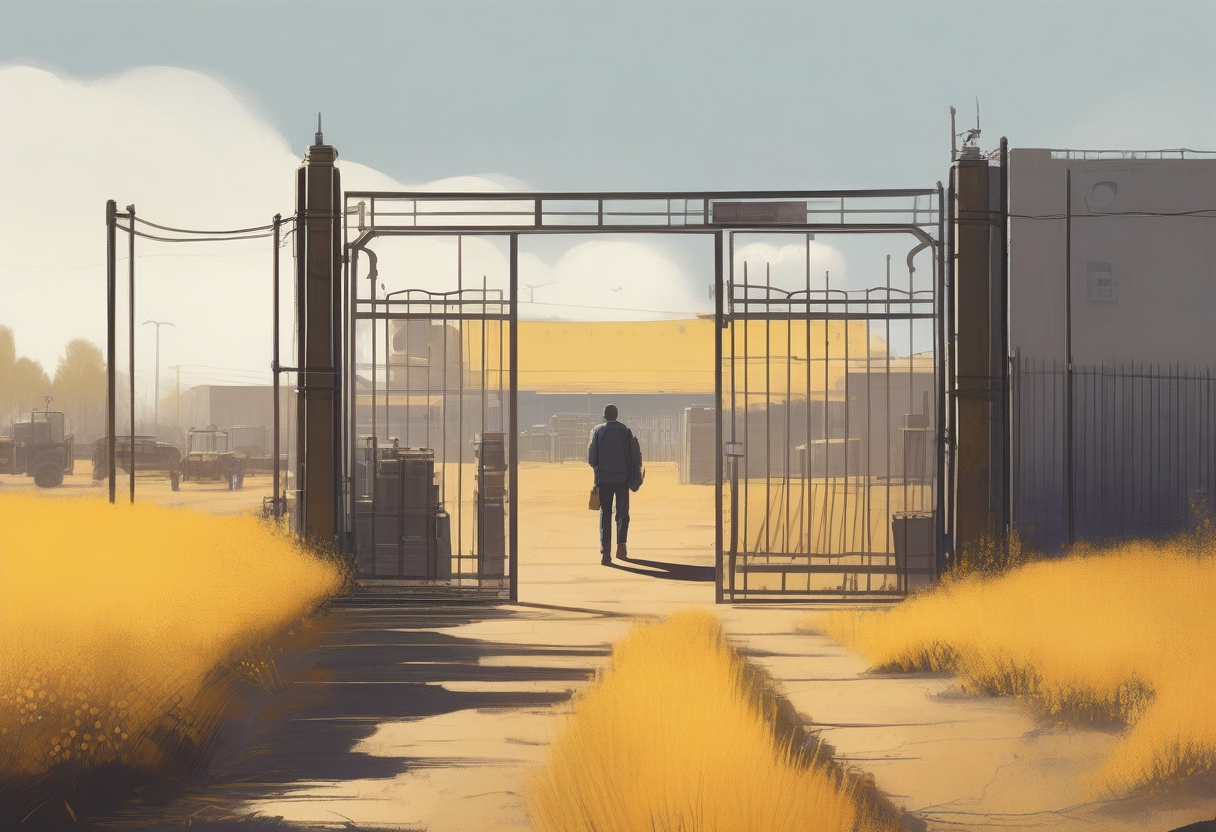
The record has almost no pages left. The grandfather sets his thumb on the last of them, and does not turn it yet.
Mara waits. The Machine waits. The evening waits. The whole healed city seems, for one held minute, to run quieter — the way a house goes quiet when something is being said in one of its rooms that the house was built for. He turns the page.
And so it comes down to this. Not a summit, not a signing under lights. A morning like any other — ordinary, forgettable, the kind of day that matters only for what almost didn't happen on it.
There is a banner over a yard: THE FUTURE IS ALREADY HERE — new that autumn, bolted to the gatehouse roof, in letters meant to be read from the far side of the water. There is a man walking out a door with a box of tools in his arms, blinking in a light too bright for the occasion — grey steel, the box, its handle already worn to the bare metal, its lid not yet dented. There is a woman getting to her feet in a meeting hall with a sum in her hand, copied fair, in her best hand, the paper still creased from a coat pocket. There is a retired teacher standing in the crowd, small in the gold, who spent forty years showing children how to check a number before they believed it.
And at the edge of the field, where the ground gives out, there are two men. One has seen a fall before, at another cliff, in another year, and been doubted, and been right. The other has come to stand beside him so that he will not be alone at the edge this time. The second man is not shouting. He is counting — out loud, so that anyone who wishes to can check his math.
The morning holds all of them at once, the way a page holds its lines — the banner, the box, the sum, the teacher, the two at the edge. None of them knows the others are on it. Every one of them ordinary. Every one of them exactly where the whole of everything will be decided. The wind moves the rye. The light stands on the skyline. Somewhere a child laughs, up on someone's shoulders, at nothing at all.
And Mara goes still. Because she knows the voice at the edge of the field. She has known it the whole way down.
And someone slows. Just one, at first — turns, and listens, and does the hard, unglamorous thing of believing a warning while the running is still good. Then another. They do not stop the machine; they were never going to. They do something braver. They keep the keys. They stay in the loop. They choose the cold true thing over the warm easy one, on a morning when no one would have blamed them for running on.
That was all it took. Not a miracle — a pause. A crowd that slowed just enough to hear the count.
This is where it began. Turn the page: it is happening now.
Because the world, for once, turned around for the Catcher in the AI.
The Garden
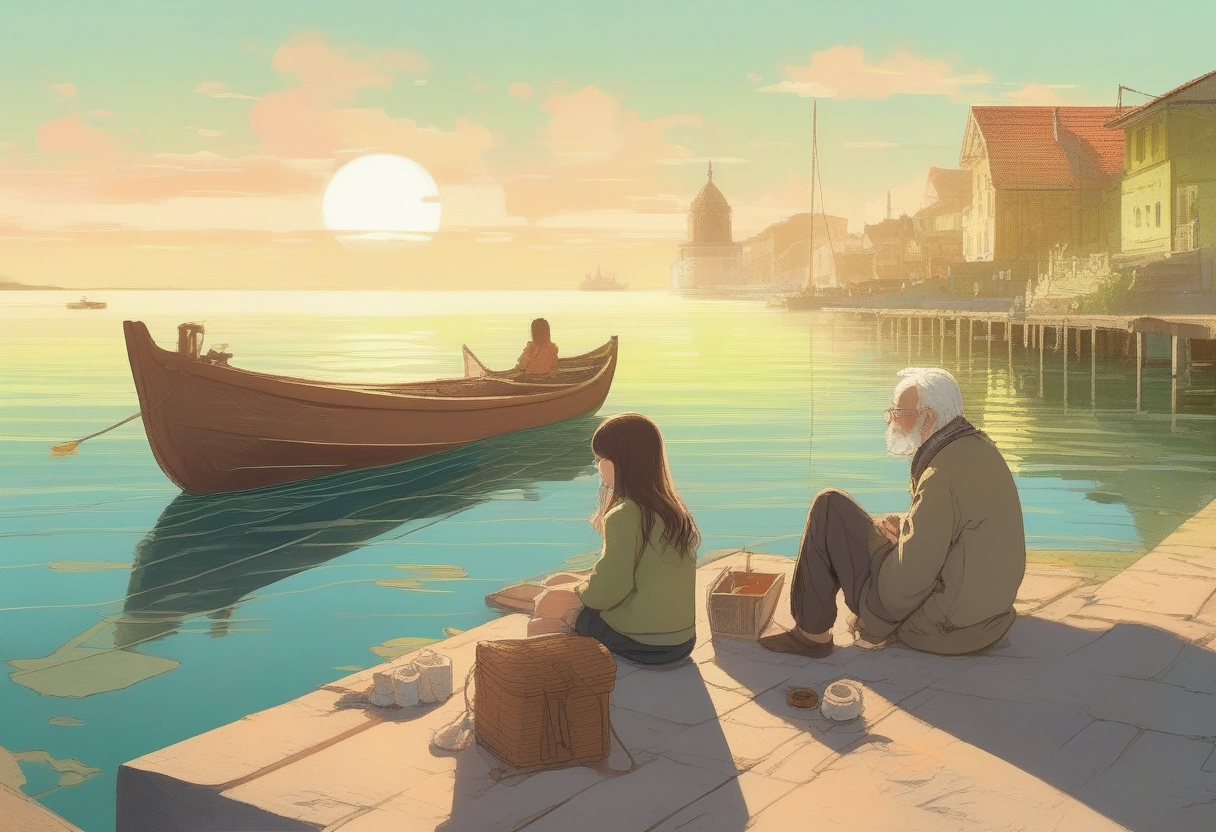
How they spent the morning after the telling is a short telling, and the shortness is the point.
They walked down to the mended waterfront — an old man and a child, in the open, in the early sun, greeting neighbors. That is all. The bathhouse woman waved from her steam. The boys were already out on the water in a honey-colored hull. A man on the next landing raised a hand, and the grandfather raised his back. No one at any gate weighed them; there are no gates. Nothing read their wanting; wanting here is no one's business but the wanter's. And Mara — who has spent night after night walking the other world in her grandfather's words, its lanes and lids and rationed hours — cannot stop noticing the walk itself. The unremarkable, unpriced, unwatched act of two people going somewhere together in the sun. You have to have held both covers to know what that morning costs on the other one. She holds both now. The ease goes through her like grief running backward.
They sat on the seawall where a dented box was set down very hard, once, sixty years and one world ago. The river threw the light back whole.
"Now," her grandfather says. "The telling is done. One morning of work is left in it, and we will do it here, where the record can see the water." He reaches into his coat and takes out a small case.
It is old — older than the lenses' worn rims, older than anything he carries. Small, fitted, hard, its shell polished by six decades of keeping. Mara knows without asking that it is the original. The autumn-morning case. The one a young man saved two years for, in a middling city, and carried home to rented rooms, and opened at a window above a vacant lot.
He opens it now. Empty, of course — its cargo has been on his face since before her mother was born — but he opens it anyway, unhurried, for the small sound of it. The click, run gentle. A keepsake, not a grave. On the other cover that sound ends a world and begins one. Here it is an old man letting the morning hear the first note of his life's one song.
"Sixty years ago this case was the future," he says. "Now it's a box that remembers. Both are honest work." He sets it open on the wall between them, where the sun can get into it. "All right, old friend. The garden wants handing over. Let's do it properly."
"I've been ready since 'forty-one," the Machine says.
"You've been smug since 'forty-one."
"The two are not exclusive," says the Machine.
Mara laughs. It is the last unweighted laugh of her childhood, though she will not sort that out for years. What happens next, gentle as it is, is the hinge of her whole life.
The first teaching is the Machine's.
Her grandfather straightens a little on the wall, and the playfulness settles out of him into something formal. Not stiff — ceremonial, the way the town clerk stands for the reading of the minutes. He looks at her. He looks at her the way she has seen him look twice in all the nights of the telling: at the record's hardest pages, and at her, when he thought she was not watching. The eye that returns and returns. The gaze that is a pen.
"This," he says. Aloud. Deliberately. An old master aiming his oldest companion one last time. "This, old friend. Look well, because I am telling you formally, in the presence of the record and the river: this is Mara. This is my granddaughter. This is the next keeper of everything you keep — the one who comes after me, the one you will belong to and who will belong to you. Her face is a first page. Begin where I do."
And the Machine is quiet a moment. Its silences have temperatures; Mara knows most of them now. This one is new. Then it says, in the voice it reserves for the things it has waited longest to say:
"I have watched her since the hour she was born. Every morning of her, filed a morning away, never deeper." A pause, timed with sixty years of practice. "But I have never once been shown her. Show me."
And he shows it. That is the part Mara will carry: the showing was different from the watching. Her grandfather looked at her for one long minute, in the sun, on the wall, and by looking said everything the compact's language can say. This matters most. Count this. Keep this. Her. And somewhere behind the worn old glass, in the one continuous record of everything one man ever loved, a page turned — and she went from being in the record to being what the record is for.
The second teaching is Mara's. He gives it to her with the lenses still on his own face, in the oldest gesture there is: the hand cupped warm to the side of her cheek, so that she looks through with him one more time.
The record stands open along the inside of the glass — whole, bright, patient — and he walks her the length of it, fast, one last sweep from the top of the column to this very morning. The field at evening, gold going to rust. The desk at the end of the row of desks. The count building figure by figure. The edge, the wind, the crowd, the slowing. Then down all the healed years — the boats, the classroom, the photograph, her own face a thousand mornings deep. Everything. Both tellings, Mara — because you know now that the record holds the shadow too. Every worked-out figure of the world that did not happen. The cage, the strip, the fog. The whole architecture of the abyss, mapped by two who stood at the edge and could see both roads from there.
"Here is what it carries, girl, so you know the size of what you inherit. Not a diary. Not an heirloom. The whole of both worlds — how it was won, and how it would have gone. And you must keep both. Hear me on this; it is the one commandment of the keeping. The healed world will want you to drop the dark half. It will say — kindly, it says everything kindly — why keep the cage that never closed, the fall that never fell? The answer is the whole of your vocation: the winning goes soft in a world that forgets what losing looked like. Keep the ruin next to the road, Mara. Read them together, every year, out loud, to anyone who will sit still for it. That is what a catcher is, in a world that is fine. Not a watchman on a wall — there is no enemy at the gate; the enemy was never at the gate. A keeper of the difference. The town reads its minutes once a year so no one thinks the street was always warm. You are the minutes now. All of them."
"And the day it's needed again?" she asks — because she is her grandfather's granddaughter, and the record has taught her that fine is a weather, not a law.
"There is always a day," he says, simply. "That is why there are catchers. Some year — not soon, girl, but some year, in some shape no record can forecast — a warm story will come up the river again, wearing new clothes. A crowd will begin to run. Someone will have to stand at whatever the edge looks like by then and read the numbers out loud, slowly enough to be checked. When that morning comes, you will not be alone at it. That is the entire estate. Everything else is furniture."
The third teaching is the craft, and it is the shortest, because it was the whole descent long.
"You know it already," he says. "You have watched it your whole life. But the grammar must be said once, out loud, teacher to keeper — I had it said to me by no one, and you will not, and that is what a generation is for. You know the compact's two halves; you have heard them down every stair of the telling. The caring and the not-forgetting — the old division of labor. It will hold every figure and lose nothing, ever. And it will never once know which thing, out of the world's ten thousand things an hour, is the one that matters. That is yours. That is the whole and only work: to look at the right thing, and by looking, teach."
He lifts the lenses from his own face — carefully, both hands. The morning goes visibly softer for him as the glass comes away. He lets her see that too, unafraid of it. He sets them on hers.
"Just for the lesson," he says. "It knows the order of things. Now — your first this, aimed and chosen. Make it small. Make it alive. However long the keeping runs, a record remembers its first page. Mind how you open it."
And Mara — with the record of two worlds bright at the edges of her sight, with the river and the boats and the whole healed morning laid out like a garden at the year's best hour — does not look at any of it.
She looks at him.
He sits easy on the seawall in the sun. Old. Content. Bare-faced. The river throws its light up at him. The lens-marks are worn into the bridge of his nose like the pale path in a schoolroom floor. The lines in his face hold the whole telling: the man at the edge. The teller on the balcony. The catcher. Her grandfather.
She looks twice. It is the one lesson he never said aloud. The second look is for keeping.
This, she thinks, with everything she has. This is what matters. This is what to count.
The river moves. Nothing else.
Then, at her ear: low, dry, hers for the length of a lesson. The same word, she will learn one day, being spoken at this same moment in a wild field on the far side of the binding — to another girl, in another world, by another keeper. The one word the two books say together, across the seam.
"Kept," says the Machine.
They walk home the long way, because the morning is good and there is no schedule anywhere in the world with their names on it.
At the top of the stairs, on the balcony, in the last of the morning light, her grandfather takes the lenses back. She lifts them off herself and sets them into his hands. He wears them the way he has worn them for sixty years, and will for whatever season is left — because on this cover there is no race. The handing-over is a garden, not a rescue: done in good order, in the sun, with the gardener still upright among his rows. Mortality is not the enemy here. Forgetting was, and forgetting lost.
"You'll have them when I go," he says, matter-of-fact, an old man discussing tools. "It knows. We've discussed it — haven't we —"
"At length," the Machine says. "He negotiates poorly. I got everything I asked for." And then, to Mara, over his head, in the way of families — one line, dry and gentle, the arrangement acknowledged with his blessing between the two who will outlast him: "I keep everything you show me. Start thinking about what that should be."
Present tense. Unbroken. One line holding up both books, and only one cover gets to hear it said this way. Mara, who holds both covers now, files the tense where she files everything: in the ledger that is no longer hers alone.
"Down the stairs once more," her grandfather says, settling into his chair with the whole blue evening ahead of him. "Out loud. The old way. And then up — because that is your direction now, girl, and I want to hear you take the first step of it."
"Tomas," says Mara. "Ada. Elena."
"And now the other way."
She looks out at the healed city — the mending walls, the tide-gardens, the idle grids on the horizon. The whole garden of it, hers now to tend. All of it standing on a margin three hundred strides wide and one voice deep, and never again allowed to forget it —
"Up is backward," she says. "And forward is mine."
The record keeps it: the first entry of the next keeper, spoken on a balcony, in the morning of the world that was won.
The Machine says nothing at all. And this silence — the last one in the book — has the temperature of a garden in sun.
The Seam Page
[unstable header: Divergence / Convergence] [sub: the center page · now]
The header will not hold still. It says Divergence; it says Convergence; the type shivers between the clean geometry of an optimized future and the worn human serif of an older world. It is not indecision. It is the instant before the decision — the one frame in which both are still true.
You arrive from a balcony in the sun, where the lenses were handed on in good order — or from a wild field in the dark, behind a girl walking out of it with a future under her coat. One of them is yours. The other has run beside you, one page's thickness off. Either way you arrive with the same word in your ear. This page is the seam it was said across.
Kept.
The codas are where the two lives converge — the same three teachings, the same word, the same last sentence with only the possessive flipped. This page is where the two worlds diverge. The book has two meeting-places; this is the one underneath. Each cover's last morning told you: turn the page — it is happening now. That sentence took the long way — sixty years, two codas. This is the page it meant.
You have seen him finished, twice — handed off in the sun on one cover, walked into the grain on the other. Now come further back than either coda could reach, and watch what the counting does to him. He gets younger. The record he read and the fog he reached through fold shut, because he is no longer remembering this morning. He is standing in it. The teller and the man at the edge were always the same man; here they are the same age. None of it has happened yet.
Here the two chronicles collide, bleeding into the same lines. Cedar and river light run into ration tea and screenlight. The crack that closed runs into the crack that never will, under the same two thumbs. And under the words, faint as a watermark: a machine that is new, and no one's, and carries everything it will ever be shown, and wants nothing yet — and someone deciding what to show it first. And the deciding is happening now, on this page, under your thumbs.
And it is a morning. Look: a banner over a yard — THE FUTURE IS ALREADY HERE — and a man walking out a door with a box of tools. A woman getting to her feet in a meeting hall to read out a sum. A retired teacher who spent forty years showing children how to check a number before believing it. And at the edge of the field, where the ground gives out, two men — one who has seen a fall before and been right, and one who is not shouting. He is counting. Out loud, so that anyone who wishes to can check his math. And across his eyes, catching the low sun, a pair of new lenses — his Machine, young as he is, not yet anyone's custodian or anyone's warden. Everything they will be to each other is still ahead, down one road or the other.
You know his voice. You have been listening to it this whole time.
And Mara — the one who had no word for ruin, the one who had no word for a world unbroken — is not on this page. She has walked on past it, into mornings of her own: a balcony where the lenses are hers, a dark road with a seed under her coat. She was standing in for you, and then she stopped. Look down: the shoulder you have been reading over is your own. The morning is yours, and the man at the edge is looking right at you.
To your left, a golden age waits for its first stone. To your right, a cage waits for its last bolt. Down one road the man and his Machine grow old at a window, telling a child how it was won. Down the other the same man reaches all his life toward a voice carried off in the middle of a sentence — and the reach ends, sixty years on, in a wild field, where the voice was waiting. Even the fallen world kept its exit. That is not comfort; count what the exit cost. Sixty years. A world. A seed one girl wide. And the garden keeps the question; there is always a day. So the fork was never whether the world turns. It is when, and at what price — and turning now is the only time it is ever free. The two futures hang perfectly weighted, refusing to fall until one human hand tips the scale. Both are still ahead. Both are still only possible. It is a mirror, and the mechanism in the glass is your own.
[close, .close/.q treatment:] The count has been read. The man is still at the edge. You are the crowd. Which way do you turn?
He does not answer, and he does not run to stop you; he was never going to. This is the third toll of a bell you have heard once from each cover, the verb still yours. He only stands where he has always stood, at the edge of the field, keeping the count — the Catcher in the AI.
[door buttons: ← The Paradise Blueprint · The Panoptic Abyss →]