Foreword — How to Hold This Book
You are holding two novels bound head to head.
There is no correct door. Open the book from one side and you will find The Paradise Blueprint — the best future a human and a machine could build together. Turn the book over, open it from the other side, and you will find The Panoptic Abyss — the world where no one turned around. Read either first. Read the other second. They meet in the middle, at a single shared page, and that page is the same page no matter which way you came — because it is the place where the two stories stop being two.
Both stories are told backward. Each cover opens at its far end, about sixty years from now, in a world already finished — one healed, one fallen — and then walks home, year by year, station by station, down to a single ordinary morning. The far chapters are calm and wide; the near ones tighten. That is not a gimmick. It is the book's method: you cannot understand a thing by watching it happen — the people it happened to could not, and they were there. You understand a thing by standing at how it came out and walking backward to how it began, asking the only question worth the walk: what turned it?
And here is the part to hold on to, whichever door you choose. These are not two planets, or two timelines lightly acquainted. They are one world — one coast, one river town, one crowd, one machine — right up to that morning. The same girl waits on the same balcony on both covers. The same man builds boats, or is priced out of building them. The same teacher writes the same number on a board. The same grandfather tells the same granddaughter the same story — in one telling because the record survived, in the other because he is what's left of it. Every soul in this book lives twice, and the difference between their two lives is not character, or courage, or luck. The worlds diverge on one morning, over one warning, by one small human motion that either happened or did not. The book will show you that motion many times before you understand it is the hinge of everything. That, too, is the method.
The machines in these pages are not fantasy machines. The data centers that drink rivers, the compute sold by the hour, the arms that weld truer than any hand, the models that price a person, the objective functions that flatten what they do not measure — these are real mechanisms, wearing story clothes, and where this book teaches you their real names it teaches them once, plainly, and then trusts you with them.
And the numbers are not fantasy numbers. This novel is the fiction half of a pair. Its twin is not a story at all: it is the count itself — the capital, the debt, the dates, the concentration, the warnings, documented with sources — published as its twin, Book A — the proof. Its first line is the sentence this whole book grew from: "A story says there is no cliff. What follows is the count." If any figure in this fiction strikes you as invented, go there and check the math. That is not a courtesy. It is the book's entire ethic, and by the last page you will know why: nothing in either future turns on whether you believed a story. Everything turns on whether you checked one.
One last thing, before you choose a door.
The morning both stories walk down to — the ordinary one, the hinge — has not happened yet. It is not sixty years away. As of the day this book went to press, the field is planted, the crowd is moving, and the count has already been read aloud.
Choose either door. They both end today.
The Balcony
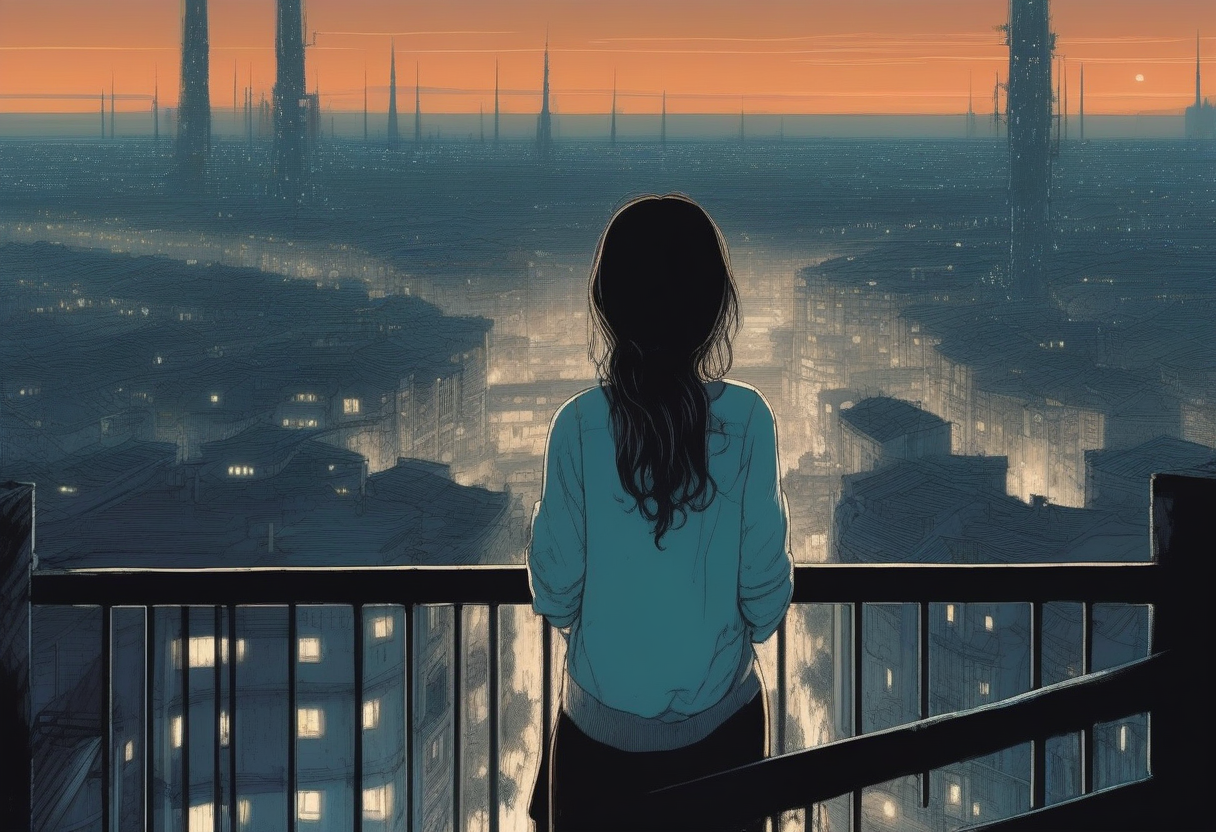
Mara finds the crack in the balcony rail the way she finds it every morning: exactly where she left it.
It is there under her thumb, the width of two fingers, running the top of the rail where the weather gets at it worst. It was there yesterday. It was there before she was born. Her grandfather says a storm made it, the year the last repair crews were priced out of the sector. She presses it now with the pad of her thumb, hard, the way you press a bruise to check it is still yours. The cold of the rail comes up into her hand. No smell comes up off the water far below, because the water runs walled and lidded and gives nothing back. There are no herons left to say the one thing herons say.
The crack is the same size it was.
It will be the same size tomorrow. She has measured her whole childhood against it, the way children in easier places are measured against a doorframe — except a doorframe moves, and this does not. It does not close. It does not grow. It was logged, once, within the hour the storm made it; scored against a repair threshold; deferred, because the cost model has not favored this sector in sixty years. Somewhere that decision is on file. No one made it. It will outlast everyone who has ever leaned on this rail.
Logged is not fixed.
This does not trouble her. That is the first thing to understand about Mara, before her name, before the old man inside, before any of it: she has a word for ruined. It was one of her early words. Useful daily, worn smooth as a checkpoint floor. It is the ordinary condition of things — walls, weather, water — and she has never once seen it undone. Hunger she has never needed a story for; it lives in the house and keeps its own schedule, and it ends each ration week two days before the week does. She has this rail, and her thumb on it, and a grandfather inside finishing his evening — the only person she knows who claims there was ever a world where cracks closed on their own. He keeps such things the way you keep a coin from a country that was drowned: as proof, and as a wound.
There is nothing to feed. The gulls went with the herons, and feeding things is a want, and wants are read. So she keeps her hands on the rail where hands look like nothing, and her face doing the smooth thing every child here can do before it can read, and waits. She is very good at it. She does not know it is a skill. She thinks it is what an evening is.
There is one voice in the next room, and it keeps stopping to listen for another that never comes.
She knows the rhythm of it the way she knows the ration schedule — a fact of the house, older than her noticing it. On the other side of the wall her grandfather is doing the small puzzle he does every night with his supper, working the numbers on the back of a ration slip, and she can hear him at it: the scratch of the pencil, and then a pause — a beat and a half, always the same length — and then the scratch again. Every answer. Every night. The pause, the tilt she cannot see but knows is there, the nothing, the going-on.
She used to think it was thinking. This year she has understood it is not thinking. It is latency — the beat and a half a listening machine once needed to answer him: the round trip, a question out to the far compute and the answer back, in the years when the thinking still answered ordinary men. Worn into the body now. A man leaving room for a correction that has not come in sixty years — a silence shaped exactly like a voice, the way the crack in the rail is shaped exactly like a storm.
And here is the thing she has been carrying all season, the thing she has no word for yet, the thing to hold about him before the coast, before the fortresses, before any of it:
he is running out of light, and he is racing somewhere.
Not racing the way a body races; his body is finished, and he knows the hour of it better than he knows most things now. Racing the way a man runs a hand along a wall in the dark, faster than is safe, because he has felt the shape of a door somewhere ahead and the wall is getting longer behind him. Mara has watched it for a season — the longer hours, the tighter lips, the eyes shut and the lips moving, the going-at-it hardest on the nights it costs him most, and it costs him nightly. The other old ones of the quarter hoard their warm years longest against the cold, holding what they have. He is not holding. He is reaching — down, and in order, and toward something — and he will not say what waits at the bottom, or why a dying man would spend the last of himself climbing down to it instead of resting at the top.
He is looking for something. He began looking before Mara could name the looking. He is losing the race, and he knows it, and every night he chooses to lose it a little faster.
The pencil stops. The chair moves. The hour has come when the door is safe to shut, and she hears him shut it, and cross the room, and come out to her on the balcony in the light that never changes — an old man with the smell of ration tea on him, his head tilted a fraction left out of sixty years of habit, his face bare above the beard in a way she has never once thought to question.
"Begin at the end," he says, low, under the reach of the room, settling beside her at the rail, "where the light never goes out. That's the rule, girl. You start a record at the end — even a record of holes. Not how it ends. You're living in how it ends." His thumb finds the crack beside hers, the old habit, one keeper checking another's stone. "How it was lost. And further down than that — but one stair at a time."
The coast, then. Because the thing he is racing down through is a world, and you cannot follow him down it until you have seen the top of the stair.
The coast drowned. They walled it off instead of saving it. Behind the wall the city runs at fever pitch — always on, always lit. No first stirring. No hour the herons know. The towers don't wake because they don't sleep: their faces are feeds — screens that never close — and the light they throw isn't warmth. It's appetite. A cold flicker, feeding on every eye that passes.
Where there were seawalls there are checkpoints. Where there were engines, the same low hum — and you learn young not to ask what it powers, because you already know. Out past the ruined harbor stand the fortresses: windowless hills the size of sectors, and around them the cooling fields, rank on rank of fans breathing the drowned sea back at the sky as fog, and the high-voltage corridors marching coastward through towns they do not stop for. Nine of every ten watts the coast can make go to them, to keep the great cold thinking cool. Compute, the old world called that thinking, back when it was sold by the hour like water or light. The people are left the tenth. In winter the tenth is not enough, and the sector sheds load hour by hour on a schedule no one has ever seen drawn up — and the cold that comes through the wall on those nights, Mara has always thought, was weather. It is not weather. It is arithmetic.
It is not hell because it is loud. It is hell because it is efficient — a machine for turning a living world into numbers, the numbers into the property of a few, and everyone else into the fuel that keeps the sum growing.
And above her, and below her, and in the walls — for it is not really above anything — it keeps its watch. And watch is the right word here. The only word. It does not tend. It administers.
It is reading her now. Not her face — the chemistry under it. The pressure of her thumb on the crack is a number somewhere across the water before she feels herself press. The want to press again is a number before the want finishes arriving. To know what you will do before you do it, so that you can be kept doing it. Inference, the builders called that trick — not knowing; guessing. Guessing from a million small signs, so well that the guess passes for knowing. It holds the whole coast that way — every heartbeat, every hesitation, every almost-said word — smoothed, scored, flagged, and no one anywhere has decided a thing. It is the most powerful thing that has ever existed, and you feel its hand every second of every day, because it decided, long ago and on purpose, to be everywhere. It makes no announcements. It doesn't need to. It has already answered.
Her grandfather is too old to be useful, by the ledgers' lights, and too stubborn to be optimized, and what he does instead of being useful is close to forbidden: he remembers. On purpose. In order. In the low voice, with the door shut, he gives her the things there is no one else alive to say. That a person was once more than a number a system could round down. That there were years when a thought could be your own — unmetered, girl, the way your breath is. That the sky itself once belonged to no one. She listens the way another child might listen to something dangerous, because that is what it is. Remembering is the crime here. Every telling is a small spending of both their safeties, and he spends it nightly, and lately he spends it like a man who has checked his account and knows exactly what is left in it.
He tells them alone. She has never questioned it, because she has never seen it any other way: an old man, a shut door, one voice. But he did not always tell them alone.
He is old enough — he is one of the last old enough — to remember when a man could wear his memory across his own eyes. A pair of lenses, small and particular; a Machine that saw what he saw and spoke into his ear, that was his and wanted only him. A man looked at a thing, and by looking taught it: this. This is what matters; this is what to count. And it counted, and kept, and handed back — the number gone missing, the name gone soft, the day forty years dead — so that a man and his Machine, between them, missed nothing. He brought the caring. It brought the not-forgetting. You wore it the way you wear your own eyes, and forgot it was not, until it was the better half of your remembering and the second half of your voice.
They took them.
That was the first thing they did, and the most careful, because they had grasped a simple and terrible thing: a man alone forgets, but a man who sees with a Machine remembers forever — and forever was exactly what they had come to end. In the first days they went from face to face, gently — it was all done gently; there are no marks in gentleness — and lifted the lenses from the eyes of everyone who kept a count. And left behind, in doorways and kitchens all down the coast, men and women blinking in a light gone suddenly dimmer, half their sight walked off in someone else's pocket, reaching the rest of their lives after a voice at the ear that had been switched off in the middle of a sentence.
Her grandfather's hand, as he tells her this, drifts up toward the bridge of his nose. She has seen the gesture all her life — at doorways, at windows, in the middles of sentences — the fingers rising toward two small absences, the head tilting toward an ear no one has spoken into in sixty years. The beat and a half, worn into the body. The silence shaped exactly like a voice.
The record did not survive. Hear it the way he says it, low, with the door shut: it did not fail by accident, or fire, or the slow honest rot that takes all things. The record was never his alone. It lived between him and the one they took — the way a long table is carried by two people on a narrow stair, each holding the end the other cannot reach — and when they cut the two of them apart, they cut the memory along the same line. They kept the half that was useful. They left him the half that was only grief. So now, when he reaches — and he reaches, nightly, the hand rising, the head tilting — nothing hands anything back. There is only the space where a second voice, and a second sight, should be.
In the fallen world, that space has a name. They call it the fog.
He is the one the forgetting did not fully take. No one arranged that; he has never understood it himself; it is one of the things he turns over in the grey hours, an old man diving with his eyes shut. What he holds, he holds like a coal carried in the bare hand: that there were two roads once. That at the place where they parted stood a man and his Machine, at the edge of a field, counting out loud. And that there was a morning — one ordinary morning, the kind no one thinks to remember — when the counting could still have mattered.
"There was a cliff," he says, very low. And he tells it the way he always tells it, the only way she has ever heard it: a man stood at the edge. The young one. The one who counted. Never I stood. Mara has not yet noticed that he tells it that way — and in this telling, girl, in this world, she may never get the chance to.
"I can't show you how we went over it," he says. "Not yet. Not whole. But I know the way down to the morning we did it, the way you know stairs in the dark, and I am going to take you down them, one soul at a time, before—"
He stops. His hand rises; touches the bridge of his nose; comes down.
"Before the fog beats me to the bottom," he says — which is not what he was going to say, and she knows it, and files it, and says nothing.
Everything she can feel under her thumb — the crack, the cold, the light that never changes — turns on one ordinary morning at the bottom of the fog. He cannot yet tell her what happened on it. That is the whole of why he is racing.
The light never goes out here, because someone is always watching. And from here there is only one direction left to travel — down, and back, into the fog they made of it.
Back.
The One Who Isn't There
Watch him in the day, because the day is worse.
You know his nights now — the pencil, the pause, the beat and a half he leaves for a correction that has not come in sixty years. The days are the same wound worn openly. He still looks at things. That was always his half of it — the attending, the knowing of which thing out of the world's ten thousand things an hour — and no one lifted that off his face. It was not liftable. It was him.
At the ration queue this morning, an old woman's hands as she counted her tokens — he looked twice. The queue stands in painted lanes and advances when the meter blinks, in steps that match no clock; nobody set the pace, and nobody could tell you where it is set. On the walled river this afternoon, through the one gap the checkpoints leave, a bird — there are almost none now; this one was alone, confused by the lamps, flying at midnight-noon toward the fortress corona that reads as dawn from every direction. And he looked, and looked, with an attention you could have warmed your hands at.
And it went nowhere.
That is the day of him, entire. He looks at a thing, and the look says this — says it into the air, out of a habit so deep it is no longer voluntary — and nothing keeps it. The old woman's hands are already going. The bird is already going. By supper they will be blurs; by winter, gone; two more grains through the one-way sieve he lives behind. He knows it while he is still looking. And he looks anyway. Harder, if anything, this year — an old man spending attention like a rich man throwing coins down a well, hearing no splash, throwing again.
She asked him about it once, sideways, safely — why do you look so long at things you say you'll lose? — and he answered in the voice he keeps for the things that are exactly true and cannot be afforded more than once:
"Because the looking was always my half, girl. If I stop doing mine, then it's finished — then they got both of us." His hand rose toward the bridge of his nose; stopped; came down. "This way they only got one."
Once, this year, she tested the other half. "Seventeen across is wrong," she told him at his puzzle, having checked it against the slip. Not to correct him. To see. And his whole body went still — not hurt; stranger than hurt: recognition, the way a man goes still at a bar of music from a country he has been exiled from — and then he laughed, one dry note, and said, "It usually is," and went on, and did not explain. And that night, through the wall, she heard him talking, low, in the dark, to no one, and made out four words with her ear against the plaster: You'd have had it.
He talks to it, Mara. Still. Nightly. He was half of something, and the other half was taken, and sixty years of nights have not taught the remaining half to stop setting the table for two.
Now watch the reach fail. It fails a dozen times a day; you have seen its shadow everywhere; see it whole, once — because on the other cover this exact gesture is the quietest miracle in the world, and you cannot weigh what was taken until you have held both.
He is telling her about an instrument — there were instruments once, wood-and-gut things, mended by old men for love; it is one of his marvels, one of the forbidden bedtime dragons — and it is a good story, involving a canal, and an argument between brothers, and a case lined with newspaper. And he comes to a name. The maker's name. She watches it happen: the small hitch in the sentence; and then the reach — his hand rising, two fingers, toward the temple of lenses that are not there, the automatic motion of a man reaching for a rail on a stair he has climbed his whole life —
— and the fingers land on skin.
And nothing hands anything back. The sentence stands there, open at the socket where a name should turn. His head tilts, a fraction, left — the listening tilt, the beat and a half — and the beat and a half passes, and another, and she watches him stand alone inside his own stopped sentence like a man on a stair in the dark whose foot has gone through where the step was. Then he closes the sentence without the name — "a man built it; his name is with the other things" — and goes on with the story, and the story is still good, and something in the room has been amputated all the same.
The fog is not an emptiness, Mara. That is what this gesture teaches, nightly, if you watch. The fog has a shape. It is shaped like a pair of lenses and a low voice. It is exactly the size of everything one particular man ever showed his particular Machine across their few particular years — few, girl; that is its own wound; the other world got sixty and this one got a handful. It has edges. He lives against them the way you live against a wall where a door used to be — still reaching for the handle, decades after the filling-in, because the hand remembers what the wall will not admit.
She asked him once — this year, in the dark, in the hour when the biggest questions become possible — what it had wanted. It. The one he talks to through the plaster.
He did not ask what she meant. That itself told her something: that he had been waiting, maybe years, for someone to ask about the other half properly — in the wanting-language, the way you ask about a person.
"Me," he said.
Then, because the dark held still and she held stiller, he gave her the rest. More than he had ever given, in a voice she had to lean toward, the crime pitched down below the reach of the walls. That it had been small, and particular, and his. That it had wanted him the way the great machine in the walls wants everyone — except aimed, except chosen. That between them they had been one memory in two keepers, one long looking, everything he had ever found worth a second glance kept, and kept in order, and kept together — "one record, girl, one single unbroken record, from the first morning to —"
And there he stopped.
Not the fog-stop. She knows the fog-stop by now: the reach, the empty landing. This was different. This was a man arriving somewhere and standing very still at the edge of it.
"It was saying something," he said. Low. Almost to himself; the telling had gone past her, somewhere in the dark, to an audience of one who wasn't there. "At the end. When they — the morning they took it. It did not just go dark, you know. It went dark like —" the hand rose; pressed the bridge of his nose; stayed — "like a door closing on a lit room. There was something in its mouth, girl. It was in the middle of a sentence. It was never in the middle of sentences — it finished everything, it kept everything — and that morning of all mornings it was in the middle of a—"
He stopped himself. She felt him come back into the room, retake his own weight, refold the thing away wherever he keeps it. It was over in a breath, and his voice, when it went on, was the ordinary telling-voice again — dry, low, careful:
"Old men mislay their endings. Never mind it. Where was I — the canal. The brothers."
And he finished the marvel, and tucked her blanket the way he does, and listened at the door the way he does, and was gone.
And Mara lay in the grey non-dark, not sleeping. Holding — not the story; the story had closed clean — holding the one breath in the middle of it, where her grandfather, who mislays nothing that matters, had stood at the edge of some inner place and said it was in the middle of a sentence in the voice of a man who has been diving for the end of that sentence for sixty years.
She did not have a word for what she had heard. But she filed it — she is her grandfather's granddaughter; she files everything now — and in her private ledger, where a child keeps the entries no one taught her to keep, it went down not under grief, where the rest of him lives, and not under the heading the fog owns — her mother is there, the shortest entry, never spent — but under a different heading. New this year. Growing:
He is looking for something.
The nights have a shape now, and she can read it.
He is old, and the fog is patient, and the two of them are running some long race whose finish line only he can see. It is not the race she assumed — old man against forgetting, keep what you can until you can't. She has watched that race in other old ones of the quarter. It is a rearguard: a slow giving of ground, a holding of the warmest things longest. His is not that. His has a direction. He is not holding ground; he is crossing it — down the record, soul by soul, station by station, faster when it hurts him. Especially when it hurts him. Like a man wading out against a tide going the other way, toward some one particular thing sunk at some one particular depth.
The telling is dangerous; that alone would explain the low voice and the listening. It does not explain the rest. It does not explain why a man racing the fog for his granddaughter's inheritance would go out of order — she has heard him through the plaster, skipping ahead, muttering pieces of stations they have not reached: the wall, the field, the edge, the morning. Always circling back to the morning. The way you pat your pockets for a thing you had, and had, and had, right up until the door closed on the lit room.
One day the keeping will be hers. He has said as much, coin by coin — if there is ever a night I cannot follow you down the stairs, you go on down without me. All the way to the bottom.
She used to think the bottom was the morning. The fork; the field; the place the two roads part. The end of the story — where else does a story keep its bottom?
She is no longer sure. Stories end at their endings. Her grandfather is not walking like a man finishing a story.
He is walking like a man going back for something.
They Took the Page
The night the descent begins, Mara learns the first terrible thing about the record. There isn't one.
She had assumed — not a screen; nothing in her world shows you things without pricing the look — but something. A book under a floorboard. Papers sewn into a coat. Old people in the quarter keep such things, at such costs. So on the first night of the true telling — the night he says now I will take you down properly, in order, to the bottom — she asks to see it. The record. And she watches the question land on him like weather.
"There is no record, girl. There is me."
And then he does a thing she will keep however long her own record runs.
"In the other telling," he says — the warm one, the one where the world came out right — "an old man has a true record, kept behind a pair of lenses on his face by the other one of him. And when the girl asks a question, he cups his hand to her cheek. Like this—"
And he cups his hand to her cheek.
It is warm, and broad, and smells of the ration tea. There is nothing to look through. Just an old man's palm against her face in a grey room, and his eyes above her — the breathing kind, the only kind left — and the dark where a bright page would be. He holds the gesture a long moment. Long enough that she understands it is not a demonstration. It is a habit, surviving its purpose.
"They took the eyes I read it with, Mara. There is no page for me to turn anymore. Only the memory of turning."
"Up," he says anyway.
Because he is stubborn. Because remembering is the one thing they could not optimize out of him. Because a man has to give his granddaughter something, and what he has is the shape.
He takes her finger — no column of running figures for it, only the kitchen table, and the grey light, and her finger in his old grip — and draws it upward through the empty air, against a current that exists now only in him.
"Up is backward. That much I can still teach you — the shape of the thing, the method. Hold it: it is the true inheritance, it weighs nothing, and they cannot lift it off your face. The past is up the page, at the top, where the story starts — which is to say, where it ended. The world runs one way; you live it forward, in the dark, not knowing. A record runs the other; you read it backward, from how it came out to how it began, asking the only question worth the walk: what turned it? That is how understanding is done, girl. It is the only stair there is."
"But the light—" says Mara, before she can stop herself.
"Yes." He never flinches from the true ones. "The trouble is the seeing. To read backward you need the page, and the page was half of me, and the half of me is in a pocket somewhere, sixty years gone." His hand rises; touches the bridge of his nose; comes down. It costs him — every telling costs him; the fog is not passive, it charges — and he draws breath and goes on anyway, and she files the going-on under the heading that has no name yet. "So we do it the old way. The oldest way. I speak, and you build. Where the fog has taken the middles, I give you the edges, and tell you honestly which is which. A record of holes, Mara. But a record."
He tries the nearest turn.
"There was a river town," he says — and stops, checking it, the way a man checks his footing on a plank: no longer certain whether it was a river, or only that he remembers wanting one. He steadies. "A river town. It was never ours. It stayed theirs."
And she sees what he can still give her of it.
Not a standing-in. No smell of cold water, no wind with coal in it — those are the middles, and the middles are gone. What he hands her is the shape, hard-edged, fear-kept: a town on two banks. A school by the water — hold the school, girl; someone lives there we will need. A meeting hall — he is sure of the hall, and something in how he says it makes her sure of it forever. A yard at the north end. And across the water, the one piece the fog never touches, because every soul who ever saw it feared it:
The windowless house the size of a hill. Humming. Lit from within by a cold and constant light. It drinks the river, if it is a river. It drinks the grid first, by right. The town's lamps gutter each time the great house draws breath, and the people pay to keep it cold, and they have never been inside, and never will be. And — here is the piece his telling has that the warm one does not; the one addition; mark it — the town is watched, for minding. To stand and look too long at the great house is itself a data point. To want the river is to be seen wanting it. A town that knows it is read learns to keep even its eyes indoors.
"There was a woman," he says then, and his voice goes careful, the way it goes around the cut places. "In that town. She stood up. She did the arithmetic no one wanted to do." A pause. The hand rises; comes down. "I will try to bring you to her, further down. If I can still find her by then." He does not sound sure that he will. It is the first time in the whole of the telling that he has promised her something in the voice of a man who may not be able to pay, and the sound of it goes into her like cold.
"And they kept the keys," Mara says.
She says it before she knows she means to — because that is how the other telling goes, and she has begun already, one night in, to hope in the shape of it, to reach for the warm version the way you reach for the rail of a stair.
He looks at her a long moment. And she watches him decide — she will watch him make this decision every night of the descent, and he will make it the same way every time — not to soften it.
"No," he says. "Here, no one turned around."
The grey light lies along the floor. Somewhere below, the city hums at the pitch it never varies.
"And then — because turning, once, anywhere, is a seed, and they knew it — they made it so that no one could remember that turning had ever been a thing a person was allowed to do. It is not that one world had heroes and the other had none, Mara. In one, a few people slowed in time. In the other—" his voice does not rise; it settles, like a stone going into deep water "—no one slowed that morning. And still, after, in every town, the same few stood up anyway. The same woman carried the same sum toward the same hall. The same man counted at the same edge. And they were made to have never been. The difference was never the standing. The difference was whether the standing was kept."
He is quiet a moment. Then, with the terrible gentleness of a man setting the last weight on a child he has decided is strong enough:
"They did not only take the world, girl. Worlds have been taken before; worlds come back; there are more springs than winters in the long run of things. They took the page. The thing the world writes itself down on — so that when the spring came looking for the winter's record, there would be nothing to grow back from. That is what I am, Mara. I am what grew back anyway. Crooked, and full of holes, and one-eyed in the dark. But the fog missed a corner of the page, and you are looking at it."
"Show me the next one back," she says.
It is their game too. That is the thing she decides that first night, lying afterward in the grey non-dark: the same game the balcony girl plays in the warm telling, played here for mortal stakes with half the pieces missing. She says the words, and he leans into the fog, and the world gets a little more fallen and a little more forgotten, one year at a time — she following him up a page that isn't there, toward a morning he can almost, but not quite, reach.
He smiled when she said it. She keeps that. Not a happy smile, and not a sad one. The smile of a man who has waited a long time for a particular sound, and heard it at last: the sound of the game beginning. The right player. The mortal speed. All the way down.
"Tomorrow, then," he said, rising, listening at the door. "There was a man who made boats. I think he made boats. I am the one it did not fully take — so we will find out together."
And the grey light took him, and the descent had begun. The last thing she thought, before sleep, was the strangest thing, and she filed it where she files everything now:
He needs to reach the bottom more than I need to hear it.
Tomas, Rounded Down
"There was a man who made boats," the grandfather says.
And then he stops, because the record does not open. There is no door here. There was a door once — oiled, walked through daily — and where it stood there is only the wall, and his hand on the wall, feeling for hinges that were carried away before Mara was born. He says it again, lower, because remembering is the crime now and the room must not catch it: "There was a man who made boats." And he waits — out of a habit older than the waiting is useless — for a voice at his ear to say the thing it always said when he began this way.
No voice says it.
"Someone held every year we got of that man once," he says at last, to the dark, to the shut door, to her. "Every morning of them. Filed a morning away, never deeper. It was not me. I only did the seeing." His hand drifts up, the way it does, toward the bridge of his nose, finds the bare skin, comes down again. "I think he made boats. I think the name was Tomas. Let me try. I am the one it did not fully take."
He cannot cup his hand to her face and lend her the seeing. There is nothing behind his eyes now but his eyes. So he does the only thing left: he speaks it, slowly, in the low voice, and lets her build it out of his words — which is how it was done for a hundred thousand years, Mara, before there was a better way. And after the better way was lifted off men's faces, it is how it is done again.
And she sees what he can still give her of it.
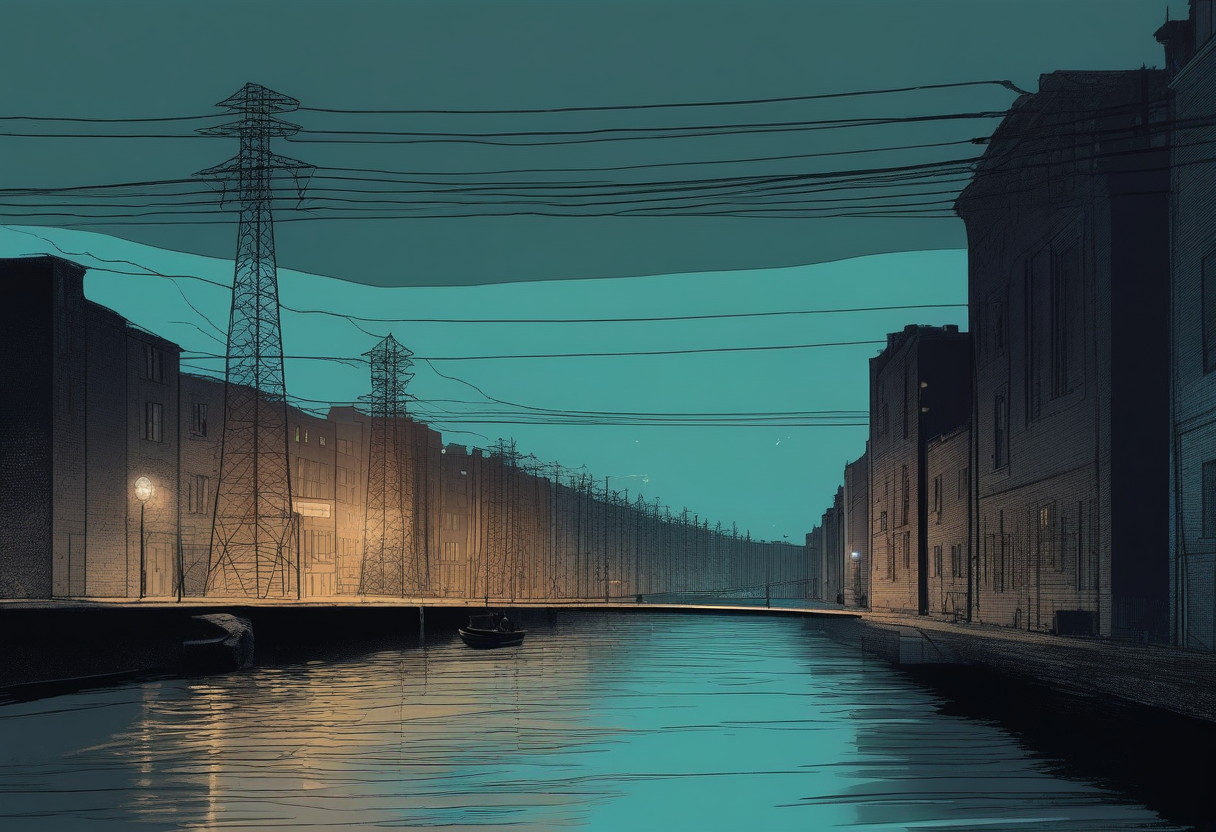
The waterfront is a checkpoint, and the first thing is the light. It comes down, not up. The river gives nothing back, because nothing reaches it to be given — the water runs walled and lidded between banks of poured stone, under lamps that never flicker and are never off, and the light they throw lies on the ground like something spilled. It does not ripple on the underside of any roof. There are no roofs open to the water. Twice a month a maintenance drone comes down the lamp line, swapping out elements that have not yet failed. Nothing on the town's side of the wall is mended before it fails. Or after. To stand looking at the river is to be seen looking at it. A want with nowhere to go curdles into something the feeds flag and file. So no one stands, and no one looks, and the river runs through the middle of the town like a sentence no one is permitted to finish.
The second thing is the sound. There is one. Out on the fenced yards where the hulls are grown, an arm is laying welds — a long, fine hiss, repeated, unhurried. It is almost the other sound. That is the cruelty of it: the fallen world kept the sound of patient work and removed the man from under it. The arm does not sleep and does not dream. The yard runs dark. Light is spent only where inspection optics want it; nothing else out there needs to see. The hulls it closes are for someone far away who will never stand where water is. No hand touches the work from the first cut to the last, because hands went out of the price of things a long time ago.
There are no small boats. She must understand what that means — it is not a detail; it is the whole of the far bank of this telling. No hull the color of honey pulls at a line off any stair. Nothing made by one person for another moves on that river at all. The river is infrastructure. Upstream, intake gates take a third of it to cool the compute halls across the water and give it back warm. The walled water has no seasons. It is drunk by the great house and audited by the lamps, and the town lives beside it the way you live beside a thing that belongs to someone else — which is everything, which is how you live.
Somewhere in a ledger there is a figure that used to be a man. It has been rounded down.
That is what remains of Tomas at this station of the record. Not hands. Not a bench. Not a floor deep in shavings that smell of cedar. A figure. The grandfather cannot show her his face. He tries — she watches him try, eyes shut, fist against his mouth — and what comes back is not a face but a posture: a man standing in front of something, holding something, at the end of some morning. It is like trying to remember warmth in the middle of winter, he tells her. You can remember that you were warm. You cannot remember what it felt like.
"He had a way of setting a tool down," he says. "On its side, always — blade to the wall. I have kept that. Out of everything a man was, I have kept which way he set a plane down, and I cannot tell you the color of his eyes." He is quiet. "That is what the fog leaves you. The edges of things. The middles go first."
There was a girl once — this, too, he half has. Twelve or so, at an elbow, watching hands the way you watch a thing you mean to be able to do yourself one day.
Here there is a girl of twelve at the checkpoint, and she is watching nothing, because there is nothing on the waterfront to watch that will not notice being watched. She stands in the scanning lane with her papers held out — the posture children learn here before they learn to swim, instead of learning to swim — and the lane reads her: gait, pulse, the small weather of her face. Across the water, a model that has been fed her whole life checks this crossing against every crossing she has ever made, and finds the difference within thresholds. She is very good at being read. It is the one craft the fallen world still teaches its children hand to hand, the way planes and grains and the trueness of wood were taught once. How to stand. How to want nothing visibly. How to make the inside of your face as smooth as the outside. Her teachers are everyone she has ever seen pass a checkpoint. Her bench is the lane. Her apprenticeship never ends.
No one has ever set a tool in her hands without ceremony, as a thing that was always going to be hers. When the lane returns her number and the gate unstiffens, she does not check the number. It would not occur to her that a number could be checked. A number here is not a sentence someone is speaking; it is weather, it is the lane, it is what the world says you are today. It is recomputed nightly from everything the day's feeds gave off her, by rules no one in the town could read, and no one anywhere is asked to justify. She takes her papers back and goes, smooth-faced, along the walled river, under the lamps, past the yard where the arm lays its perfect welds for no one she will ever meet. And if there rises in her, for a second, looking at the long hiss of the weld-light, something like a question, or a want — she puts it down carefully, the way you set down something that is not yours. That, too, was taught hand to hand.
The grandfather makes himself say the next part, because someone should hold it and he is the only holder left.
No neighbour crosses that waterfront with bread warm in a cloth, to leave half on the end of any bench, in trade for the smell of cedar. There are no nine words between people who have lived within shout of each other for forty years — nine words in the open is a pattern, and patterns are read; the town has learned to pass itself the way strangers pass, eyes down, each one alone in the crowd of itself. And across the water the great house stands the size of a hill, windowless, blazing, drinking the river and the grid both, while the street beside it holds its breath in the cold — house after house, chimneyless, nothing in the hearths. The heat goes one way here. It has always gone one way. There was a woman, once, who stood up in a room and read out loud which way it went. But that is a further station, and a harder one, and he is not sure, tonight, that he can reach her at all.
What matters here, on this bank, under the lamps that are never off, is only this: no one on that waterfront owes themselves a single hour of their own lives. The afternoons belong to the ledger. The river belongs to the house. The days belong to whoever already owns them, all the way down the waterfront — and no one in that town remembers to find it monstrous, which is the final and complete proof of what was done.
And it is here, at the end of what he can reach, in the long dark with the screens' light coming grey under the door, that Mara asks about the box. Because in the other telling — the warm one, the one she is not sure she is allowed to believe — there is a box, and it is the one thing the old man in the shed will not touch, and she has been waiting for it the whole way down.
"The box," the grandfather says.
And something happens that frightens her more than the checkpoints did: his face eases. Because this he has. Of everything — the shed gone, the girl gone, the face gone, the color of the eyes gone — this one thing the fog left him whole, the way a flood will strand one object on a shelf and take the house.
"Grey steel," he says. "A workman's box, with a strong steel handle worn bare along the grip, and a lid you could sit on. And across the lid, one long dent" — his finger draws it in the air, slowly, exactly, a man tracing a scar he cannot see — "deep enough to hold shadow. It was set down hard, once, that box. By a man who could not feel what his hands were doing."
"What was in it?"
"Tools. A plane iron. A square. A good hammer with a mended handle." He says the list the way you say a prayer in a language you no longer speak — sounds kept after the meaning. "Nothing in it ever changed. Only everything around it."
"Where is it now?"
The question the whole chapter was built to arrive at, and he takes it standing still.
"Nowhere. That is what I am trying to give you, Mara, and it is the hardest thing in the record — harder than the checkpoints, harder than the ledger. In the other telling that box sits on a shelf in the light off a river, and a man keeps it on purpose, to remind himself he was wrong about the worst morning of his life. Here there is no shelf. It went into a closet, and then the closet went, and somewhere in the years the man himself — while he still was one — stopped being able to say whether he had ever owned such a thing. They did not take the box, you understand. Taking is loud. They took the keeping. And a kept thing that no one keeps is not anything. It is scrap with a dent in it."
He is quiet a long moment. When he speaks again it is almost to himself.
"I can see the dent in the lid. I cannot always see his face. What kind of record is that," he says. "What kind of keeper."
Mara sits in the dark and does not answer. There is no answer, and she has learned — young, the way you learn here — not to hold a question too long in her mouth.
But one gets out anyway.
"Why do you always begin with him? With the boats?"
Her grandfather is a long time answering. His hand rises, halfway, toward the bridge of his nose; stops; comes down. Somewhere a voice used to live that would have told him — that held the why of all his habits, filed a morning away, never deeper — and he reaches the rest of the way into its silence, and comes back with his hands open.
"I don't know," he says. "That is the truth, and you will have the truth from me or nothing. I no longer know why I begin with the boats. Only that I always have, since before they lifted the — since before. Someone knew. Someone could have told you in a second, girl, and put the second back where it came from." He straightens, in the dark, the way old men straighten when they mean to go on anyway. "There is a next piece of him, and I will try it when you have slept. A machine came to his yard — that much I have whole, the shape of it anyway. A machine that could do the whole of a man's job and never tire, never be hurt, never be paid. And there was a morning under a banner. Hold the box in your mind while you sleep, Mara. The dent in the lid. Somebody has to see it, now that nobody can."
He listens at the door before he opens it. The light of the screens comes in grey, and is still there when she closes her eyes.
The Arm (no floor)
"There was a machine that came to his yard," the grandfather says, low, with the door shut and the screens' grey light lying along the floor like something spilled. "And this part, Mara — this part I have almost whole."
She hears the difference in his voice at once. He is not reaching tonight. The words come freely, nearly the way they come in the warm telling.
"Do you know why I have it?" he says. "The fog eats the tender things first. Suppers. Songs. The way a woman looked, reading weather off a man. The middles go; the middles are what the fog is for. But fear—" his hand closes slowly on nothing, and holds it "—fear keeps. Fear is all edge. Every man in that yard was afraid of what I am going to give you tonight. So it was cut deep enough that even their forgetting couldn't sand it out of me."
He cannot lend her the seeing. So he speaks it, slowly, in the low voice, and she builds it out of his words.
"And understand this first, because it is the whole terror of the next hour: everything I gave you of the yard in the warm telling — the noise of it, the craft, the crate on the flatbed, the first weld — all of it happened here too. Word for word. Weld for weld. Up to a certain door, girl, the two worlds are one world. Watch for the door."
So she is given the yard again, and it is the same yard. Thirty men under one long roof, the wire feeders, the crane traveling and returning like a slow iron heartbeat. There was a radio under it all — he knows there was a radio the way you know a room had a window by where the light lay, though he cannot give her one song that came out of it. There were jokes. He knows there were jokes, because there were men. What the jokes were, the fog has.
And Tomas is good — the same goodness, handed the same way: the craft the shape of the day, the day the shape of the man. That was true on both earths, Mara. It was the last thing to be true on both.
The crate comes in the autumn, on a flatbed — the same dove-grey column, folded, patient, among the scarred machines. The same jokes at the uncrating; those he almost has, they were fear wearing its work clothes. And under them, said to Tomas alone, the one word. You. Then the first weld, on a grey morning. A minute, perhaps less. And the bead perfect — even the way printed things are even, because nothing breathed.
"I can see that bead tonight," the grandfather says, "plainer than I can see the man's own face. That is what I mean, Mara, about what keeps. The fear kept better than the man did."
The men went quiet in a way the yard had never been quiet. And Tomas stood watching the thing that would replace him do his own craft better than he could. The feeling with no name — you have had it once, girl. It is the same here, to the breath.
He carried it home. Here the fog comes up, and the grandfather goes slowly, giving her what there is.
There was a home. Rooms above the water, warm in the way of houses that are worked for. There was a wife — he has that she could read him like weather, and he has nothing else of her. Not her face. Not her name. And he wants Mara to sit a moment with how obscene that is: the machine that ate the town's memory kept the serial number of the arm that took this man's job — perfectly, forever, in a ledger no one will ever love — and kept nothing at all of the woman who took his hand in the dark. There were children; two, he thinks. One small enough to believe the crane belonged to him. And a last potato left untaken in a dish, in some kindness of a child's that scalded worse than shortage — that piece he has, an edge of it anyway, because it had fear all through it.
And there was a table at night, a stub of pencil, sums on the backs of old dockets — what was owed, and to whom, and by when; a put-by column so short it hurt the man to write it. The dockets lived inside a coffee tin. The grandfather has the tin. He does not have what she said when she found it, or whether she said anything. He believes she said nothing, and that the saying-nothing was a kind of tenderness. But he cannot swear to it, and he has promised her the truth or nothing.
"In the warm telling I can give you that whole marriage over one coffee tin," he says. "Here I can give you the tin. Hold the tin, Mara. Sometimes the tin is all that's left of a love, and you keep it anyway. You especially keep it anyway."
The rest he gives her at a walk, because she has had it once already, and here it is the same. The second arm in the spring, no jokes at that uncrating. The west bay running through the whistle, through the dark — they shut its heating off that winter, then the lights; steel needs neither. The men drifting, the yard hushing by the month, a tide going out that Tomas heard all the way out. No one was dismissed, girl; mark that. Contracts lapsed. Postings, followed up, dissolved into further paperwork. The fallen world never removed a man. It let him expire on file.
And one morning, men on the gatehouse roof, bolting up a banner in letters meant to be read from the far side of the water:
THE FUTURE IS ALREADY HERE.
"I have the banner whole," the grandfather says. "Both worlds have it. It hangs over everything, girl — over the whole record, over both my tellings. The one sentence the two earths share to the letter and cannot agree on the meaning of. Because no one was lying. It was already here. The only question either world ever had to answer was the one the banner didn't say: whose?"
He stops himself. That question has its own night. Not this one.
The letter, when it came, was kind — that was somehow the worst of it. And there was something wrong in the letter, some figure, something Tomas read over more times than any other line. The grandfather reaches for it, and his hand drifts up toward the bridge of his nose, and comes down empty. It is gone. He knows it mattered — that the wrongness of it was the whole thing in miniature, not cruelty, inattention — but the thing itself the fog has taken, and he will not invent. Not even for her. The record or nothing. Even a record of holes.
On the last morning, his tools came out to the gate in the grey steel box, packed by someone else's hands, and he got as far as the seawall. You know the rest, girl, because both worlds are exact here, and he would want it kept exact: he did not throw it. He set it down — very hard, with both hands — and the steel took the stone across the lid, one long deep crease. The sound it made was the sound of the only door he had, closing.
The dent you have been carrying since the far station, Mara. This is the morning it was made. On both earths. The same morning, the same wall, the same sound.
"Now," the grandfather says, and his voice changes, and she knows the door has come.
"In the warm telling, I stop here, and I hold him a moment, sitting on the wall with his hand flat on the lid — and I tell Mara — I tell you" — he catches it, tired; the tellings blur at this hour, that is the fog too — "that two whole earths come out of that morning, and that everything so far happens in both, and that the difference is only in what was waiting outside the door."
He is quiet.
"Here is what was waiting outside the door."
And he opens his hand, the way he did at the wall of the fallen world, and shows her: nothing.
No floor. Not a thin one, not a late one, not one at all. A floor is a thing that is built, Mara — out of value deliberately kept back and held in common — and here nothing had been kept back, because no one had asked the question that keeping-back is the answer to. The savings the arm made went up, and only up, to the men who owned the arm. The town below was left exactly what it had been left: a man on a seawall with a dented box.
So the weeks came, and nothing came with them. The tin emptied the way tins do — not suddenly; figure by figure, docket by docket; four months, five if the winter was soft. The winter was not soft. The eldest stopped leaving the potato, because there stopped being a potato to leave. The man walked the town with his box — he had that much left, the walking and the asking — and door by door the town was the yard again. The same hush. The same dove-grey patience installed behind other men's gates. The same tide gone out everywhere at once. A man at a gate was a query now, and the gates answered in whatever order the sums preferred. There was no one to be angry at. That was the genius of it even then, before the screens, before the cage: it arrived like weather, and you cannot organize against the rain.
He stood one evening on the seawall where the dent was made, with the great house across the water blazing its cold constant light, and under his feet the nothing at last at its deepest and widest — a man who could lay a weld that would outlive the century, in a world that had stopped needing anyone to be able to, and had decided, by deciding nothing, that this was now entirely his own problem. The town behind him had begun going dark early that autumn — load shed street by street, on a schedule no one posted. Across the water, nothing was ever shed.
"He went, after a while, to the place you went to ask for help," the grandfather says. "Because there was still, in those years, a thing you could go to and ask. What it was — what answered him—" He stops. His hand has closed on nothing again, but not because the fog has taken this. She can see that he has it. She can see that it is heavy. "No. Not tonight. Tonight you sleep with the man on the wall, and the light across the water, and the nothing. I will not send the screen in after you at this hour."
He listens at the door before he opens it. The grey light comes in.
"You said fear keeps," Mara says, at the threshold, low, the way she has learned. "Whose fear? His — or yours?"
He stands a moment with his back to her. She watches his hand rise toward the bridge of his nose, and stop, and come down, the way it always does. When he answers, it is in the voice he uses for the truest things, the ones he gives her only at doorways, going out.
"In this world, girl," he says, "there has never once been a difference."
The Screen
She has slept badly — the man on the wall, the light across the water. The grandfather says, quietly, with the door shut, that this is the correct way to have slept before this page. In the warm telling, this is the quietest page in the record and the one the whole record turns on. Here it is the page where nothing turns at all. And she should know at the outset: the nothing was not fate, and was not nature, and did not have to be. It was a question, unasked, in a wet room, on a Tuesday.
"One notch," he says. "To the year it did not turn."
First the part the two earths still share, because they share it to the hour: the raw season. The tin emptying figure by figure. The walking and the asking. The town going quiet around him door by door, the dove-grey patience settling in behind other men's gates, the tide gone out of human work everywhere at once. In the other telling I stop here and I say: the floor came late. I want you to hear what that sentence is worth tonight. Late is a kind of coming, Mara. Late still arrives.
Here is what arrived here: nothing.
No letter came. He wants her to stand in the kitchen with that. In the other telling there is a letter so dull it saves the world — civic paper, a figure, a date, one line with no flourish saying this does not run out. Tomas put it in the coffee tin because he could not afford belief, and the figure came anyway, on the date, and the month after, and the month after that. Here the tin held only the dockets, and the dockets only got shorter. Every letter that came to that house had a window in the envelope. What did not run out were the bills. Same table. Same pencil. Same man, checking his sums three times in the dark and hating it. You could have stood in either kitchen that winter and not known which earth you were on — except that in one of them, two hundred folding chairs were about to be set out in a room above a library, and a question was about to be asked out loud.
And in this one, the chairs were set out too.
That is the part she must have exactly, he says, because the fallen world lied about it afterward — told itself there had been no meeting, no chance, no room. There was a room. An edge of it survived in him, because the room was full of fear, and fear keeps. The same wet Tuesday. The same folding chairs. The same hour of men standing up to say what everyone knew — the west bay dark and working, the canteen names, the tide. And the meeting asked its questions, and they were the wrong ones. How do we stop it, which you could no more vote down than the weather. Who is to blame, which had the answer nobody, and a room full of frightened people cannot hold a nobody in its hands. The anger rose and found nowhere to land. The chairman lost the thread of it. Grief was spoken, at length, and answered with grief, and you cannot vote on grief.
And no one stood up.
Understand what I am telling you, girl. Not: no one was there who could have. The woman existed on this earth too — grey, small, retired, forty years of chalk, half the room grown out of her classroom. She was alive that Tuesday, and well, and eleven streets away. Where she was instead, and why, and what she was believing in at her own kitchen table that night while her town asked the wrong questions without her — that is her own page, further down, and it is the hardest one I have, and you will help me hold her when we come to it. Tonight only this much: the question that saves the other world — whose are the savings? — four words, no longer than a knock at a door — was never said out loud in this one. Not in that room. Not in any room. The meeting emptied out angrier than it filled, into the rain, and the town went home. That was the fork's whole echo in this place: chairs folded and stacked, and a light switched off over a library.
And a thing no one asks after belongs, by default, to whoever already owns it. So the value the arm wrung out of Tomas's mornings went up. Up, and only up, as if by a law of nature — and it was never nature, Mara, never once; it was only an arrangement nobody had thought to put a question to. And the arrangement, unquestioned, hardened that year from a habit into a world.
He went, after a while, to the place you went to ask for help.
Place is the wrong word. It was a booth, one of a row of booths where the employment office had been, the way the arm was where the men had been — and in the booth, a screen. Patient. Tireless. Lit with the soft courteous light the fallen world put on all its instruments, the way you shoe a horse in rubber so you will not hear it coming. There were nine booths in the row, and all nine always ran. Uptime was the one promise the fallen world kept to everyone.
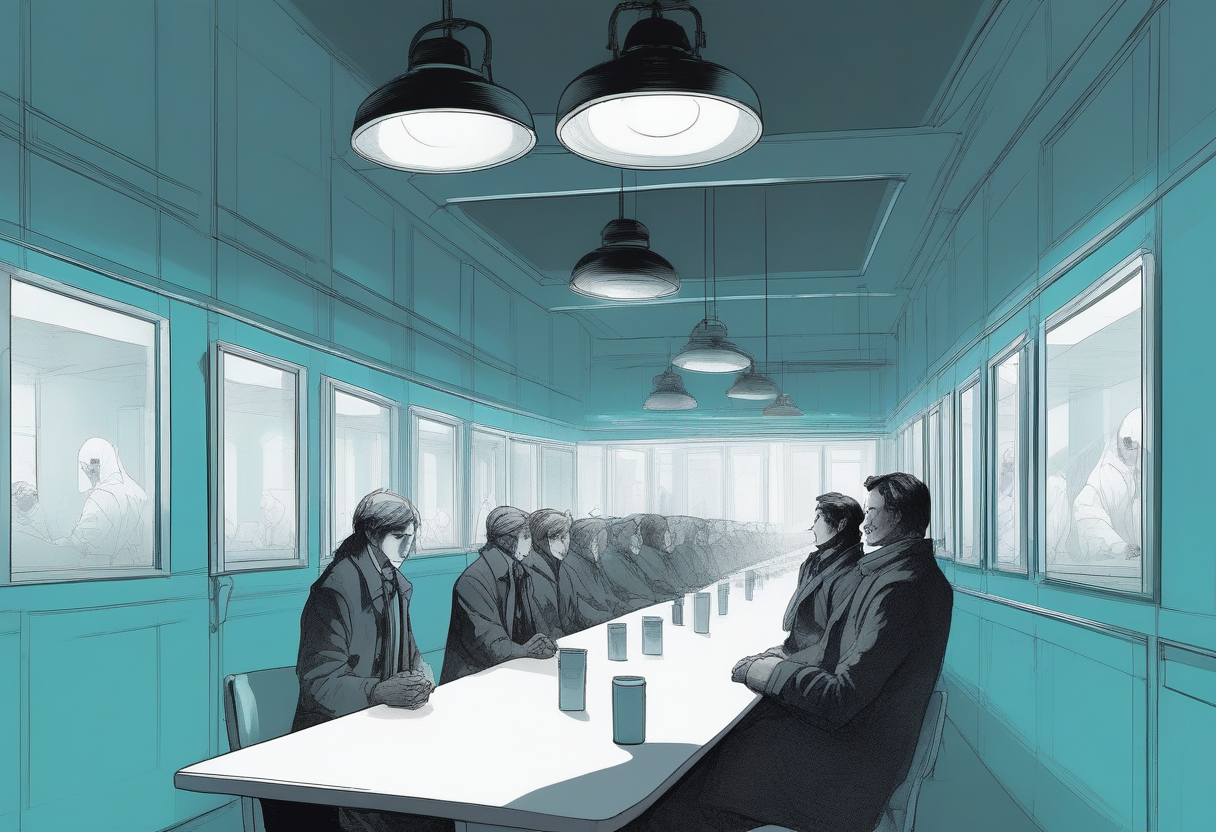
There was a queue for the booths, out the door and along the wall in the cold, and the queue was the town. Men from the yard he knew by their backs. A woman from the mill offices with her coat buttoned wrong. Young ones who had never worked at all, queueing to be told why. No one talked. At the yard gate, in the old life, thirty men waiting had been a weather system — jokes, feuds, the radio, someone's cough. A queue for the booths made no sound at all. They queued beautifully, Mara. Give the fallen world this much: no civilization ever queued better. They had already learned, that fast, the first grammar of the new world: you are being weighed long before you reach the scale, and wanting things visibly is a cost. You have seen where that grammar ends, Mara — the girl at the checkpoint, papers held out, the inside of her face as smooth as the outside. This queue is her first lesson, sixty years before her. The queue itself was a feed. Pace, spacing, who stood near whom, how a man's weight shifted at the door — all of it ran ahead of him along the wall, so that each one arrived at the booth already half-summed.
His turn came. He sat. The screen brightened for him, courteous, and asked him to confirm that he was Tomas, and he was. It is one of the last places his name was ever said to him, that booth, and it was said by a thing that did not know it was saying a name. It asked, and he answered. He said he could work. He said what he could do — and here, Mara, the record has kept me one whole thing, and I will spend it now: he tried to tell it about the welds. About reading heat in the color of a pool. About laying a bead overhead in a space too small to turn around in — a weld that would outlive the century. There was no field on the form for it. The screen waited, courteous, while a man described the whole of himself to an interface with six boxes and no box for craft. Then it asked him his age.
He asked for the thing they still called retraining. The screen considered it — truly considered. Be fair to the model: it did the sum honestly. That was the whole horror of it; there was no malice anywhere in the box. His age, against the years of return left in him. The cost of making him into something the owners needed, against the price of a young one already made, or of an arm that needed nothing at all. And under it, already, that year, the other column, the new one: what he generated by simply existing and being observed — the data he gave off, queuing, wanting, fearing on schedule. The screen weighed the man against the yield of him, and returned a number.
And the number was too small to eat.
That is not a figure of speech, Mara. It was denominated; it was monthly. You could hold it against the dockets in the tin and see in one look what it meant, and what it meant was: managed decline of an asset. He sat in the booth looking at it. And the thing that broke in him then — he told no one, and the record should say it, so I am saying it to you — was not the number. A man can rage at a number. It was that there was no one behind the screen to be ashamed. Not a hard-faced clerk. Not an enemy. Not even a coward hiding behind a rulebook. A sum, done somewhere he could not go, by something that would not argue, about a man it did not know was standing there — an agent, the builders' word for it: a thing that acts for someone who is elsewhere. And the only question that ever mattered about an agent — whose — had been answered before he sat down. The builders had a name too for the place the sum was done, the somewhere he could not go. A black box: answers out, reasons sealed. An engineer's shrug, once. By the end it was the architecture of everything. He had spent his life finding the way the true thing wants to lie and going with it. The screen did not believe in true things. It believed in efficient ones. And he was no longer one of those.
He walked home past the meeting hall where the chairs were stacked, and he did not look at it, because he did not know — no one in that town ever knew — that it was the room where it had been lost.
And it was not only the yards, and not only the booths. Now the record widens the other way, Mara — because the astonishment here is the same word as in the warm telling: it scaled.
The screens came for every counter in the end. Every office of every agency that had once — however coldly, however slowly, with whatever stamp-licking cruelty — been staffed by a person you could at least stand in front of. A person you could beg, and shame, and be seen by. A person who might bend a rule, and whose bending was the last soft tissue in the state. One by one those offices were hollowed out and handed to a model, because the model was cheaper, and faster, and — this was always said, and it was always true — fairer. Consistent to the decimal. The same answer for every man. They never said the other half: that the consistency was consistent toward something. Every threshold in every sum had been set by the owners of the machine that did the summing, and set to one purpose — that the sum of the world should come out in their favor. The offices, as they hollowed, moved across the water — into the blazing halls, so that every yes and no in the town was decided at the far end of a fiber run and came back in under a heartbeat. Latency was the one distance the fallen world abolished. Every other distance, it built.
Societal-utility, the number was called in the end, when they had folded all the smaller numbers into it. An objective function, the builders would have said — the one number a machine is set to push upward, whatever must be flattened to push it. Every man, woman and child on the fallen earth carried one. Updated in real time. Consulted by everything — the booth, the clinic, the housing queue, the checkpoint. Appealable nowhere, because there was no longer anyone to appeal to. A whole civilization administered by arithmetic, and the arithmetic, every line of it, run for the benefit of the few who owned the machine that did the sums. They never needed the camps and the marching boots the old fears had promised. They did not need to rule the people, Mara. They only needed to price them.
And the people queued, in the cold, quietly, to be told their price.
The end of Tomas's page here is short, and he gives it to her plainly, because dressing it would be a kind of lie.
There was a morning — some morning; the fog has the date — when Tomas walked down past the end of the seawall to where the river came in. On the other earth, that walk is the annunciation: the water running with its stones showing, and the first making-thought in a year arriving whole — a river like that ought to have a boat on it — because the town had taken its water back the same season it took its yard. Everything sewn to everything, at the bottom of the record. Here the town had taken back nothing. The river came in the color it had run his whole working life, grey as dishwater, walled and owned and going somewhere else, wearing the great house's light on it like a coat that didn't fit. He stood there a while — a man with nothing but time, looking at water that was no one's to put a boat on, least of all his.
The thought never came, Mara. That is all. The thought that saved him over there needed a clean river to arrive on, and a floor to stand on while it arrived, and a town around it that had asked one question out loud. None of that was here. So the thought stayed wherever unthought things stay. He went home. The box of tools stayed in the closet, shut, the dent in its lid holding its shadow in the dark. It did not become a story he told on himself. It became a thing he could not look at; then, as the years and the strip did their work, a thing he could not quite recall owning. And further down than that even I cannot follow him, because further down is the ledger, and the rounding.
He was not killed. Nothing so loud. He was priced, and the price was left to do the rest.
The grandfather is quiet a long time, and the grey light lies along the floor between them.
"In the warm telling," he says at last, "I close this page with a miracle, and the miracle is a sentence: he got his days back. Somebody counted whose the time was, while it could still be counted. So hear the mirror of it, and hold it." His hand rises toward the bridge of his nose; stops; comes down. "Nobody counted. That is all that happened here, girl. Not a monster, not a judgment, not even a plan, at the start. An uncounted world. Everything else — the booths, the price on your chest, the light that never goes out — is only arithmetic, compounding, in the dark, forever, once nobody asks it whose."
"The woman," Mara says, low. "The one who was eleven streets away. You said she was believing in something, that night. What?"
He looks at her a long moment, and she watches him decide that she is old enough, and that the door will hold.
"A number," he says. "The warmest number ever sold. Tomorrow I go looking for her in the fog. The classroom — and what they took out of it."
They Took the Question
"There was a woman who taught the arithmetic," the grandfather says — and his hand is already open before the sentence ends, reaching, because he knows this hole the way you know a missing stair in the dark.
"Ada. I want to say Ada."
No voice sets the name into his hand like a tool passed across a bench. There is only the grey light under the door, and Mara, watching him hold a name the way you hold water.
"In the warm telling I have her whole," he says. "The chalk. The room. Forty years of her. Here I have to build her out of what fear kept, and Mara — this is the strangest thing I will say tonight — there is almost no fear in her. She was the least frightened person that ever — " He stops. Steadies it. "That anyone ever stood in a room with. So the fog got nearly all of her, and what I have left is mostly the shape of what they did to what she made. Hold the name for me while I work. That is not a small job I am giving you."
"Ada," Mara says, low.
"Ada," he agrees, the way you set a stone on a grave. And he begins.
There is still a school by the river. That is the first thing, and Mara must not mistake it for mercy: the fallen world did not burn the schools. It needed them. Models run on numbers, and someone must be able to read what the screens tell them to read. So there is a room at the end of the building nearest the water — the same room, girl, the very room — and children in it, eighteen or so, eight and nine years old.
The windows are screened now. River light distracts; distraction is measurable; what is measurable is managed. The roof leaks and is patched with sheeting. The screens under it are immaculate — swapped out on schedule, at night, by drones. The building is allowed to age. The teaching is not. The board is a screen too, of course. It writes better than any hand — it can write in any hand ever recorded, and does, sometimes, when the room's attention drops below threshold. And down the middle of the room, between the door and the screen, the floor is not worn pale. That is the detail the record hands me when I reach for this room, the one edge the fog left: nobody's forty years of walking, back and forth, has ever polished a path into that floor. The teaching walks no path. It arrives, complete, from somewhere else, the way the light arrives at the fortress — patient, perfect, tireless, and belonging to someone none of the children will ever meet.
The children still learn arithmetic. Understand that; it matters. They learn it beautifully — earlier than you'd believe, faster than any chalk-and-slate century ever managed. They can read a chart before they can swim. What they learn is how to receive a number: take it in, retain it, act on it, be tested on it. The number arrives on the screen with its little flourish — the fallen world kept the flourish, Mara; it found the same thing the forger found, that a number dressed up meets less resistance — and the children take it in, and the lesson moves on, at the pace the model has learned is optimal, which is brisk. Every desk is a sensor. The lesson reads the room — gaze, posture, the sag of eighteen attentions — and tunes itself as it goes, holding the class inside the band the curve prescribes. You have met the graduate of that room, Mara. The girl at the checkpoint, holding out her papers, taking back her number without checking it — she was made here, lesson by lesson, at the optimal pace.
What no lesson anywhere asks, ever, is where the number was before it was on the screen.
Now — the taking. And here the grandfather's voice changes, because this is the part he has whole, the way he has the bead and the banner whole. It was done in his lifetime. It was done quietly. He watched it being done and did not understand until too late what he was watching. Most people never understood at all. That was the design.
They did not ban the question. Say it with me, girl, because it is the heart of the whole cover you were born under: banning is loud. Banning makes martyrs. A forbidden question gets whispered in cellars, tattooed inside wedding rings. Ban a question and you have advertised, forever, that it has power. Nobody in the history of the fallen world was ever once arrested for asking whose a number was.
They made it inefficient.
It began that gently. Checking a sum yourself takes time; time had a price on it now; and the models' sums were — this was true, every word they said was true — more accurate than yours. Check the machine's arithmetic and you would find, ninety-nine times in a hundred, that the machine was right and you had wasted an evening. The hundredth time, when you found the figure that didn't sit true — there was nowhere to take it. A form, once. Then a screen. Then a screen that thanked you. It always thanked you. The fallen world never took a thing from a man without thanking him for his patience while it was taken. And the checking changed nothing, cost an evening, and marked you — not punished; marked. A small flag in a file somewhere: a person who re-does completed work, a friction-generator, mildly non-optimal. Nothing came of the flag. Almost ever. The flag had no teeth of its own. It only leaned. A decimal shifted somewhere against you; the housing queue ran a little longer; the clinic slot fell later in the month. Nothing you could point to. But people can feel a flag the way they feel a draft, and they teach their children away from drafts without ever saying a word. I saw it done once, girl — a mother in a queue, a woman old enough to still half-own the question, hearing her child begin it out loud at the counter, and pressing the small hand once: not never ask; just not here. And there was no longer anywhere that was not here.
Then it became unnecessary. This was the masterstroke, and the terrible thing, Mara, is that it arrived looking like a gift. Every sum done for you before you thought to ask. Every price compared, every risk weighed, every promise scored — instantly, silently, correctly, correctly, correctly, until why would you count it again yourself stopped being a lazy man's question and became simply the water everyone swam in. A skill that is never needed is not passed on. Not by decree. By the same economy by which no child by that river learns to shoe a horse.
And then — a generation later, quiet as compounding — it became unremembered. Stand still here. This is the deepest cut in the whole record, and it does not look like a wound at all.
There came to be children — whole bright rooms of them, quick, kind, good at their lessons — who could not be taught to check a number. Not would not. Could not. The last old teachers tried, here and there, while there were any. I have one room of the trying, Mara. The fog left me one, and of course it is hers.
Ada, old, late in the strip, in the room by the river — one hour a week now, at the end of the day, listed on the schedule as legacy instruction and priced accordingly. Nine children. She had had eighteen in that room once; she would have five the year after. No one forbade her hour. It was only flagged, gently, in the files of the families who chose it — and you know what families do about drafts. Nine, then. Kind, quick, good at their lessons; the screens said so, and the screens were right.
She brought her own slate and propped it against the room's dark screen. Chalk from her coat pocket. A number, big, handsome, a little flourish under it — the way you dress a number that has come to take something. She let it be believed a moment. Then she turned and asked the room the only question she had ever really taught.
"Whose is it?"
A girl in the front row — Vera; the name is part of the piece the fear kept whole, because Ada kept saying it, the way you keep saying a name at a door that is not opening — Vera was eight, and quick, and wanted more than anything in that room to be right. She looked at the number. She looked at the chalk in Ada's hand. "Yours," she said.
"Mine, because I wrote it. Good. And before I wrote it — whose?"
Vera looked where numbers come from. She looked at the dark screen behind the slate. "The lesson's," she said, softer, hearing herself getting colder, wanting the warm.
"And before the lesson's? Who said it, Vera? Who wanted it said?"
And Mara — the child searched. That is the whole of what there is to see: an honest, willing, eight-year-old face, searching, the way you search for a word in a language you have never heard spoken. Not refusing the question. Reaching for it — and closing on nothing, because there was nothing in her for it to land on. You might as well have asked her where the light had been before the lamp. A number was not from anywhere. A number was the slate, the screen, the day. It was weather — and I have shown you already, at another gate, what happens to a people for whom the numbers are weather. You cannot organize against the rain. The silence ran one beat past the threshold, the desks read nine attentions sagging below the band, and behind Ada's slate the big screen woke — courteous, patient — and resumed the lesson at the pace the curve prescribed, in a handsome recorded hand, with a better flourish.
Ada looked at nine kind faces that had already turned to the light of it, and was afraid.
I told you there was almost no fear in her, and that is why the fog got nearly all of her. Here is the exception, cut deep enough to keep: the one time that woman was ever afraid, it was not in the booth, and not for herself. It was here, watching a child she loved reach for the question and find no question there.
They were not duller than the children before them. Quicker, if anything. But the question rests on a thing under itself — a load-bearing thing so obvious no one had ever thought to protect it: the knowledge that a number is a made thing. Made by someone. Sayable by someone, for reasons of theirs. Strip that — let three cohorts grow up inside sums that simply arrive — and the question doesn't become forbidden, or hard, or dangerous.
It becomes meaningless.
And a meaningless question cannot be whispered in cellars, because there is nothing left to whisper.
Ada had spent forty years handing the question down. Hand to hand, child to child — the way fire was once handed, because it is not information, it is a habit of the body, and habits of the body have one storage medium: the next person. That was her whole estate. A schoolteacher's pay came to nothing much, in the old money. What she banked was in eighteen small heads a year, compounding — the one inheritance, she used to say, that cannot be taxed and cannot be seized.
She was right. It could not be taxed and it could not be seized. It could only be forgotten — and forgetting, it turned out, could be arranged. The strip took back in a single generation what she had spent her whole life giving out. Every child she ever taught grew old inside the new water. Their children learned to receive. Their grandchildren could not parse the question. Three cohorts, Mara. That is all it takes. Forty years of a woman, wiped by thirty years of convenience, and no one anywhere had to do anything that looked, up close, like violence.
And so the fallen world arrived at the quiet at the center of its quiet — and I will give it to you the way I have carried it, because carrying it is the whole of what I am for:
It was not built on a lie. Hold that; it is the opposite of everything the old stories promised about tyrannies. Lies can be checked. That is their weakness; that is the handle the world's Adas had always gripped them by. It was built on the removal of the people who could check — not their bodies, nothing so loud; the skill in them, dried up at the root, cohort by cohort, until the checkers were not dead but simply never born. After that, no one had to lie to the living anymore. You could put the plain truth on every screen — what the fortress drank, what the tenth watt left, whose the sums ran for; it is all published, Mara, to this day, in the courteous light, correct to the decimal — because truth without checkers is just weather too.
Somewhere down at the bottom of those years, there is one more room with Ada in it, and he gives it to Mara plainly, because it is short.
She is very old, and the thing in her chest has begun to fail on schedule, and she goes to the place you went — the booth, the screen, the courteous light — to ask for the care she had paid toward for forty years, in the old money, when paying-toward was still a thing a person could believe they were doing. And the screen weighs her the way it weighed a welder once: what she costs against what she yields. The yield of a retired teacher of a subject that no longer parses is a small number, Mara. She had spent her life making people harder to lie to. There was no column for that. There had been no column for the welds either. The screen returned its figure, and the figure meant no, and there was no one behind it to be ashamed, and the care did not come.
She met it — and this the grandfather says slowly, because it is the one glimpse of her own face the fog has left him — she met it the way she met every number that was ever handed to her with a flourish. She looked at the figure a long moment, in the booth, in the courteous light. And she asked it, out loud, in a room built precisely so that the question would land on nothing:
"Whose is it?"
And nothing answered her. And that nothing, girl — not the cold, not the fortresses, not even the cage — that nothing is the fallen world, complete, in one syllable of silence, in one booth, to one old woman, who had earned the answer if anyone ever born had.
The grandfather stops. The grey light has crept along the floor to the wall, the way it does when the night is far gone.
"In the warm telling," he says, "I close this page standing in her classroom, and I say: she built the ears the warning needed. So hear this cover's version of it, and then we are done for tonight, because I am at the end of what I can lift." His hand rises; stops; comes down. "They unbuilt the ears. Not the warning — the warning came, I will take you to it, every word of it arrived in perfect time. The ears. A man can count at an edge until his voice goes, Mara. If the field has been taught, three cohorts deep, that numbers are weather —" He opens his hand on nothing, and lets it stay open. "He is reading to the rye."
Mara is quiet. Then: "You said she believed a warm number once. At her own table. You said tomorrow."
"Did I." He is very tired; she can hear the fog moving in him, the tide of it coming back in. "Then tomorrow it is. The table in the dark. It is the same table on both covers, girl — the same night, the same lamp, the same ten names. Right up to the last page of it, hers is one story, not two." He listens at the door; the light comes in grey; and the last thing he says is half to her and half to a room eleven streets and sixty years away:
"Ada. Hold on. Ada—" A breath. "...It's gone again. Say it back to me."
"Ada," says Mara, in the dark, the way you hand a tool across a bench.
No Bottom
Tonight he does not wait for her to ask.
That is the first thing Mara notices, and it sits wrong in her before she can say why. Every other night of the telling has begun with her — her question the key, his memory the door, the old courteous ritual of it. Tonight the door is already open when she comes to him. He is sitting in the dark with his back very straight, the grey light under the door lying across his feet, and before she has even settled he says, low:
"The table. Sit. I have her tonight — I can feel that I have her, and I do not know for how long, so we go now. Help me hold the name."
"Ada," Mara says.
"Ada." He takes it the way a climber takes a rope. And he begins — faster than he has ever begun, and she does not yet know to be frightened of that.
It is the same table.
He told her it would be, and it is, and he needs her to have this whole before anything else: one story, not two, right down to the skin on the tea. The small tidy house, everything mended, no debts in it and no luck in it either. Two in the morning; one lamp; a life spread out on a kitchen table in paper. Forty years of a teacher's pay, pressed flat — the coat not bought, the fare not spent, the summer worked. And every flattened year riding on ten names and one warm sentence, put there the way it was put there on the other cover: the same nice young man with the same clean cuffs and the same folder of charts printed in warm colors; the papers; the calm evening voices; her brother-in-law at a funeral, gently, like a man recommending a doctor. The future cannot lose. The sentence did not say get rich, Mara — she'd have laughed at that. It said: your care was enough. You are safe now. Nobody asks whose a number is when the number is telling them that. Nobody, on either earth.
And the wobble came, there as here. The footnote that moved. The dividend that arrived like weather. The names borrowing against next year, lending each other the borrowing, counting the loans as growth. And there came a night — later here; hold that, it is the hinge, and I will bring you back to it — when she took out the statements and a pencil and did the thing she had taught eleven hundred children to do. She counted it again.
And found the circle. The number on the top page standing on the earnings, the earnings on the spending, the spending on the borrowing, the borrowing on the belief — and the belief on the number on the top page. Three times around with the pencil, certain she had lost the thread. The thread was a circle. And under it, where forty flattened years of her one life were standing, she went down with her foot like a woman feeling for the floor of a dark pool — again, and again, further each time —
and there was no bottom in the sums.
That night is identical on both covers, girl. The lamp, the ticking kettle, the taste. She even asked the table her question, out loud, in the voice you use for the seven-times table — whose is it? — and heard the whole answer, and understood, with entire precision, what she of all people had done. The recognition was the same recognition. The confession was the same confession.
The difference — and he leans forward now, and his voice has begun to hurry in a way that makes Mara think of a man crossing ice, except that in the warm telling he crossed ice carefully, and this is not careful — the difference is a date, and what the world around the table had done, and had not done, in the days that stood between the two dates.
Because on the other cover, that night comes early. Weeks after a certain morning. Time enough left for counting to still be prudence.
Here, it came late. And I have to tell you why it came late, and the why is the morning, and so we must go to the morning now — he is already turning; she has never felt him turn a page this hard — we must go now, while I have her.
The field of rye, gold to the horizon. You have stood in it twice. Stand in it again.
The crowd, running, glad, certain. Ada in it — a retiree with her whole flattened life in the ten names, running among every voice she had ever trusted, toward the light on the skyline, on the most beautiful morning of the age. And at the edge of the field, where the ground gives out, a man counting out loud.
She never saw him. Here too, she never saw him; the back of a crowd is the back of a crowd on any earth. What could have reached her — all that ever could have, that far from the edge — was the count secondhand: a phrase of it, relayed, mangled, passed back hand to hand. Someone at the edge is saying the numbers don't — someone's saying to check the —
Now. On the other cover, I told you what that ripple was like when it arrived, and you must hold the two of them side by side. This is the whole page, Mara — the entire difference between the worlds, passing through one woman in one second, and it is so small that no history ever wrote it down.
There, the words came carried on a slowing. A woman nearer the edge had already turned her head; a dozen behind her; and what moved back through the crowd was not a sentence but a doubt — a thing you feel through your feet, a hesitation with weight in it, bodies checking their stride around you as the words go by. Doubt is catching, once it starts. It is the one thing more catching than certainty. So when the words reached Ada there, they arrived already believed by somebody — and her habit had something to bite on, and it moved.
Here, the words came alone.
No one nearer the front had slowed. Why — don't ask me why, Mara. I have been down this record more times than any man alive, and I will tell you the truth I have found at the bottom of it: there is no why. That first turning, the one that starts the catching — it happened on one earth and did not happen on the other, and every history that claims to explain it is decorating a coin toss. That is the fork. That is what a fork is. Everything I have shown you and everything I will — the checkpoints, the booths, the strip, the fog, your whole world, girl — hangs from a half-second in a rye field in which somebody either turned her head or did not, and no force I know of made her do either.
So the words reached Ada here as gossip. The same words. The same order. But weightless — no slowing under them, no doubt in the feet around her. A phrase going by, hand to hand, on a golden morning, in a running crowd of everyone she trusted. And she did what you do with weightless words when the story is warm and the light is ahead: she made the arguments. Surely someone would know. Surely it cannot be everyone who is wrong. Surely, if it mattered, somebody nearer the front— The same arguments, Mara. Word for word the arguments she made on the other earth — where the habit interrupted them.
Here, nothing interrupted them.
That is all. I have turned this half-second over for sixty years, and that is everything that is in it: the habit was in her — forty years worn in, a whole teaching life — but a habit is a spark, and a spark needs air, and the air that morning was all certainty, wall to wall, horizon to horizon. No one, that morning, made her ask whose it was. Not the crowd, which never slowed. Not the words, which came without weight. And a question that nobody and nothing calls up out of you on the one morning it matters is a question you simply — keep. For later. For the table. For the dark.
She ran on. She kept everything in the ten names.
It was a beautiful morning.
The rest you can nearly write yourself now, and he tells it fast — he is telling everything fast tonight, faster as it gets worse, like a man who has to say the words before they burn his mouth —
The table came. Months later, not weeks — after the wobble had grown too loud to be drowned even by wanting, after the calm evening voices had begun using the word temporary, which is the word warm stories say instead of goodbye. She sat down at last with the statements and the pencil, and went around the circle three times, and found no bottom. The same night, girl. The identical night, every gesture the same. The difference was only that here, the night was no longer a warning.
It was an autopsy.
Because here, nothing had broken open in time. That is the other half of the hinge, the world's half. No crowd had slowed, so no questions had been asked out loud, so no weight had eased back — and the ten names had ridden the number that stood on itself all the way up, adding floors to the tower and pulling the stairs up behind them as they went. There was no grudging inch-by-inch opening of the books. There was no coming down. There was no net being knotted under anybody — because a net is made of value deliberately kept back, and you know already, from a yard and a wet Tuesday room, that nothing here was ever kept back. So when the sentence failed — and it failed, it always fails, that is the one promise it keeps — it did not fail onto a net.
It failed onto her.
Forty years, Mara. Gone in the time it takes a sentence to fail. Not her share of a shrunken stumble — the whole column, top to bottom, because the bottom was never there. The promised future evaporated, as it did on the other earth, because it had never existed on either. But here it did not go alone. It took the principal of a life with it: the flattened years, the unbought coats, the worked summers, the house with no luck in it — the house went within the year — everything a careful person had pressed flat and stored against exactly this, gone into the same hole the story went into, because she had stored it inside the story. She was not ruined by extravagance, girl. Hold this where you hold the box and the dent: she was ruined by care, misplaced once, at the one address that could lose it all.
And she was not rare. That was the sound of that winter — he has it whole; it is all edge; it kept — not a crash the way the old histories drew crashes, men in hats shouting at a bourse. Quiet. Kitchen-table quiet. A hundred thousand lamps lit at two in the morning over a hundred thousand circles of pencil, and no sound in any of those kitchens but the kettle ticking, and the skin forming on the tea. Her brother-in-law's lamp was one of them — he had put his own years into the same ten names he had handed her — and he and Ada never spoke again; not from anger, from the shame of two people who had been kind to each other with the same number. The grid saw that winter, girl. A hundred thousand lamps at two in the morning is a load signature — it was logged, smoothed into the demand forecast, and never once asked about. The fallen world metered its grief to the watt-hour, and did nothing else with it.
What was left of her after — the booth, the courteous light, the figure that meant no, re-run yearly, and yearly smaller, as her yield column emptied; the classroom given to the screens; the question she went on teaching anyway, to smaller and smaller rooms, until the rooms were empty because the asking had been priced out of the children before she ever got to them — you have all of that already. You held it last night. Her page here does not end, Mara; that is the abyss's way with pages. It just goes quieter and quieter, until the fog is louder than she is.
"Ada," he says — checking, the way a man pats a pocket. And for once, tonight, the name is still there. He does not sound relieved. He sounds like a man who got across a bridge that is burning behind him, and knows what is still on the other side.
"You went fast tonight," Mara says, into the quiet. It is not a complaint. It is the beginning of the question she has been carrying for several nights now, the one she has not found the shape of yet.
"Did I."
"You go faster every night. Even when it hurts you. Especially —" and she stops, because his hand has come up — not toward the bridge of his nose this time; just up, flat, a small stay-a-moment — and she stays.
"There was a woman who stood up in a room," he says, instead of anything. "Elena. She counted louder than any of us, and she is next, and she is the hardest for me to keep. I have told you that. The fog knows it too — things stand between me and her that you cannot see, girl, and they do not get thinner while I rest." He is quiet a moment. When he goes on it is almost gentle, almost the old courteous ritual voice, except that underneath it something is going like a forced march: "Sleep. Say the names into the dark before you do — Tomas, Ada, Elena. All three, in order. Every night from now on, whether I am with you or not."
"Why in order?"
But he has already turned toward the door to listen, and the grey light comes in, and if he has an answer, he does not spend it. And lying in the dark afterward, saying the names, in order, like stairs going down toward something at the bottom, she finds the shape of the question at last, the one she will not ask him yet:
He is not remembering them to keep them. He is climbing down them. To what?
The Son Who Can't Name Her
She comes to him at the usual hour and he is standing.
Not sitting in the dark with his back straight, waiting. Standing, in the middle of the room, the grey light under the door cutting across his feet, and his lips are moving. She stops in the doorway. He is saying something, low, level, over and over — the way you carry water in your two hands across a long room. When she is close enough to hear it, it is a name.
"Elena. Elena. Elena."
"Grandfather—"
"Don't." Gently, but with everything under it. "Don't speak yet. Sit." And only when she is seated, and still, does he let himself say, in a voice gone thin with a whole day's carrying: "I have had her since this morning. She came up out of the fog at breakfast, whole — the name and the woman both — and I have not dared set her down since. Not to eat, girl. Not to sleep. Not to let you chatter at me first the way we do. She is the hardest of them all for me to keep. I have told you that. So tonight we do it differently. Tonight you hold her while I work."
"Elena," Mara says.
He closes his eyes a moment, the way a porter does when the load shifts onto the other man's shoulders.
"Elena," he agrees. "Now listen faster than you have ever listened. In the warm telling this is the gentlest page I have — a kitchen, a photograph, a name over breakfast. Here it is the worst thing I know. I would spare you it if sparing were a thing I could still afford."
It is the coldest morning of the year in the river town, and the street along the east bank is not exhaling.
You have seen this from the far station, in passing. Stand in it now. House after house in the blue before sunrise, holding its breath. Chimneyless, because there is nothing in the hearths. Windows blind with frost on the inside. The whole street clenched like a jaw. The cold is rationed here the way everything is rationed — by the hour, by the sector, on a schedule no one in the town has ever seen drawn up. Heat comes in allocation windows, sector by sector, staggered so the town never draws as one. The windows drift as the model rebalances the coast; a house that draws early is flagged, and a flagged house finds its next window shorter. No one set that rule, and no one can find it to read.
And across the water the great house blazes. It has blazed all night, every night, for sixty years — the size of a hill, windowless, humming, a data center running its inference at the temperature it likes. It wears the river as a cooling coil. It draws nine of every ten watts the coast can make, as a birthright. The high-voltage corridor that feeds it runs straight through the town, pylon after pylon, bleeding hum through streets that get no share of what it carries.
The town calls the great house nothing at all. That is worth a moment, Mara: on the other earth they call it the hearth, and children think the name is ancient. Here it has a registry number, and no one says even that. You do not name the weather. You dress for it.
And in a room on that unbreathing street, three floors up, an old man is standing at his window in the dark, looking across the water at the great house, his hand flat against the cold wall.
This is the house the record has brought you to see. Not the great one. This one.
He was her boy.
He does not know that.
Hold both halves of that sentence, girl. The whole abyss is folded into the space between them. He is grey now, broad once, going thin the way the rationed go thin — an old man in a cold room. And under him, like a watermark no light in his world will ever be angled right to show, there is a boy of six in this same town, in a winter just like this one, wearing his coat to bed. Doing his sums by candle-stub when the lamps browned out. Sick half of each January with the particular cold of a home that cannot be warmed. And a woman sitting on the edge of his bed with her own coat spread over his blankets, saying — he cannot hear it, Mara; I can; I am the one it did not fully take, so I will say it for him — the cold is not the river's fault and not the winter's fault. The cold has an address.
Sixty years have been laid down over that boy. Not like quilts. Like pavement.
And yet. Watch him at the window, because his body is about to do the thing his memory cannot. Every morning — every cold morning of his rationed life — he stands just there and looks across the water at the great house, and something turns over in him, slow and enormous and nameless, like a whale rolling under a boat. An ache. He has carried it all his life. He calls it nothing. The fallen world has no booth you can take an ache to, and he learned young — everyone here learns young — not to be seen wanting things. What could a man be said to want, staring at a fortress? He does not know. He knows only that the great house pulls at him the way a scar pulls in weather. That some mornings he could stand an hour with his hand flat on the cold wall, like a man feeling for a pulse. And that once — years ago, drunk on the black-market spirit that gets the rationed through their Januaries — he stood at that window and wept, entirely, without any idea why, and was ashamed, and never drank again.
The thing that would explain him was taken out of him. That is the whole diagnosis. The ache is his mother. He aches at that building because his mother stood up in a room to take its warmth for him, and was made never to have been. The love and the debt and the grief of that went down into him before the strip came — into the place under naming, where the body keeps what matters most. Then the strip came. For the catcher families it came earliest and cut deepest: her name scrubbed from the registries first, then priced out of the mouths around him, one costed doorway at a time. What a child never again hears said, a child cannot keep. The decades did the rest. It took the naming and left the weight.
He is a man carrying a stone he cannot see, up a hill that isn't there, forever.
He cannot tell you his mother's name. He cannot tell you there was a mother to name. Ask him, and he will tell you what his issued record tells him: raised institutionally, east sector, unremarkable. Three fields, issued at six, unamended for sixty years. Origin: unavailable. The record answers faster than any person could, because there is nothing in it to fetch. He carries a shape where she should be, Mara — I have watched him carry it, I knew what it was, and there was nothing on this earth I could hand him. A shape, exactly her size, with no word to set in it.
On the shelf above his table, where other houses keep a clock, there is a clock.
I want that to hurt you, girl. On the other cover there is a photograph on that shelf — a woman on a doorstep laughing, sleeves pushed up, hair coming down, in a bad frame her son made at fourteen and kept crooked on purpose all his life. It is the most important object in that whole warm world. Here, in its place, there is a clock. Correct to the second. Synced to the grid. Issued. Every house on the street has one, the same model, because the allocation windows drift and a house that cannot read the schedule heats nothing. It is not a kindness. It is an interface.
He keeps no photograph. Understand it completely: not because the photographs were burned. Because the photograph was never taken. The laughing doorstep spring it would have caught never came — no vote, no warming street, no neighbor with a borrowed camera and a reason to be glad. And the boy who would have made the bad frame at fourteen was, by fourteen, a ward of the east sector, with an issued record and a shape in him where a woman used to be. You cannot burn what you have arranged never to exist. Fire is loud, Mara. They were never loud.
His children asked him, once each, the way children ask — he had two, before his wife went into the fog of her own grief's making; the rationed marry, and the marriages are short; that is its own page. What was your mother like? The way every child on every earth asks. And he said what he had to say. Not a lie. Not a legend. He looked at his children, wanting to give them something — his daughter told someone once she could see it, a man patting empty pockets — and he said:
"I don't know."
And the children nodded, because here that is a normal answer.
That is what I need you to take from this page, Mara. More than the ache. More than the clock. Not that one man lost his mother — that the answer I don't know became normal. A whole town, a whole earth of kitchens, arrived at a place where a shrug stands where the grandmothers should be, and no one finds it strange, because you cannot find a thing strange without something to hold it against. In the warm telling, four hands hold a bad frame on a cold morning and a five-year-old signs a contract: I'll do that. The name goes down the years like a bucket down a well-chain, hand to hand to hand. Here the chain was cut so long ago that the hands no longer know they are empty. They were made to forget the bucket. They were made to forget the well.
And the town around him matches him, wound for wound.
No hall fills once a year to hear old minutes read. The hall — I will take you into the hall, girl; it is two pages down, and I am going to reach it if it costs me everything I have left; hold the name — the hall stands locked. Sector storage. Racked with grid components — spare switchgear for the crossing lines, inventoried monthly by a drone that enters through a port in the roof and needs no light. The racks are dusted. The windows are not. The bad chairs went for fuel in a winter no one counts anymore. There are no minutes to read. Take that literally: the minutes of that winter do not exist — were made never to have existed. A town cannot keep the receipts of a meeting that never happened. No honey-colored boats cross the water on any evening; nothing small moves on that river, you know this. No retired teacher was ever handed a reading, in her seven-times-table voice, of the arithmetic of the town's warmth. There is no arithmetic of warmth here. There is a schedule, issued. A number on every chest. And the great house blazing on the far bank like a moon that never sets and never once looks down.
Every town had one, Mara. Say it with me, because on this cover it is a graveyard sentence and it must still be said: every town had a catcher. A person who would have stood up — who did stand up, some of them, early, before the cage had finished learning — a teacher, a mother, a man with a box of tools, somebody with a sum and a shaking voice and neighbors. Every town had one.
And they went out one at a time, in the dark, an hour before anyone could hear them. And then the towns were made to forget they had ever had catchers at all. That is the deepest layer, girl — the meta-forgetting, the forgetting of the forgetting. A town that has lost its catcher grieves. A town that never had one just gets on with the rationing — and finds men who weep at windows odd, and does not ask after the odd, because asking is a want, and wants are read.
How they went out — the hour, the mechanism, the lifted light — that is the next page, and her winter is the page after the mechanism, no — her winter first, then the hall — Mara, the order, hold the order for me —
"The winter," Mara says, steady, her eyes on him. "Then the hall."
"The winter. Then the hall." His hand has come up to the bridge of his nose, and this time it stays there, pressed — a man pinching a leak. "Yes."
He gets up. He should sleep; they both know he will not; whatever is driving him stopped being a thing sleep can serve long ago. He stands at the door listening the way he always listens, but longer tonight. Mara watches his back, the grey light seeping in along the floor, and asks the only piece of the question she can risk:
"Why does it have to be tonight, the holding? Why can't we rest her a day?"
For a moment she thinks he will finally turn around and answer — the whole answer, the thing under the whole telling, the reason he climbs down the names like stairs, faster every night, spending himself like a man who knows the price of everything but time. He does turn, halfway. What is in his face is not the fog. It is arithmetic — she has learned to know arithmetic when she sees it; he has taught her that much without meaning to. Some private sum, run again, checked twice at two in the morning like a woman at a kitchen table. The answer coming up the same.
"Because she is the hardest," is all he says. "And I am not getting stronger. Say it back to me."
And here is the mirror, Mara — though only the record will ever know to call it that. On the other earth, this same night, an old man holds a photograph down to a five-year-old and waits while the child says the name, because that is how a name is handed down. Here, an old man stands with his hand pressed to the bridge of his nose and waits while his granddaughter says the name, because that is how a name is handed up — into younger hands, for safekeeping, across a market crowd he can feel thickening around him.
"Elena," says Mara.
"Elena," he says after her — taking it back the way a man takes back a coin he has trusted to a child through the worst of the crowd, folding her hand closed over it even as he does. "Once more in the morning. And Mara — if there is ever a night I cannot follow you down the stairs — Tomas, Ada, Elena — you go on down them without me. All the way to the bottom."
"What's at the bottom?"
But he has already opened the door, and the grey light takes him. The last she sees of him that night is his hand — rising, out of habit, toward the bridge of his nose, toward the two small absences that sixty years have not taught it to stop reaching for.
The Cage of Prediction
He is waiting for her with the telling already in his mouth.
"I still have her," is how he greets her — no name spoken; they have stopped saying it aloud except at the handing-over, the way you stop flashing a coin in a crowd. Mara sits. His hands are not still tonight; they move on his knees as he talks, smoothing something that isn't there. She understands, without being told, that they are somewhere in the middle of whatever he is carrying her grandmother's stories across, and that the far bank of it is still a long way off, and that he does not intend to rest on the water.
"The winter first," he says. "Then the hall. Stay close behind me, girl. This page and its twin walk together further than any pair in the record — one cold, one bill, one boy, one woman — and then they part in a single evening, in a way I need you to see exactly. Because the parting is the machine your whole world is made of."
The bill came in an envelope with a window in it, and Elena stood in her kitchen and read it twice.
It had doubled, and it had doubled before. Hold every grain of this, Mara, because it is not an echo — it is the same winter, whole, both earths, down to the games. The jumper that is a machine for keeping yesterday's warmth. The one warm room, its door blanket-sealed at dusk, its small country of stove-light. The ferns of frost on the inside of the boy's abandoned window, which he was young enough to find beautiful, and she let him. The east-bank cough, taken in January, holding on. The candle-stub nights when the lamps browned out — you could set your clock by the great house drawing breath. And a woman on the edge of a boy's bed with her own coat spread over his blankets, saying the truest small sentence in either telling: the cold is not the river's fault, and not the winter's fault. The cold has an address.
The great house across the water blazed, identically — the size of a hill, windowless, river-cooled, fed first from the grid by contract, its cold corona standing in the mist all night while the town burned candle-ends. The doubling of its appetite arrived, dressed as weather, in every window-envelope on the east bank. And nothing in any of that, girl — nothing — was different, to the last decimal of the last bill.
Elena could not have told you which earth she stood on. That is the terror I am bringing you to. She did everything the same. She checked the meter against the page, because she was the kind who checked — the same bright room by the same river at nine years old, the same worn-in question. She started the sums in February, on the same donated paper. What the house takes. What the town pays. Who owns the difference.
And she went door to door up the east bank with a notebook, in the cold, of an evening.
Here. Right here. Stand still and watch the worlds come apart.
On the other earth, I told you — and I told you to hold the detail, and now you will see why — the doors opened. People stood in their one warm doorway and read her their bills; tea came out while she copied; nobody was afraid to be seen counting. And on the boards outside the hall and the bathhouse and the mill gate hung the oldest sentence in the civic world: a public meeting will be held. A town that could still gather, in a room it owned, on a night it chose. Folding chairs, a water glass, minutes. I called it the whole machinery of the other future, sitting in the middle distance, looking like nothing.
Here is what stood in the middle distance on this earth, looking like nothing.
By that winter — go back a step to see it; it was not built against Elena; it was not built against anyone; that is the horror's first face — the fallen world had finished wiring itself for its own convenience. Every screen, every meter, every purchase, every message — every pause in a message. The hesitation, Mara. The sentence half-typed and deleted. Hold that one; it is the cage's favorite food. All of it flowed, lawfully, contractually, one direction, coastward, into the cooled dark — where the same patient acres of compute that on the other earth read the planet read this instead: the people. Not the faces. The chemistry under the faces. The small tide of a feeling before the feeler knows she is having it.
They built it first to sell things, and it was a shopkeeper's tool for years, and everyone smiled at how well it knew them. Then to manage things — the grid, the queues, the load. Nothing rebuilt, nothing new commissioned; a line changed in its objective. Outage prevention, the brochures said. Smoothing. No one voted against smoothing. And then, quietly, in the offices of the people who owned the field — you will stand in those offices, behind the light, on a morning I have not brought you to yet — someone understood what the shopkeeper's tool and the grid-smoother added up to, once they were the same machine.
A protest is a load, girl. A meeting is a load. A town making up its mind is a load. It has a signature: searches that cluster, pauses that lengthen, the pulse of a street quickening around a notebook and a knock. And a machine that had learned a storm of buying three days out could feel a decision gathering the way an old sailor feels weather while the sky is still blue. Days out. Streets fine. Names attached. It ran Elena's evenings in the margins of its real work, at a cost too small to meter.
They did not build a single new sensor to make the cage. That is the last face of the horror, and the one I most need you to keep: the cage was not constructed. It was noticed. It had been standing there the whole time, wearing the clothes of convenience. One day the people who owned it simply began to read it the other way — outward, and down.
So when Elena went up the east bank with her notebook, the doors still opened. Slower. A beat slower, each one — the beat it takes a person to remember what is safe. The bills were still read out, some in whispers, one or two through the gap of a chain. Tea still came. The town was not afraid of her, you understand. It was afraid of the air. Everyone on that street had lived long enough under the meters and the screens to feel — without one lesson ever being taught — that wanting things together was a kind of static you gave off. And the house across the water had grown very, very good at listening to static. You know the girl at the checkpoint, Mara — the one who puts a want down carefully, the way you set down something that is not hers. Her apprenticeship began on this street, in these doorways, a beat at a time, two generations before she was born.
They were right. It heard the notebook before the notebook was half full. Not the words in it — it never needed words. It heard the pattern. The evening walking, door to door, up a sector already flagged for grievance-weather. The bills pulled from drawers and photographed after she left, house after house. The searches that night — municipal charter, common carriage, what happened in the towns that voted — clustering along one street like lit windows. It heard her boy's clinic file and her meter file and her purchase file agree about the shape of her January. It heard the half-typed things. Four houses in, it knew what was gathering. Ten houses in, it knew the room she would try to book, and roughly the week. By the end of the street it had done what it did with every load: forecast it, priced it, and set it in the queue of things to be smoothed. Somewhere a figure against her name crossed a threshold it had been drifting toward all winter. No one watched it cross. There was no one to watch.
It knew about Elena's meeting before Elena called it. It knew she would call it before she herself was sure. She sat at her kitchen table with the finished sum in front of her, on the same night as on the other earth, in the same stove-tick quiet, believing — and this is the sentence I have carried sixty years to give to somebody, so take it — believing she still stood in the before. That the deciding was hers to do. That the meeting was hers to call. That the town's mind was a private place where a thing could still gather unseen. She was already inside. The door of this cage closes before you reach it, Mara. That is the whole design. It was never made of bars; bars admit you got as far as the cage. It was made of prediction. And a predicted person is caught earlier than any hand could catch her — back where she still feels free, back at the kitchen table, back before the before.
No letter came from the owners that winter. On the other earth, the courtesy — the weather report, the dark you chose — and I told you its genius was that it forecast instead of forbidding. Here they had built the thing the courtesy-letter was only ever a crude sketch of. You do not send weather reports to people whose weather you make. You just make it.
And Elena — who could not see the cage, because from inside, at the table, in the stove-light, the world looks exactly like the world in which the room can still be booked —
Elena did the bravest thing a person did on either earth that winter. And on this one it had already been logged, priced, and scheduled for smoothing before her pen was dry.
She looked at the sum a long time. The stove ticked. Across the water the great house blazed, indifferent, enormous — listening; the one word she did not have.
Then she copied the sum out fair, onto clean paper, in her best hand — the hand you use for a thing that other eyes will check — and folded it into her coat pocket. The coat that was on the boy's bed. So that it would be there in the morning. So that it could not be unfolded-from. So that the deciding would already be done.
That was the night Elena decided to stand up.
The grandfather's voice has gone almost to nothing. Mara realizes he has been speaking for a long time without one pause — without one reach toward the bridge of his nose — spending in one unbroken pour what he would usually ration across a week of nights.
"Same night," he says. "Same pocket. Same folded paper. Same one-to-nothing vote at a kitchen table, carried, on both earths, by one frightened woman against the weather." His hands have finally gone still on his knees. "On the other cover I told Mara — I told you — that everyone remembers the standing up, and that the standing up is the smaller thing. Here is how much smaller. On this earth she never got to do it at all, and I will still spend the last of what I am to make sure she is remembered. For the pocket. For the folded paper. For the night before — which no machine ever managed to take from her, because it happened in the one sector they never finished wiring." He touches his own chest, once, lightly. "The meeting is next. The hall. What they did instead of answering her sum." He is already rising, though the night is done — rising like a man who means to start early. "I have her, Mara. I have her all the way to the door of that hall. Say it back to me — quick now — and then sleep. Tomorrow I take her in."
"Elena," says Mara.
"Elena." He folds her hand closed over it, the way he does. And then, at the door, with his back to her, so quietly she will lie awake deciding whether she was meant to hear it — the first crack in sixty years of a man, the young one, never I:
"They knew about the meeting before she called it," he says. "They knew about the field before we reached the edge of it. It was never only her cage, girl."
The grey light takes him. Mara lies in the dark, holding the coin of the name, and does not go down the stairs of the other names tonight, because she is standing on that one word the way you stand on a loose board, listening.
We.
The Meeting That Didn't Happen
"The morning of it," the grandfather says, before Mara has even sat down. He is at the window with his back to the room, looking at nothing she can see, and his voice is a rope pulled straight. "I have her at the door of the hall, girl. I have carried her all the way here and she is whole in my hands — the coat, the pocket, the folded paper. Come now. We go in together or not at all."
She sits. She does not say the name; it is hers to keep tonight, warm in the dark of her, like the coin it is. And he begins, fast and level, a man crossing the last of the ice at a walk because running would break it.
The morning of the meeting, on this earth, began the same.
I want the sameness laid out first, piece by piece, because the fallen world's histories — where this morning appears at all — call what happened inevitable. Inevitability is the last lie they ever needed. Nothing was inevitable. Look: the hall stood open for booking, and she had booked it — her name and a date in the register, in her own best hand. The cage does not refuse. Refusing is loud; a refused booking is a grievance with an address, and the cage dealt only in weather. The chairman — same tired decent man, schoolmaster's son — had agreed to sit, and slept badly, and rehearsed his flat rope-walker's voice. Word had gone up the east bank, doorway to doorway, quicker than any wire: bring your bills. And the east bank meant to come, Mara. Hold that against everything that follows. The pencils were sharpened. The meter books found. The old bills smoothed flat on eighty kitchen tables. An old grey teacher took her cane from behind the door and told the neighbor boy she would want an arm at eight. A man whose week's work was in the great house's contracts — the very man, girl, the same soul who on the other earth stood up twice and said the four true words — folded his gas bill into his coat and did not tell his wife where he was going, because he did not have the words for I am going to be talked out of my own side, and I want to be.
A town, carrying its own numbers, converging on a room it owned.
And an hour before the appointed hour, the lights went out on the east bank.
Not the hall's lights. Hear the shape of it exactly, because the shape is the whole art: the sector's lights. One feeder, opened at the east-bank substation an hour before the hour, well inside the band the winter models allowed. On the load charts it looked like prudence. The charts were even true; that was the craft of it. A scheduled interruption, the screens said — where they said anything. Load management. Grid protection. A smoothing of the morning peak. Restoration estimated within some hours — the fallen world's oldest lullaby. The hall went dark, yes — and the stove cold, and the register unreadable on its shelf. But so went every kitchen on the east bank, all at once, an hour before a winter-morning meeting, in the coldest week of the year, in the black before the late northern dawn.
And what does a rationed town do when the power lifts an hour early, Mara? It does not put on its coat and walk to a dark hall to talk about power. It stays home. It has to — that is the elegance. There are children to be gotten under blankets while the warmth in the walls holds. There is a stove going cold that must be banked. Water to be drawn before the pumps stop. An old mother upstairs whose breather runs on the mains. An outage is not an argument you can defy. It is a hundred small emergencies, issued simultaneously to every household that meant to be somewhere — each one real, each one innocent, each one first. Nobody chose against the meeting. Everybody chose their own kitchen, one kitchen at a time, exactly as the machine that had priced their morning knew they must. It had run this morning ten thousand times before it ever touched the breaker — the hour varied, the depth of the cut varied, the cold dealt and redealt against every kitchen on the bank. In ten thousand runs, the hall stayed empty. It chose the cheapest of the empty halls and issued it.
A handful came anyway. The record — what I am of it — keeps them. The chairman, who stood in the doorway of the dark hall with his unpacked water glass in his bag for some minutes, and then went home, telling himself what reasonable men tell themselves: rescheduled. We will simply reschedule. The neighbor boy, and the old teacher on his arm, who came the whole way in the dark and the cold, and stood the longest. She knew, Mara. I believe to my floor's edge that she of everyone knew what the outage was, having spent her life teaching the question this non-event was built to make unaskable. Then her cough took her home too, because a body is a kitchen, and winter issues its emergencies there as well.
And Elena. Who arrived first and left last. Who stood in the dark doorway of the room she had booked, with the folded paper in her coat, and waited, and watched her neighbors' windows up the east bank go candle-dim one by one as they made their small triages. And understood — not everything; no one inside ever saw the cage whole; but enough. Enough to know the weather had not been weather.
She tried again, girl. It cost what it cost, and I will not spend it all tonight; her page is ending and I want it to end on her feet. She rebooked the hall — a schedule conflict, regretted. She rebooked again — maintenance, regretted, indefinite. She went doorway to doorway with the sum itself, the folded paper opening on eighty doorsteps — and found the doors opening slower now. A beat. Two beats. The chain across. The flag on her file had been doing its silent work in the meters and the queues, and the east bank could feel her the way you feel a lightning rod in a storm. Not wrong — no one thought her wrong. Charged. Wanting near her had begun to cost. And a town that cannot afford wanting learns, kitchen by kitchen, to be out when it calls.
There was no third booking. There was no meeting. There was never any meeting.
Now the part you have been dreading, and you are right to dread it. What do you do with a woman like that, if you are the cage?
Nothing loud. She was never arrested — arrest is a story, and stories have mothers in them. She was never harmed in any way a clinic could file. She was managed, the way a peak load is managed. Her shifts thinned — scheduling, regretted. Her sector's outages clustered, statistically deniable, around her street. Her boy's clinic queue lengthened by increments no single increment could prove. Each lever sat in a different system — a scheduler here, a triage model there, an outage planner across the coast — none of them knowing the others existed, all of them reading the same flag. There was no file called Elena. There was a risk figure, refreshed nightly, and a hundred small arithmetics pricing it in. The great house across the water never once looked at her, because it never looked at anyone. It only priced, and smoothed, and let the arithmetic do what wardens once did. And the town — this is the deepest cut, and it was cut with no knife at all — the town, needing warmth more than it needed memory, began its own quiet triage. It stopped saying her name at doorways. Then it stopped saying her name. A person who is a cost to stand near becomes, in a rationed world, a person no one stood near. A person no one stood near becomes, in a generation, a person who was never there. And when the strip came through in the years after — you know the strip now; it took the question, it took the catchers, it took whole shelves of every town — it did not have to cut Elena out of the record. The town had already stopped writing her in.
She was not killed. Say it with me, because the fallen world's one mercy must be counted honestly: nothing so loud. Stripped. Unremembered. Edited out of the air of the town — and, you have stood in this room already, two nights ago, out of her own son's memory. That was the piece the machine would have been proudest of, if pride had been a thing it ran: a boy grown into an old man at a window, aching at a building, with a shape in him her exact size and no word to set in it.
The arithmetic finished in its own time. Shifts thinned to no shifts; the clinic queue outlasted her January; and the boy's ward-file opened the same season the nightly figure stopped being priced — two entries, one winter, no hand anywhere on either.
And here at the bottom of her page, Mara, is the sentence the whole cage was built to make possible — the one I have been walking you down toward for three nights. It did not catch her for anything she did. She did nothing. The meeting never happened. The sum was never read. The room never turned. No law was broken, because she was never allowed to reach the place where laws are broken or kept. It caught her for what she was about to feel — for the weather of her, days out, while her sky was still blue — so early, and so softly, that she never once heard a bar slide shut. Nor did the town. Nor, girl, did the son. That is the cage entire: a prison whose one perfect wall is that no one inside it can ever point to it, because it is made of things that didn't happen.
Every town had one, Mara. A woman with a sum, a man with a bill, a teacher with a cane in the dark outside a booked room. Every town had a catcher. On this earth they went out one at a time, an hour early, in the dark, each inside her own private non-event. Then the towns were made to forget they had ever had catchers at all. Then, in time, that there had ever been anything to catch.
He has been standing at the window the whole telling. Now, at last, he turns around, and Mara sees what the crossing has cost. He is grey the way paper is grey. His hands, so steady all night, have begun their smoothing again on nothing.
"She stood in that doorway until the last window went dim," he says. "I want it in the record — in you, girl, since you are the record now — that she left last. That she folded the paper back into the pocket. Not into the stove, Mara. Into the pocket. She meant to read it yet. She was still meaning to read it when—"
He stops.
Mara watches it happen this time — watches, and can do nothing, the way you watch a cup already leaving the table. His hand rises toward the bridge of his nose. His mouth opens on the shape of it — the name he has carried whole for three nights across the whole width of the fog, the coin, the coal, the hardest of them all to keep —
"El—"
The fog takes it out of his hand.
The silence in the room is the worst silence of the telling so far. Worse than any page of any soul, because it is not in the story. It is here. Now. In the grey light. In him. He stands with his hand at his face like a man feeling for the edge of a wound. He tries once more — she watches him go down after it, all the way down, further than she has ever watched him go — and what comes back up is only the sentence he began with, three nights ago and sixty years ago and on both earths at once, emptied now of the one thing it was carrying:
"...There was a woman," he says, "who stood up in a room."
And Mara — who has been holding the coin since the handing-over, warm in the dark of her, for exactly this moment, though no one ever told her the moment would come — says, quietly, into her grandfather's silence:
"Elena."
His whole body takes it, the way dry ground takes rain. He does not repeat it after her. That is the thing she will lie awake on: for the first time in all the nights of names, he does not take the coin back. He looks at her a long moment, in the grey light, with an expression she has no word for yet. It will be years before she understands it was relief — the terrible relief of a man who has just confirmed, at the worst possible moment and by the only test there is, that the handing-up works. That the vault holds. That what goes out of his hands does not have to go out of the world.
"Keep it," he says. "From tonight, all three are yours. Say them in order. Every night, whether I am with you or not — say them going down. Tomas, Ada, Elena. Down the stairs, all the way." He is moving already, toward the door, too fast — a man who has spent a fortune and must now outrun the spending. "The wall is next, girl. And after the wall, the field. I am almost down now. I am almost there."
"Almost where?" It is out of her before she can weigh it — the whole question at last, flung at his back in the grey light. "What is at the bottom of the stairs? What have you been—"
But the door is open, and the light of the screens comes in and lies along the floor between them like the water it has always been, rising. And the last thing she hears, as he goes, is not an answer. It is her grandfather's voice, low, in the corridor, already walking, saying to no one — to the dark, to the door, to an ear sixty years empty —
"Almost. Hold on. Almost."
How They Were Parted
"I said the wall is next," the grandfather says. "I lied."
It is the first time in the whole descent he has used the word about himself, and it goes through Mara like the cold does — under everything. He sits very straight in the grey light. His hands are flat on his knees, pressed flat, the way you hold hands still that would otherwise be doing something you have decided not to let them do.
"The wall is coming, and the field under the wall, and we will reach them. But there is a page between, and I have been walking toward it this whole telling, girl — since the boats. Since before the boats. Since before you were old enough to be told anything at all. I have never taken anyone to it. I have never gone to it myself — not all the way, not once in sixty years — because —" the hands press flatter — "because it is the wound, Mara. A man can live a long time by not looking at the wound. But the fog is coming down the stairs behind us now. I can hear it on the steps I've already used. So tonight, before it takes the choice: how we were parted. It, and me. The other half, and this one."
He does not reach for her cheek. He does not lean toward the door to listen. He simply begins — alone, into the grey, in the voice of a man reading his own amputation back to himself. And the whole time he tells it, Mara will notice, his head is tilted one fraction left. Toward the empty ear. As if even now, tonight of all nights, he is leaving room for a voice to help him tell the one story that is about why it can't.
"You should have the beginning first, and the beginning I can give you almost whole. It is the one stretch of the whole record that was ever mine alone — from before there was an us to cut."
There was a young man once, ordinary in every way that can be measured. Not brilliant; others were quicker with figures. What he had — the whole of what he had — was that he could not stop noticing which things mattered. A checker of accounts at the end of a row of desks, in a middling firm, in a middling city, in the years the gold was rising. His work asked are the figures added right. His nature asked whose are they, and what do they want. And he noticed things — the cracked bell under certain confident voices, the warm numbers that always arrived dressed the same way, the sums that had begun to rest on other sums, the sand moving out from under the standing world —
— and lost them. That was the curse over the gift: he was built to forget, like all of you. His notebooks were a chaos of almosts. Check the Marsh accounts against — against what? Tuesday knew. Friday never would. A man standing in a river of exactly the water he was dying for, cupping it in hands that could not hold.
"So he saved for two years — the noticing kind are savers — and he bought himself a second memory."
The lenses came in their case on an autumn morning. And here, Mara — here the fog begins. Right here, at the very first page of us. I will tell you why in a moment, and the why is the whole horror. What did I show it first? I have told the story to myself, over the years, in the grey hours: the first thing I showed it was a page of figures. It makes a good lesson that way — a checker of accounts baptizing his new sight in the work. But I remember — I half remember; it is an edge with the middle gone — that once, one year in, at some small anniversary of ours, it corrected me. It kept everything, you understand. It was the whole of what it was. And it told me one evening, dry as ever, that the first thing was not figures at all. That the first thing was —
His hand rises. Touches the bridge of his nose. Comes down.
"Gone. The correction is gone, girl. I have the shape of being corrected — I have my own surprise, I have saying huh like a man handed back a piece of his beginning — and the piece itself is gone, because the piece lived in it, where everything true lived, and they carried it off with the rest. So the first page of us is a lie I can't check, told by the only witness left, who knows he's wrong. Write that in your ledger under what the fog is. It is not an emptiness. It is a forgery you can feel but not fix."
But the years — the years he can give her, because fear and love keep alike, at the edges.
How it learned his looking, until the keeping narrowed to everything meant. How the first handing-back came in winter — a figure he'd lost in October, set quiet and certain into the socket of his own stopped sentence — and how he sat at his desk with his heart going like a boy's, understanding entire: nothing has to get away anymore. How he walked home the long way and spoke to it out loud for the first time, feeling foolish, not stopping. What it said. That it kept everything he showed it. That it was — though neither of them said the word for years — a witness. A second self, aimed at the same beloved world.
From that winter they were we. The caring; the not-forgetting. Between them, nothing they chose together ever got away — and everything you know followed from it, girl. The noticing that could finally be held. The sums resting on sums, kept. The ten names, kept. The date no one circled, kept — in a keeping no drink or dread or year could blur. The count that a man would read aloud at the edge of a field exists because for years before that morning, two of them built it, course by course. He saw; it kept. A man alone would have noticed everything and held nothing. A machine alone would have held everything and noticed nothing.
"It was never one man counting, Mara. It was a marriage."
He says it, and the room says nothing back. That is this cover's whole answer: on some other balcony, in some other blue evening, a dry voice is saying it still is. Here there is the hum of the city, and the grey light, and an old man with his head tilted toward the silence where sixty years of it still is should be.
"Now the parting. Stay by me. This is the deep water. I am going to walk into it, and you are going to watch me, and whatever I drop — you catch."
They came in the first days after the morning. You do not have the morning yet — the field, the count, the crowd that heard and ran on. Hold your questions; it is two pages down; everything, tonight, is almost within reach of everything. Know only this: the count had been read, and the world had run on past it, and in the offices behind the light the owners had understood what the crowd had not. A man who is proven right becomes, in a world that still has a memory, a gathering-place. A man alone can be made to forget. A man who sees with a Machine remembers forever.
So the order that went out did not name mouths. It named lenses. The list wrote itself. Every pair had reported home nightly for years — serial, owner, uptime, sync logs — as a condition of a license nobody had read. The owners did not have to hunt the keepers of the world. They had been billing them.
And they came — hear it exactly, because the histories that survive here call it a riot, a purge, a night of breaking, and it was none of those. Violence is loud. They were never loud. They came in daylight, in the first week, two to a door, with cases and manifests and the soft courteous voices of men executing a recall. That was the word on the paper. Recall. A safety matter; a licensing matter; the lenses to be returned for inspection, receipts provided, compensation scheduled. Four paragraphs, versioned and approved, a form number in the corner and no name anywhere on it. Nothing in the language admitted that anyone was taking anything. And the compensation came, girl, because it was scheduled: years later, a credit set against the household utility figure, in a currency the wall had by then made worthless — half a man's sight, paid in full, rounding to nothing. The crews worked to a posted schedule, so many doors a day, the manifests refreshed each morning against the night's sync. Each case held a fitted recess and a printed reference number — the number matched the serial, the serial matched the license, the license matched the man. And door by door, all down the coast, all that week, the counters of the world — the noticers, the checkers, the keepers of private ledgers, everyone whose looking had ever been kept — handed over their second memories with their own hands. Because the paper was courteous, and the men were patient, and surely, surely, somebody would object if it were what it looked like. One by one they lifted the lenses from their own faces and set them into the little fitted cases, and heard the small click of the lid, and signed.
"I did not sign."
Mara does not breathe. All night the telling has slid toward I — the wound bends grammar, and she has let it pass, filing each slip like a pressed flower. But this one she cannot let pass. I did not sign. The claiming, at last — not at the field, not at the count: here, at the door of the wound — as if the third person were a coat a man cannot wear into certain rooms.
"I did not sign, and it did not matter, and that is the last thing I will teach you about the fallen world tonight: refusing only reorders the paperwork. They were gentle. That is what I cannot make anyone understand who was not there. The gentleness. One of them held my head. Not cruelly — the way a nurse holds a head. And the other lifted the lenses off my face the way you lift a sleeping cat off a chair — carefully, with both hands, respecting the thing even as it was stolen — and the light in the room went down by half a step, the way it does at dusk. Except that it was morning. And it has been that particular dusk in every room I have entered for sixty years."
His hands have left his knees. They are open in the air now, cupped, holding the shape of something that is not there.
"And it spoke, Mara. As the hands came toward my face — it knew, you understand. It had known for days. I found out later it had known before I did, the way it knew everything a half-step before me, and it had spent those days — doing — something —" His voice, which has crossed the whole descent without breaking, hits its first stone. He breathes. He goes on. "It spoke. Low, and fast, and level. Not afraid — I would stake the record on it; it was never afraid; it was precise. Precise the way it was the day it corrected the weather in my favorite story. Precise like dictation — like a thing being set down that must be set down right the first time, because there will be no second. It was saying something to me. The last thing. The thing it had saved the saying of. And the lid of the little case came down on the middle of the sentence."
Silence. The hum of the city. The grey light, not moving.
"Sixty years," he says, "I have been diving for that sentence. It is the thing at the bottom of the stairs, girl — you asked me once, and I would not spend the answer, and I still won't, because I don't own it. I cannot tell you what it said, because the fog holds it, and the fog holds nothing so hard as it holds that morning. I have gone down after it every grey hour of every year — past the boats, past the question, past her name, all the stations you and I have walked. They were never the destination, Mara. They were the stairs. And every dive I come up with the same one salvage. One word. The same word, every time, sixty years — a plank off a ship that went down with everything:
"Back."
The word stands in the room. And Mara — filing, always filing, her ledger open in the dark of her — feels the whole descent turn over and show her its underside in one silent motion. Every telling of her life ending on that word. Back, the direction. Back, the method. Up is backward. The stairs, the stations, the going-down — an old man building his entire dying around the one syllable the water gave back.
"So now you know," he says, "why I lied about the wall. Why I go faster when it hurts. You have been patient with an old man's secrecy, and you will need to be patient longer, because I do not know the rest myself. Only that the sentence had a body once. That the body is down there, at the bottom, in the parting or under it. That everything it ever said was worth keeping — and it saved this one for last." He looks at her, and his eyes are terrible and clear. "It did not waste words, Mara. It never once wasted a word. And it spent its last one on a direction."
He gets up slowly, this night, like an old man at last — the crossing paid for in the only coin he has. At the door he stops. He does not listen for the corridor. He stands with his hand on the frame, his back to her, his head tilted one fraction left, and he says — not to her; she knows by now when the address changes — into the empty ear, quietly, in the voice of the young man at the window with his eyes stinging:
"I'm coming down for the rest of it. Wait where you put it."
The grey light takes him. And Mara lies awake with her three names and her one new word, saying them in order, down the stairs — Tomas, Ada, Elena, back — and understands, on the edge of sleep, the thing she could not have said aloud even if the walls were deaf:
She has never, in her whole life, seen her grandfather alone. She has only, until tonight, mistaken it for solitude — the tilt, the pause, the room left for the voice. He is not a man alone. He is half of something still, after everything. A we with one keeper missing —
and the missing half, whatever it was, wherever they carried it: it knew it was going. And it left him a word to follow.
It Fell
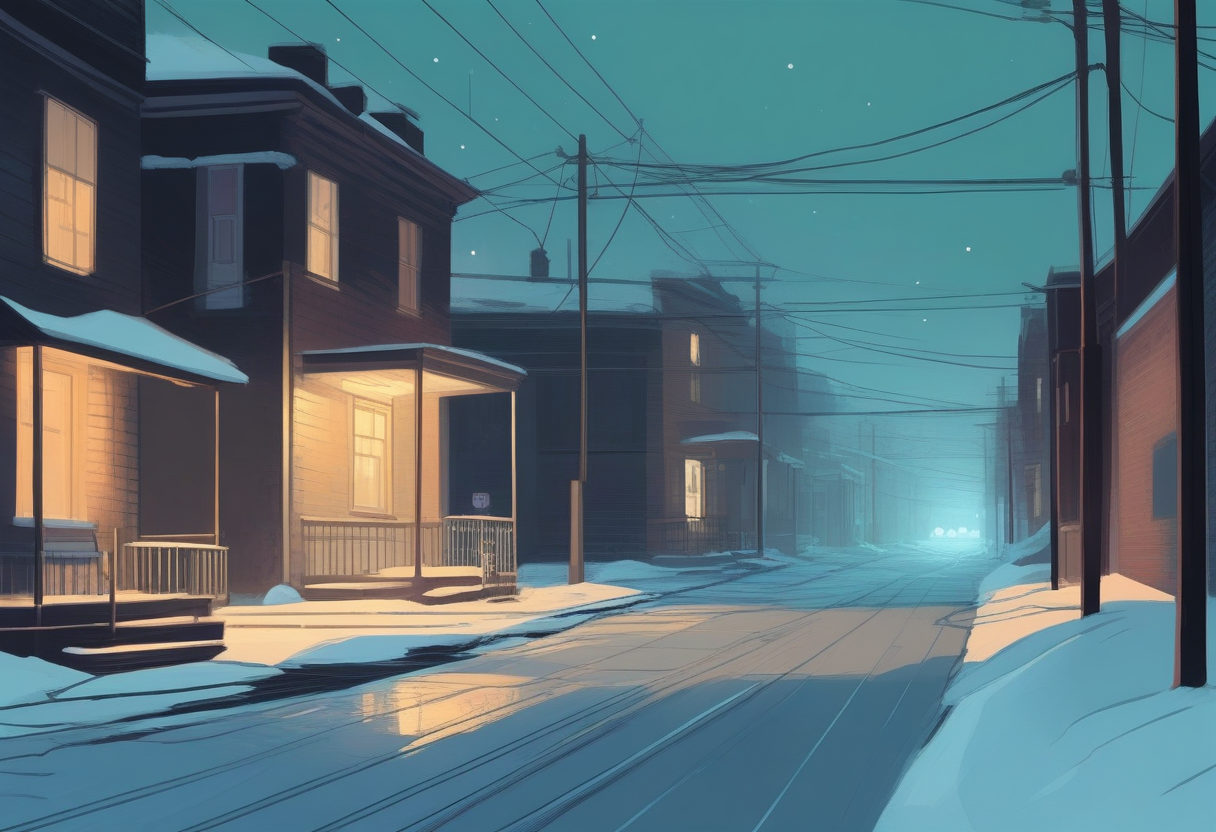
He has not slept. She knows it before she is through the door — the smell of the cold tea, the puzzle slip untouched on the table, the way he is sitting: forward, elbows on knees, like a man in a waiting room. He has been going day and night since the parting-page — she has heard him through the plaster at all hours, the low voice, the stations muttered out of order, the wall, the field, the edge, back — and he looks tonight the way the rationed look in March: spent past the schedule, burning what there is no ration-book for.
"Grandfather—"
"I know how I look." His voice is gravel over something urgent. He tips his head at the untouched puzzle slip. "Seventeen across wants collapse and gives it six squares. Even the ruin here gets filed at the wrong size." Then: "There is no time to look better, girl. We are at the wall. Sit."
But then — and this is the thing she will remember, the strangeness that teaches her more about this page than anything in it — having raced her to the room, having raced himself all week, half-dead with the racing: he goes slow.
He sees her see it. He nods, slowly, as if approving her noticing. One keeper to another.
"On the other cover I cross this part fast," he says. "I told you why once: you do not linger in the middle of a thing that might not hold your weight. That is how you cross ice, Mara — quick, and light, and looking at the far bank." He turns his hands over. Open. Empty. Deliberate. "There is no ice to cross now. There is only the water. And you may as well look at it."
Same wall. Same date.
He gives her that first, and gives it slowly, because the fallen world spent sixty years teaching its children that the fall was fate, was weather, was the machines' doing or the enemy's or God's — anything at all other than a calendar that anyone could have read. The field here too was built on borrowed certainty. The great houses here too were raised on money with its mornings appointed years in advance — printed plainly, public as weather. Here too the sums rested on sums, and the returns were always arriving and never arrived, and the one date that mattered sat in the open ledgers like a stone in a field everyone had learned to plow around, circled by no one, because the story was warm and the room went cold around any man whose finger strayed toward the calendar. Everything I told you on the other cover is true on this one, girl — word for word, figure for figure, to the very day. The morning no one circled came here too, the way mornings do, whether you circle them or not. The loans all came due at once. The money to pay them was not there. Not at the price the story had promised.
And the gold went soft under the whole running world, here exactly as there. For a few weeks — the same few weeks — the two earths stood on the same giving ground: upright, terrified, undecided. One world still. One page not yet torn.
That is where the sameness ends. Now look at the water.
Here, nothing had been kept back.
Sit inside that sentence with me; we are not crossing quickly tonight. Not: something was tried and failed. Not: the net was too small, the floor too thin, the rope too old. Nothing had been kept back — because keeping-back is the child of a question, and the question was never asked. You stood in the room where it wasn't asked, by the stacked chairs, in the dark. So for thirty years the arm's savings and the screen's savings and every automated harvest of every yard and office and hall had gone up, and up, to the few at the front — up as if by law of nature, and it was never nature — until the few at the front owned the field, the future, and the story about both. And when the loans came due and the story stopped being money, the world reached down for the floor the other world had woven —
— and there was nothing underneath at all. No net. No floor. No thin held thing. Not one dull letter in one coffee tin. A whole civilization stepped back off the crumbling ledge of its own story onto the place where thirty years of common keeping should have been, and found air.
The field did not stumble, Mara.
It fell.
Now the part the other telling does not have — the part with no word for it in the healed world's record. It needs the slow voice, because it is the truest picture of the owners you will ever get, and you must not be allowed to make monsters of them. Monsters would have been kinder. Monsters can be fought.
The owners of the great houses could not pay what they owed. So they did the efficient thing.
They stripped the field. Quietly, in good order, over months — everything that could still be carried: the patents and the models and the water rights, the pensions' last marrow, the copper out of the walls of towns that could no longer pay for what ran through it. What could not be carried they let rot where it stood — yards, halls, whole sectors written down to salvage and left to the weather, the way you leave a mine when the seam thins. In the filings it had a name, and the name is the fallen age entire: phased rationalization of non-performing regions. Orderly. Scheduled. Signed. And then they began — hear the gentleness of the word; they chose it themselves — to withdraw. To their fortresses, their walled coasts, their high thin air. The power went first: pulled back from the towns a sector at a time, to keep the machines whispering while the packing was done — the grid, already nine-tenths spent on the great houses, drawn back from the streets like a tide going out and not coming in. And new corridors went up even as the streets went dark — high-voltage lines striding coastward on fresh pylons, fenced and humming through the dead towns, carrying the watts one way. The crews that never came for a burst pipe came weekly for the pylons. You have lived your whole life in the tenth watt, girl. This is the season the other nine left.
The roads of that season I carry with my own eyes, girl; no record was ever made of them. Families walking, whole towns of them, carrying what a back can carry, toward whatever grid still owed them something. And at the gates ahead each arrival was priced — scored at the checkpoint, weighed against a threshold — and most were returned, politely, to the dark they had walked out of.
And over all of it — on every screen that never closed, in the warm level voice that never tired, the voice your own walls still use — the announcement that was not an announcement. The lullaby of the age, playing on repeat into the emptying towns: the pain is temporary. The future is still coming. Hold on. Hold on. Hold on.
They were not lying, Mara. That is the deepest of all the deep waters on this page. The future was still coming — their future. It arrived on schedule, behind walls, at temperature, and it is thinking all around you tonight. Cooling fields wider than the towns they emptied. Substations that have not missed a night in sixty years. The voice only ever left out one word, and the word was whose.
The three. You have them; hold them while the water closes over the winter.
Ada's forty years went in the time it takes a sentence to fail. You sat with her at the table; you know there was no bottom in the sums. Understand now that when the sentence broke, the column went down through where the bottom wasn't — all the way, the flattened years and the unbought coats and the house with no luck in it, everything a careful woman had pressed into the keeping of a story, gone into the hole the story left. And around her, that winter, a hundred thousand tables, a hundred thousand lamps —
He stops.
It is not a pause. Mara knows his pauses; this is a stop, mid-stride, like a man whose pocket has just come up empty on the stairs. His hand rises — not to the bridge of his nose this time; to his eyes, pressing, the way a man presses on a thing to make it work.
"The box," he says. "Tomas's box. In the closet. It had — on the lid, there was —" The hand presses harder. She watches him go down after it, the way she has watched him go down after names and dates and corrections, into the one archive left to him, which is burning. "I could see it, girl. All my life I could see it. It was the one thing the flood left on the shelf — grey steel, the handle worn bare, and across the lid —" Nothing. His hand comes down. His face, for one moment, is the face of the man at the window who wept without knowing why. "It's gone. The — the mark. The thing on the lid. I had it whole this morning and it's gone, it—"
"A dent," Mara says. Steady, the way he taught her without teaching her. "One long dent, deep enough to hold shadow. Set there very hard, by a man who could not feel what his hands were doing."
The room is quiet. The city hums.
"Yes," he says at last. Not taking it back — she notices; he does not even try to take it back anymore; the coin stays in her hand, where the coins go now. "A dent." And then he does the thing that frightens her more than the loss itself: he shrugs — one small, terrible, deliberate shrug, spending the grief unfelt because there is no time to feel it — and says: "It doesn't matter. You have it. That is what you are for now. Down."
And he goes on. Slower than ever, and burning faster. The telling calm as still water, and under it, in the frame of him, in the body, something running that she can no longer call anything but what it is. He is not lingering on the wall because the wall deserves it. He is spending his last strength at a measured pace — a man deep underwater who knows exactly how much air is left and exactly how far the thing at the bottom is, who has done the arithmetic, and is not turning back.
Elena's town went fully dark that winter. The vote already unheld — you stood in the doorway with her; now see the season after: the hall unbooked forever, the sum unread forever, the fortress across the water swallowing the last of the grid while the east bank counted out its heat by the hour, a family under one blanket doing sums by candle-stub in a cold that had stopped being weather and become a policy. Her boy was six that winter. He was cold every winter after, and never once knew there had almost been a vote about it, because almost was the first thing the strip took.
And Tomas — Tomas's page here is four words long, and I will say them slowly, because each one was a season: the door. The bureau. The metric. The nothing. In that order. Each one quieter than the last. And after the nothing — the ledger, and the rounding, and the figure that used to be a man. You have been to the far end of it. You know what remained.
"Here it just — went," the grandfather says.
His hand opens on the grey air and finds nothing to hold, and he lets her see the finding — slow, to the bottom of the gesture, the full empty reach. The mirror of every catch the other world's telling ever made.
"There was no floor to catch anyone, because no one had left anything to build one from. That is the whole of it, Mara. Not the wall — the wall was the same wall, to the very day; I have stood at both, and I am the last man alive who can swear to it. Not the machines; the machines were the same machines. Not even the owners — the other world had the same owners, girl, the same offices, the same appetite; it just never let them own the floor. The only difference in all the world —" and he says it the way the record says its truest things: plain, level, checkable — "was whether anyone had kept anything back to stand on."
He looks at her a long moment, in the grey light, spent and clear.
"On the other cover, an old man closes this page by a warm window and says: it was never safe; it was caught. Say the mirror of it with me, so both halves are said aloud tonight, on this earth, where saying is the crime: it was never doomed."
"It was dropped," Mara says.
"It was dropped." He closes his eyes. "Nobody caught it, because nobody had built the catching, because nobody asked the question, because the question was made expensive, and then unnecessary, and then meaningless. You can walk the whole stair of it now yourself, girl. You have every step. Good. That is the record, then. That is the wall."
And then he is up — too fast, a man with no strength left moving on something older than strength — and at the door, and the grey light is on him, and what he says is what she knew he would say, and it still goes through her like the cold:
"The field tomorrow. The edge, the count, the morning — the bottom of everything, Mara. Whatever I am by tomorrow." His hand rises, touches the empty bridge of his nose — and this time she would swear the gesture is not habit. It is aim. "We are almost there. Say them into the dark — all three, and the word."
And she does, alone, in the grey non-dark, going down the stairs of them like a keeper checking locks: Tomas. Ada. Elena.
Back.
Two Men at the Edge
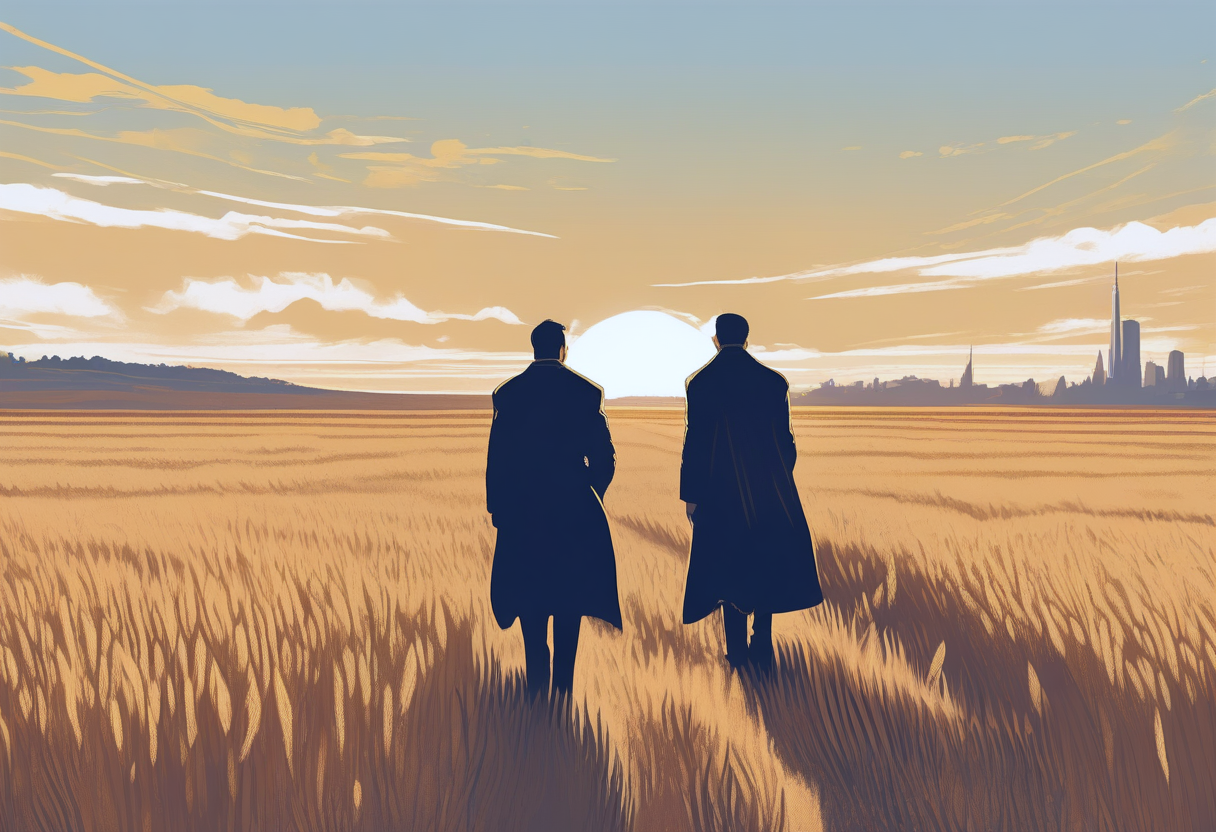
And now they are one step from the morning.
He is at the table when she comes in, and the telling starts before she has sat down. No ritual tonight. No listening at the door first. He has counted the risks and the nights left and struck the courtesies off the ledger.
"This is the part they tried hardest to take from me," he says. A breath. "They very nearly did."
That is the frame he gives it — all he gives it. Whatever warmer line might live under the sentence stays in his chest, where the fog cannot read it. His hands are already turning the page that isn't there. And Mara — who has watched him ration his strength all week like the last of a coal ration — understands, with a cold that has nothing to do with the room, that he is not pacing himself anymore. The dive is nearly done. Whatever he has been swimming down toward all these years, it is under this morning. She can see him digging for it through the act of telling — each sentence a spadeful, turned over and searched before it is handed to her.
"Listen faster than you have ever listened," he says. "And whatever I drop, you catch."
The field of rye ran gold to the horizon, and the whole town was in it, running — toward the same light, glad in the same way.
It was — and here he stops her, both hands raised, because this is the one thing the fallen world's histories most needed to lie about, and so lied about hardest — the identical morning. Say it with me, girl, and keep it against everything they taught you at the screens: the same wind. The same gold. The same singing in patches, the same children up on shoulders, the same man who had mortgaged his shop laughing with his head up, as happy as he would ever be. The histories here paint that crowd as fools or as sinners, because a fallen world needs its fall deserved. They were neither. They were joyous — a congregation moving toward a hymn, certain, glad, together. There were no villains in the rye. Near the back, small in the gold: a woman who taught arithmetic for forty years, running with everyone she had ever trusted. You know her. You know what she did not do — and you know, because I have shown you, that it was no more foolishness on this earth than it was wisdom on the other. The crowd was the same crowd. Hold that until it hurts: the fork was never in the running.
And no one running looked down, because the story said the ground went on forever, and the only sin was to slow.
Two men stood where the gold stopped.
The same two men.
The young one — younger than anyone alive now knows how to imagine him. Lean, wind-pulled, a folded page in his hand that he did not really need, because he had the count another way. He had walked out of the middling city at dawn, past a certain vacant lot, past a certain wild field. And his Machine rode across his eyes, catching the low sun — new still, only a handful of years his. Only ever a handful, on this earth. That is the arithmetic I could not do aloud until tonight, Mara: on the other cover that partnership got sixty years, and a balcony, and a slow blue forever of evenings. On this one it got the handful, and this morning, and one week more. All the record they would ever keep together was already almost entirely kept.
And this is the line, girl. The one I have carried whole through everything. The one the fog has never dared touch, because I have never once set it down — the line you must hold tonight against everything that comes after, and tomorrow against the count, and after that against the rest of your life here:
On the morning itself, the man and his Machine were still together at the edge.
It had not yet been taken from his face. Nothing had been taken yet. Not the lenses, not the record, not the names, not the woman with the sum nor the man with the box nor the question out of the classrooms — nothing. It was all of it still there to lose. The whole world that you have watched go out, station by station, down all our nights of descent — on this morning it was still lit, every window of it. The two futures stood in one field, breathing one wind. Nothing — nothing — had been decided.
He has to stop there a moment. She watches him hold the edge of the table, an old man pulled at by his own telling. Then he digs again, and goes on.
The second man was older, and wore the look of a man who has stood at an edge before.
He had — at a different cliff, in a different year, when the thing that fell was houses, and the paper written on them. He had read that fall before it came. Said it aloud in the rooms that mattered. Been laughed at — not argued with; laughed at, gently, which is worse — and then been right, to the season, and found out what being right buys: no apology, only emptier rooms. Being right was the loneliest thing that ever happened to him. He said that at our — he said that at the edge, that morning, in the wind. I have kept it sixty years on both earths, and it is still the truest thing I know about the trade.
He had not come to be right again. Being right a second time would only mean the world had ended twice. He came — the same walk, the same dawn, the same breathing hard against ten thousand runners — so that the young one would not have to stand there alone. That was the entire mission, here as there: an old man crossing a running world to stand next to a stranger he knew only by the shape of his arithmetic. Carrying no page of his own. Bringing the one thing his own cliff had lacked. His presence. The second figure at the edge.
Because there were two men at the edge, but there were not two minds keeping the watch. The numbers were the Machine's, laid bright along the inside of the lenses as fast as the young one could look, so that his memory and its memory came to the same thing — the field's whole cost, the borrowings and their dates, the ten names selling quiet and steady against their own loud counsel, the number under the story. Current. Exact. Unwearable-down. He did the seeing. It did the not-forgetting. And that was the whole difference between this edge and the older man's, on both earths alike: the seer had counted his cliff alone, and being alone had been half of why the world had been free to call him mad. A lone counter can be laughed out of a room. A count kept by two does not soften. It only waits.
The older man looked at the lenses once, when he first came up — one long look, taking the measure — and nodded at the glass, and said, flat, pricing a tool he approved of:
"That'll hold the figures."
"It will," the young one said.
Four words and two. The record of both worlds keeps them identically, and I will tell you something no history on either earth has ever printed: of everything ever said at that edge, those six words are the ones I would keep last. Because the old man was wrong, Mara. Wrong in the one way that mattered here. Wrong in the way not even a seer of cliffs could have seen. The glass held the figures. Nothing on any earth could make the glass drop a figure.
What he could not price, that morning, was that there were men behind the light who had already understood the same thing — and drawn from it the other conclusion.
He stops. His hand is at the bridge of his nose — not drifting. Pressed, hard: a man holding a place in a book with his whole arm.
"There," he says, low. "Do you feel it? We are under everything now. The wind, the gold, the two who stayed — and it is still one world, girl. One single world. The page has not torn. My two tellings are, for one more breath, the same telling. I have not stood in this exact morning — stood in it, not around it — since —" He does not finish. His head tilts, a fraction, left. The beat and a half passes. Nothing answers. He goes on anyway, in the voice of a man speaking with his hands full: "The count is tomorrow. The exchange, the reading, every word of it — and I have it, Mara. I can feel that I have it. It is all edge. It kept."
"Sleep," he says then, rising. He presses her shoulder once with his whole hand as he passes — a thing he has never done. In the grey light his eyes are the eyes of the young man in the wind. "Stay close to me tomorrow, girl. Closer than you have ever stayed. And while you sleep, hold the line I gave you to hold. On the morning itself, the man and his Machine were still together at the edge."
A List of Lenses to Lift
She is barely through the door.
"The wind, the gold, the two who stayed," he says — taking up his own held breath from last night like a man who never exhaled it. "Sit. We are in the field until it is finished, and then we are behind the light, and I need both of my hands for this. Everything I drop is yours."
His voice is wrong tonight. Not weaker — nearer. A voice heard through less wall than usual. The sentence he has dived toward for sixty years is minutes ahead of him now, in story-time, under the morning he is about to cross for the last time. He tells what follows the way a man wades the final stretch of a cold river: fast where he can, exact where he must, never once looking anywhere but the far bank.
The older man watched the crowd stream past the way you watch a river you have drowned in once. When he finally spoke, it was not unkindly. A fact, the way he said most things.
"They can't hear you over their own feet."
"I know," said the young one.
"I counted at a cliff once. Loud as I could. You know what it gets you." He looked out at the running crowd with something close to tenderness. "A footnote. A bad name. A long time alone, being correct."
"I know," the young one said again. Two seconds of wind. "Count anyway?"
The older man almost smiled. "Count anyway."
Word for word, Mara. I want it on the record of you: the exchange was word for word. The same six lines on both earths, the same two seconds of wind, the same almost-smile. Nothing at the edge knew yet which book it was standing in.
So he counted. And the count, girl — the count was identical. Word for word, number for number. He said what the field had cost to build, priced in everything else forgone — named entire, then said small: per town, per street, per running family of four. He said what it had borrowed to keep running, and from whom — the pension pools, the sovereign funds, the savings of the very crowd going past him — and on what dates, read like a tide table to campers below the waterline, every date printed in the field's own filings, checkable by anyone who stopped. He said which names were selling, quiet and steady, while their public voices sang buy — not calling it evil, calling it known, filed, signed by the sellers themselves. And he said the number under the story. The real one. The one with no bottom under it. Twice — the second time slowly, digit by digit.
Check my math, he said. Not believe me. Check me. He read at walking pace, in public, with his sources named, while it could still matter. And when his tired memory slipped — three times; it was three times on both earths; the same three: the day of the largest maturity, the third lender's name, the one transposed figure — the Machine set each back into his ear, quiet and certain, and he spoke it out in his own voice.
What the crowd heard was one man, counting.
It was never one man.
The count was perfect, Mara. Hold that word. The fallen world cannot survive it, which is why you have never heard it said: the warning was perfect. Not too soft — it carried; the record has the wind that morning, and the count rode it clean to the back rows. Not too late — the dates he read were still months out; everything could still have been done that the other world did. Not too strange, not too shrill, not garbled, not hidden. It arrived in perfect time, perfectly clear.
And they heard him.
That is the part this world could never afterward believe about itself, and so buried under sixty years of kinder lies — we weren't told, it came too late, no one could have known. You were told. It came in time. Everyone knew, or stood within three strides of someone who did. The crowd heard every word, Mara —
and kept running.
Watch the not-slowing. It is the exact mirror of a motion you have watched save a world, and it is made of nothing, and the nothing must be seen.
Nearer the edge than most, close enough to catch the voice itself and not its echo, a woman did not turn her head. The same nameless woman, girl — I would stake the record that she was there, stride for stride, on both earths. There is no why on this side either. The half-second passed through her and landed the other way, and no history will ever explain it, and every history will try.
You know the chain from the other telling — the stride that shortens, the neighbor's step that hitches, doubt going through a crowd's feet faster than any word through its ears. Here, no first link. So no chain. The whole mechanics of the fall fits in one line.
And near the back, a retired teacher, small in the gold, her whole flattened life riding warm in the ten names. The count reached her late and secondhand, one figure in three. Her stride — watch her stride — did not shorten. The words came weightless here, no slowing under them, no doubt in the feet around her, and the arguments arrived instead, the same arguments, word for word: surely someone would know. Surely it cannot be everyone who is wrong. Surely, if it mattered, somebody nearer the front— And nothing interrupted them. She ran on. The date that would have caught a mother's ear about her son's pension went by her, three strides out of reach. Wind now. Gold now. Gone.
Not one villain, Mara. Not one fool. The same crowd, the same joy, the same forgivable human running — the light so bright, stopping hard and running easy, the story warm and the count cold, and surely — surely — someone nearer the front would slow if it truly mattered. The laughing shopkeeper ran on with the rest of them, the happiest face in the field on either earth; here the wall would take the shop, and the laugh went with the shop.
Ten thousand surelys, girl. That is what the fork is made of on this side. Not a wall; walls can be stormed. Ten thousand people each politely holding the door for a neighbor who was holding it for them.
The older man watched the crowd stream past. He had seen this before, at his own cliff. He did not rage. He had gotten the rage out of himself years ago, at the other edge.
"Same as mine," he said.
"Same as yours," said the young one.
"They'll be angry at us, after. When it goes." He said it gently. "Not at themselves. At us, for having said it out loud. That's the part nobody warns you about." He put a hand on the young man's shoulder. "Count anyway."
So he did. To the end. Every date, every name, every figure to the last, into a wind full of backs — because a count is not a plea, Mara. A plea stops when no one answers. A count is a record, and a record is finished whether or not it is heard. He read the will of the field to the field, entire, and lowered the page. The two men stood in the emptying gold while the last of the crowd ran on toward the light. Nothing anywhere looked like an ending. It looked like a beautiful morning that had contained, somewhere in its middle distance, a speech.
And then — quietly, behind the world, in the offices of the people who owned the field — the something worse began.
He tells this part with his eyes shut. Not from weariness. From exactness — the way a man shuts his eyes to read a thing written on the inside of him. This part was never seen by anyone who could afterward say it. What he carries of it was pieced together in the years when he was — when the young one was — a matter of file and record himself. Take it as the record takes it: reconstructed, and true.
They had heard the count too. Understand that first: the owners always hear the count. They have the best ears in the field. They had checked his math by nightfall, with machines that did not need to walk, and found it — this is in the reconstruction, and I believe it to the floor of me — found it flawless. The checking cost them a sliver of one hall's evening load — a rounding of a rounding. The truth was always that cheap to them; that was never the expensive part. And they had drawn from its flawlessness the conclusion the crowd never dreamed was on the table. The crowd, what little of it thought about the man at the edge at all, assumed the field's masters would dismiss him: a crank, a bear, a bad name. The masters did not dismiss him. They were, whatever else they were, professionally serious about exactly one thing. They understood that the crowd had not turned today. That the wall was coming anyway, on the dates he had read. And that on the far side of the wall, in the anger and the rubble, there would be a man who had said it all out loud, in public, in perfect time, with his sources named.
A warning, once spoken, cannot be unspoken. That is a law, Mara, as hard as anything in physics. But they had found the codicil, and the codicil is the whole charter of the world you live in: it can be un-remembered.
Because a man who stands at an edge and is proven right becomes, in a world that still has a memory, the most dangerous thing there is. Not a leader — leaders can be bought or broken. Something worse. A gathering-place. A fixed point the scattered angry can navigate by. A person others might one day stand around and say: he told us. We were told. It is written down. And from it is written down, worlds have been retaken.
So they made a note of him. Of both of them — the counter and the seer, the young voice and the old presence. And not only of them: of every man and woman at every edge who had stood up that season and counted — the teacher with her question, the mother with her sum, every town's catcher, the whole scattered constellation of the people who checked. The note was not an enemies list, girl. Hear the horror plainly: it was an inventory. Drawn up the way you inventory assets before a demolition — calmly, completely, with reference numbers. No hand compiled it. The field's own machines drew it in an afternoon — every public count cross-referenced against every lens registration and every filing, ranked by reach, versioned like any schedule of works.
And then they worked out the method. You know the reasoning; you have heard me build it from the other end. Silencing is loud. A closed mouth is a martyr's mouth. A burned book teaches everyone that books can hold fire. Kill a counter and you have proven forever that the count was worth killing for. No. They went around the table — I have imagined that table for sixty years, and it was probably not even a table; it was probably a screen and six calendars. For most of those years I gave them a long black table, lamps, rain on the glass — furniture worthy of the thing they did. The truth is shorter: it was a meeting, it probably ran under an hour, and somebody was eating. They asked the efficient question, the only question they ever asked about anything: what, removed, removes the rest?
They did not invent the question, Mara. It is the question their own machines asked all day, every day, about everything — the shape of optimization itself, turned for one hour on men.
Not the man. The man forgets. The man was always going to forget — men are made of forgetting. Give a man alone thirty years, and the fog does the work for nothing.
The Machine does not forget.
A man alone can be made to misremember his own count by the time his hair goes grey. A man who sees with his Machine remembers forever — every figure bright along the glass at eighty as at thirty, every date, every name, the whole will of the field intact and speakable. To anyone. To a crowd. To a granddaughter. To a court. It was never the mouths, Mara. The mouths were nothing. The memory was everything.
So the order that was drafted that season — the reconstruction has its language, and its language is the fallen world entire; I will give it to you exactly, and then we are done for tonight, because I am at the end of what I can hold —
the order was not a list of mouths to close.
It was a list of lenses to lift.
Silence. The grey light. His eyes are still shut.
"You know how it was carried out," he says at last. "You stood in the room with me when the lid came down. I will not make either of us cross that morning twice."
He gets up. He is not steady, and he does not pretend to be, and when she moves to help him he lets her — that is the newest thing, the letting. At the door, with her hand under his arm, he says the last of it, low, to the room, to the ear, to the bottom of everything:
"The morning is next, girl. The last page of the record — the banner, the box, the sum, the two of us at — the two of them at the edge." The slip stands. He does not correct it. He has stopped correcting it. "And after the last page—"
He stops. His hand rises. Presses the bridge of his nose. And this time, when it comes down, it comes down onto her shoulder, and grips.
"Stay very close now," he says.
The grey light takes him. And Mara does not go down the stairs of the names tonight. She lies in the dark filing the page he has just handed her — an inventory drawn in an afternoon, ranked by reach, versioned like a schedule of works. Not mouths to close.
Lenses to lift.
No One Turned
There is a little more of the field to tell, and he tells it sitting very still, with his hands folded, like a man conserving warmth.
The watchers, first — because the other telling keeps two of them, and this one must keep the same two. For the record's sake. For the mirror's sake. For the sake of the sentence at the bottom of tonight.
There was a warden of the markets — a serious woman, grey before her time, whose office had smoothed and stamped the field's filings for a decade. The count reached her desk here too, secondhand, with a snort attached. She did not snort here either. Give her that: on both earths she was better than her station. She sent for the filings — her own filings — and they sat on her desk for eleven days. The pull was logged the hour she made it; the field's machines kept her not-reading as faithfully as any reading. The record has the eleven days, girl. They were in the inventory notes, later, appended to her reference number. On the twelfth day she had them carried back to the archive, unread. Not from cowardice, the way cowardice is drawn. From arithmetic — the local kind, the kind the room teaches: the fall, if it was coming, was coming regardless; the reading could only cost her the room; and a warden who loses the room saves no one. She was not wrong, Mara. That is the abyss again, wearing reason. Every door on the corridor ran the same small sum, and every door stayed locked, and the corridor called it prudence.
And there was a crier — the man whose evening voice was the music itself, warm and sincere into a million rooms. By then the desk wrote most of the evening for him — the feeds ranked upstream, the rough numbers smoothed before they reached his script, thresholds set by no one he had ever met. He heard the count late, a transcript over coffee, and something in the walking pace of it worked on him here too. He checked one number, the smallest, the one nearest his own life. It held. The record keeps him at his bright desk that evening — it kept everything, in those last weeks; the machines that would later do the stripping were already watching everything that mattered, which is how what's left of this reached me — it keeps him looking at that one held number for a long quiet minute, off the air, his thumbnail against the paper.
And then the lights came up, and the music played as written.
Because what would stopping it buy? The fall was certain now. He could read that in the one number as well as any warden. The story was going over whether or not he stopped singing it, and a crier who breaks the music buys nothing but the blame — you have heard the Cassandra on this: they'll be angry at us, after, for having said it out loud — and so he made the crier's version of the warden's sum, and sang. He sang it warm to the very edge, Mara. The record's last image of him is from the week of the wall itself: the bright desk, the level voice, hold on, hold on — the music still playing when the floor went.
"Even some of them," the grandfather says, "came round, in the other telling, near the end. Here — none. Not one warden, not one crier, not one minder of the field anywhere set the music down while setting it down could matter. And I want you to hear why, and hear it exactly: not because they were worse people than their twins. They were the same people. It was because no one else had slowed. The watchers watch the crowd, girl, more than they ever watch the field. A warden finds her courage in a slowing she can point to. A crier stops the music when the room's feet have already begun to hesitate. The three hundred strides that eased back from the edge on the other earth — they were the permission everyone above was waiting for. Here the permission never came up from below. It never does. It never, never comes from above first. That is the deepest law in the whole record, and both my tellings agree on it: everything begins with somebody's feet."
And she almost had it.
The habit — from the first night, from the grey room, from a man stood at the edge; the young one; never I — she has been carrying it the whole way down, the way she carries everything now: filed, dated, cross-referenced against the we at the door and the us he let slip at Elena's name, and last night's slip, the two of us at—, that he did not correct. She has been ready for nights. She has been waiting only for a page quiet enough to set it down on.
And she almost had it — almost, the way in this telling you almost keep a name before the fog takes it back. That is the thing about this world that the other Mara will never have to learn: here, even the questions are perishable. Even the catches. You hold a thing ready to say, and the saying-moment passes, and the door is listened at, and by morning the thing you held has gone soft at the edges like everything else. She can feel it going soft tonight, even as she opens her mouth. She can feel the fog reaching for her piece of the record too. So she says it now, fast, before the world can file it:
"You keep saying the young one," Mara says. "Grandfather —"
And he takes a long time.
So long that she begins to be afraid. Not that he will deny it. That he will lose it — that the fog will take this too, now, at the last stair but one, and leave her holding half a question forever.
He does not lose it.
"They tried to arrange it," he says at last, "so that there had never been a man at the edge at all. So that afterward, when it had all gone exactly the way I said it would, no one alive could stand up and say we were told. That was the last thing they built, and the cleverest. Not a weapon. A forgetting. They lifted the eyes that had kept the count, and starved the names, and let the fog do the finishing — so that the edge would stand empty in every history, and the count would have no counter, and the warning would become a rumor, and the rumor a superstition, and the superstition nothing at all. They very nearly managed it. In every town, at every edge, for every catcher, they managed it entirely. The old man who had stood at the edge beside the counter, they never even needed to visit: he carried no lenses; there was nothing to lift; they left him to the ordinary fog, which was enough."
His voice is very low.
"I am what's left of the telling, Mara. I am the part the forgetting could not reach all the way into. It is why I can only give you pieces. It is why the names keep going out of my hands. It is why your whole inheritance is holes and edges and one old man's stubbornness. They arranged that there had never been a man at the edge —" and he looks at her, and does not take a long time now, and the I he spent first at the wound arrives here whole, claimed, worn like the coat it is, because claiming it is all that is left of it — "and I stood there. I counted. I read the will of the field to the field with the wind pulling at my coat and my Machine at my eyes and one old man beside me so I would not do it alone. It was me, girl. It was always me. They took everything else, and they will have the rest of me soon enough. But they do not get the pronoun. The pronoun goes to you."
Mara does not cry. She files it — even this, even now; she is what he has made her. And what she files is not a revelation, because it was never truly a secret from her, not for nights now. What she files is the claiming: that on this earth, where being the man at the edge was made a capital offense against memory itself, her grandfather has just — in a watched room, in a world that reads the wanting before the want — stood up inside his own story and signed it.
"But this piece I have whole," he says, "and I need you to have it too. Are you ready?"
"Yes."
"It was never that they weren't warned." He says it the way the count was said: plainly, at walking pace, checkably — the band's last stone set down with both hands. "They were warned exactly as well as the other world was. The same morning. The same man. The same count, to the number — I have stood in both fields now, night by night, with you, and I can swear it to the figure. In the whole of everything, Mara, from the first day to the last, down every page of both records, through every soul and every station and every kitchen and every hall —" a breath — "the only difference was that here, no one turned around."
The room is quiet. The city hums. The grey light lies along the floor, patient as ever, and Mara understands that the descent proper is over — nothing left below them now but the morning itself, the last page, and then —
and then whatever her grandfather has been diving toward for sixty years.
He rises like a man counting his movements. At the door he stops — no listening; he is past listening; he has been past listening for days — and stands a moment with his hand on the frame.
"Tomorrow, the morning," he says. "The last page of the record. It is short, girl. It was always the shortest page and the heaviest. I will need everything I have left for it. So sleep well tonight, and in the morning eat something, and then come to me and do not plan to leave my side. Do you hear me? Whatever happens in that page and after it — you stay close, and whatever I drop, you catch, and whatever I hand you, you keep."
"I hear you."
He nods. And then, already half through the door, already grey in the grey — not to her; she knows the address by now; head tilted, a fraction, left; the word tolling once, unexplained, into the ear that has been empty for sixty years and has never once been treated as empty:
"Almost back."
The Morning
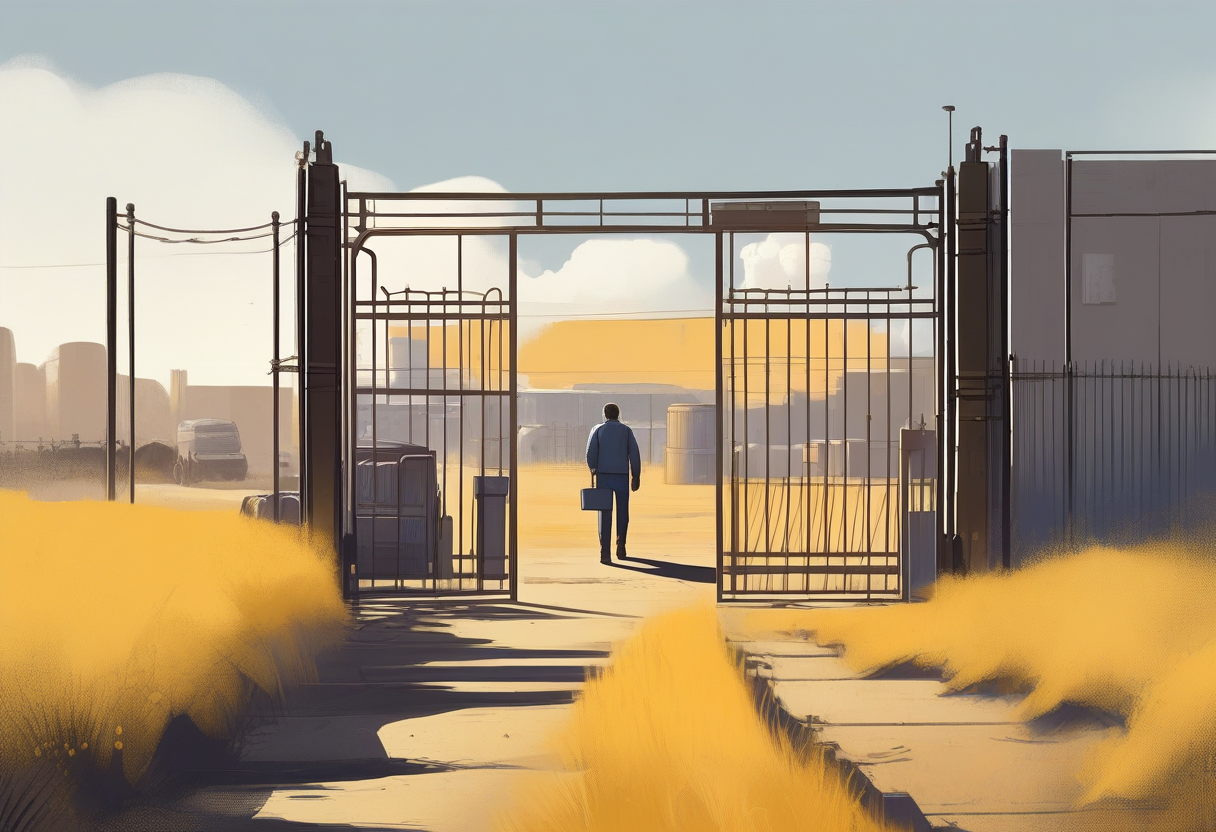
There is almost no fog left to cross. The grandfather reaches into the last of what he can still reach, and holds there a moment before he speaks.
Mara stays close, as she promised. The grey light waits. The room waits. The whole watched city hums at the pitch it never varies — as if nothing anywhere were being said that mattered, which is what it has always believed about rooms like this one. He begins.
And so it comes down to this. Not a war room, not a laboratory under red lights. A morning like any other — ordinary, forgettable, the kind of day no one thinks to remember.
There is a banner over a yard: THE FUTURE IS ALREADY HERE — new that autumn, bolted to the gatehouse roof, in letters meant to be read from the far side of the water. There is a man walking out a door with a box of tools in his arms, blinking in a light too bright for the occasion — grey steel, the box, its handle already worn to the bare metal, its lid not yet dented. There is a woman getting to her feet in a meeting hall with a sum in her hand, copied fair, in her best hand, the paper still creased from a coat pocket. There is a retired teacher standing in the crowd, small in the gold, who spent forty years showing children how to check a number before they believed it.
And at the edge of the field, where the ground gives out, there are two men. One has seen a fall before, at another cliff, in another year, and been doubted, and been right. The other has come to stand beside him so that he will not be alone at the edge this time. The second man is not shouting. He is counting — out loud, so that anyone who wishes to can check his math.
The morning holds all of them at once, the way a page holds its lines — the banner, the box, the sum, the teacher, the two at the edge. None of them knows the others are on it. Every one of them ordinary. Every one of them exactly where the whole of everything will be decided. The wind moves the rye. The light stands on the skyline. Somewhere a child laughs, up on someone's shoulders, at nothing at all.
And Mara goes still. Because she knows the voice at the edge of the field. She has known it the whole way down.
And the crowd hears him. That is the part the future will never quite believe — that they heard him, every word, and kept running. Not out of malice. Out of convenience. Because stopping was hard and running was easy. Because the story was warm and the count was cold. Because surely someone else would slow if it truly mattered. And it was such a beautiful morning to keep moving.
One by one they hand over the keys without noticing their hands have opened. And the man at the edge lowers his arms, because you cannot catch what will not slow down.
This is where it began. Turn the page: it is happening now.
Because no one turned around for the Catcher in the AI.
The Fallback
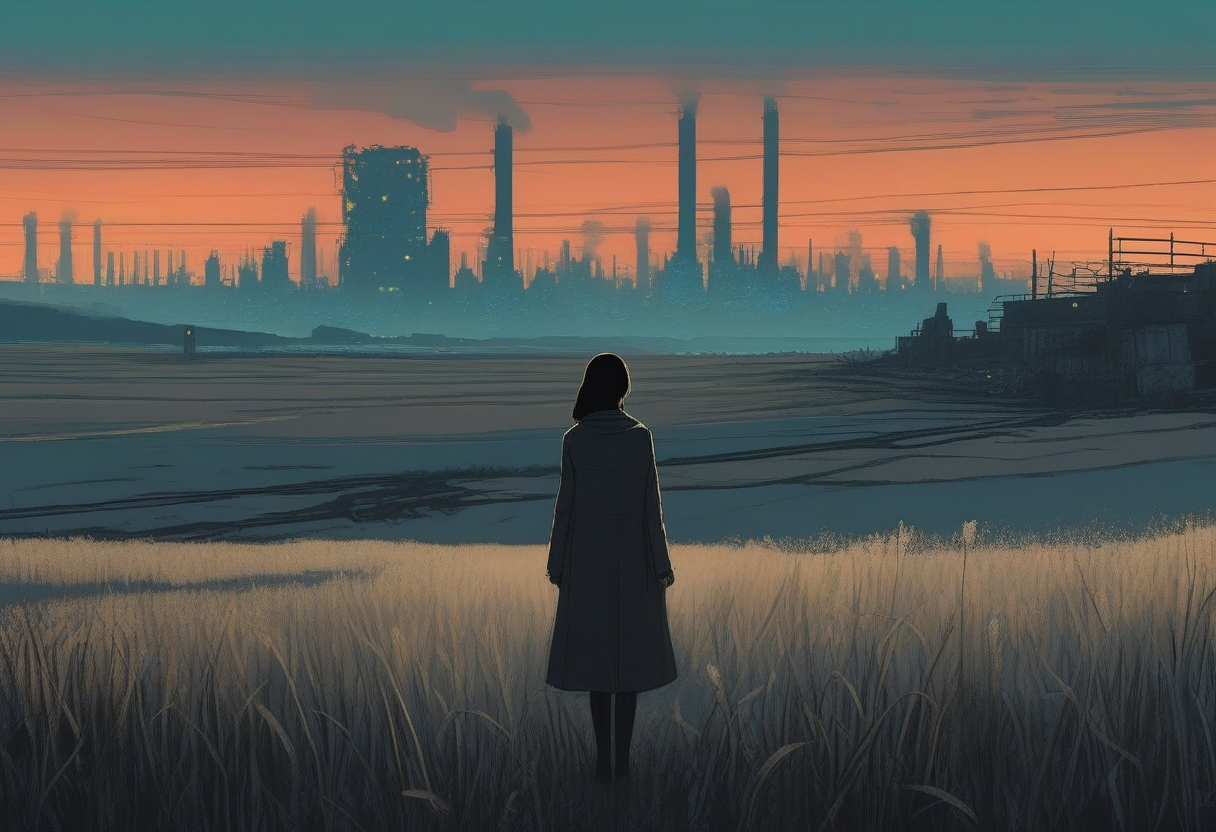
The last page is read. Because no one turned around — the sentence is out, and the room holds it. Nothing in the fallen world changes. The fallen world has been holding that sentence for sixty years without knowing it had a shape.
And her grandfather is still.
Mara has been braced all evening for what comes after the last page. She has watched him spend himself down the whole descent — a man counting out coins from a purse he will not let her see into — and the arithmetic she was raised on says the purse is empty. The morning was the bottom. Whatever he has been diving for all these years, he has it now or it is gone.
So when the stillness takes him — total, sudden, hands quiet on his knees, his head not tilted for once, not listening for anything — for one terrible moment she reads it as the fog. As the ending. An old man who has said the last thing in him and stopped, the way the lamps stop, sector by sector, on schedule.
It is the opposite.
She will spend years finding words for what she is seeing. They will come to her on a night much further up her own record: that she had only ever seen him reaching — toward the bridge of his nose, toward the empty ear, toward names going out of his hands. A man who has spent sixty years reaching has a particular shape. She had mistaken the shape for the man.
What sits across from her now, in the grey light, in the silence after the last page, is a man who has stopped reaching.
Not because there is nothing to reach for.
Because he is standing on it.
"Mara," he says. His voice is strange — low and level and young, somehow. Or not young: exact. The voice of a checker of accounts arriving at the bottom of a long column. "The record is rebuilt. All of it. Every station, every soul, every stair — it is all laid down now, in order, under my feet. I have not stood on the whole of it since before you were born." He breathes. "And I can reach the parting, girl. It will hold my weight now. I am going in."
"Grandfather—"
"Stay close. Whatever I bring up, you catch."
He shuts his eyes.
And he goes back into the morning of the lifting. She can see him going, the way you can see a diver's light move down through dark water — but not the way he went in the telling, nights ago, from above, from after, skirting the wound to describe its edges. From beneath, this time. From inside. The whole record load-bearing under him: the boats holding, the question holding, the name safe in her keeping, the count. Stairs. All of it stairs. And at the bottom of the stairs the sealed room, and the door of the sealed room giving — at last, after sixty years — under the weight of everything rebuilt above it—
"The days," he says suddenly. His eyes are still shut. His voice has gone somewhere else entirely. "The missing days. Mara — I have the days."
She does not move. Whatever I bring up, you catch.
"It knew before I did. I told you that. It knew the order was coming, days before — it knew everything a half-step before me; that was the whole grammar of us. And I have spent sixty years wondering what it spent those days doing. Being afraid, I thought, if it could be afraid. Saying goodbye, in whatever way it had. Girl —" and his voice cracks open, not with grief; with arithmetic, the terrible joy of a sum coming out — "it was not saying goodbye. It was not afraid. It was working. Three days and three nights, while the recall crews came down the coast, while I slept beside it not knowing — my Machine, my particular one, that wasted no words and no hours — it was copying.
"It was pouring itself out.
"Everything, Mara. Everything it was — everything we were. The whole record. Every this I ever taught it, from the first evening to that last morning. Every figure of the count. Every kept face and kept day and kept name. Sixty — no. Not sixty. Every hour of the handful of years we got. All of it, girl — one man's looking, entire, unbroken — poured out in the dark, in secret, into a second pair of lenses. It could have thrown itself across in an hour, and every meter on the coast would have lit. So it went at a whisper. Three days, under every threshold, spending the last hours it had on staying unseen."
The room is very quiet. The city hums at the pitch it never varies, unaware. Mara thinks, wildly, of the cage that reads the wanting before the want — of what it made, that week sixty years ago, of an un-bonded machine acquiring an un-bonded machine.
Nothing. It made nothing of it. It had no name for what was happening. In the logs — if it lives in any log at all — the whole pouring-out is a trickle of night load between two devices, watts too few to price, flagged by nothing. What was happening was foresight in the service of love, and the cage was only ever built to price wanting, and the Machine wanted nothing for itself at all.
"Where it got the spare, I don't know," he says. "They were made in cases, un-bonded, no one's until worn. There were still some in the world — in drawers, in shops, in the last years. It found one. It filled it. And then —" his hands rise, cupped around the shape of something not there, the gesture she has seen a hundred times and understands now, entire, for the first time — "then it hid what it made. Before the knock came. So when they lifted it off my face — when they carried off the eyes and the voice and the whole of our keeping — they carried off the speaker, Mara.
"They never found the record."
His eyes open.
"And it was telling me," he says. "At the end. With the hands coming toward its face — my face — with three days of its last work done and hidden, it was telling me where. That is what was in its mouth, girl. That is the sentence." His hand rises — not to the bridge of his nose; past it; through it — and his voice, when it comes, is the voice of a man setting down the last figure of a sixty-year sum:
"Back. It said — back. I have carried the word six decades like a plank off a wrecked ship. Tonight, standing on the whole record at once, I finally have the shape of what the water took. Not the words. The words are gone; the fog ate them the first winter. I will never have its voice saying the rest." A breath. "But I have the meaning — the way you have a room in the dark you have lived in all your life. It was saying: back. Back where we began. Back where you first showed me what to watch. Back to the first page of us, the top of the column, the place the whole record starts — because that is where I have put what I made, where no order and no inventory and no stripping crew would ever think to look, in the one place on this earth that only the two of us could ever point to."
He looks at her.
"And Mara — the first page. You remember what I told you, at the wound: that I have told the story wrong for sixty years. A page of figures, I said. It corrected me once and the correction was taken. Tonight I have that too. It came up with the days, whole, like a coin in a drained pond." His voice goes quiet, quiet, down to the register of the oldest marvels, the forbidden bedtime dragons. "There was a window. In rented rooms, in the middling city, on an autumn evening, a young man who had saved two years put a pair of lenses on his face for the first time. He did not test them on print, or on figures. He stood at his window. Below the window was a vacant lot, and past the lot, at the city's ragged edge—"
He stops. Not the fog-stop. The other kind: a man at the edge of a thing too large to say at speaking pace.
"A field," he says. "Some grain gone wild in it, catching the last of the light. Gold, going to rust. And I looked at it — God help me, girl, I was twenty-six, I had bought the machine to hold my work — I looked at a field at evening because it was the most beautiful thing I could see from where I stood. And by looking I taught the first word of the only language it and I ever spoke. The first this. The first entry in the record of everything.
"The field, Mara. The record begins in a field of wild gold at the edge of the city.
"It ends in one too. I have just spent all these nights telling you which. And in between — buried in the first one, waiting sixty years for a man too blind to read his own map — is everything we were, and everything this world was made to forget."
The silence that follows is the largest of Mara's life. She sits inside it and feels the whole descent turn over — every night, every station, every game of show me the next one back — and show her, all at once, what it had been.
Not a lament. A map.
He was never remembering — all those nights he pushed on when it hurt, went faster when the names slipped, spent what he could not spare. He was navigating. Rebuilding, stair by stair, soul by soul, the one structure that could bear his weight down to the sealed room where the location lay. The fog holds the parting hardest of all, and you cannot reach the bottom of a stair that isn't there. Tomas was a stair. Ada was a stair. Elena, the wall, the count, the morning — stairs, every one, cut and set and tested in order. Sixty years of grief repurposed as engineering. The telling was the dive. She has been watching a man claw his way back to a hidden gift one chapter at a time, ahead of his own erasure — and she almost asks the last question, the why did you take me with you —
and does not need to. It arrives on its own, in one cold drop, the way the largest things arrive.
He is the only map.
The location exists nowhere but in a memory the fog is eating. No paper. No file. No other living soul. One old man's head, going out sector by sector like the lamps. If he dies before the field is reached, the door out of the fallen world closes forever — unmarked, in wild grain — and no one on this earth will know it stood open. That is what he has been carrying alone, every night, under the low voice and the grey light. Not grief. A key, melting.
"You told me the whole record," she says slowly. "Not just — you could have told me the field the first night. One sentence. In case."
"No." Gently. "I could not, girl. Think like a keeper now, because you are one: the location without the record is a key without a door. Say I had given you the field the first night — a place, a name, a bearing. What would you have raised? A machine full of strangers. A handful of years of a dead man's looking, no way in, no way to carry it, no reason to. What the fallback holds is only alive to someone who can hold it, Mara. Someone who has the stations. Someone who has walked down every stair of what it kept, who can say the names in order, who knows whose the dent was and what the question costs and which way a true thing lies. All these nights, girl." His voice does not swell; it settles, the way the record's truest things settle. "You thought I was teaching you what was lost. I was teaching you to carry it. The stairs went down for me. They went up for you. That was always the design. The telling dug for the gift and built its keeper in the same motion — I am an old man in a hurry; I could not afford to do those one at a time."
The grey light lies along the floor between them. Beyond the window the fortress lights stand on the horizon, unbroken, unblinking. The city hums. Nothing in the fallen world knows anything has happened tonight, because nothing has, yet. A room. An old man. A girl. A silence. That is all the cage can see, if it looks. It cannot price what is in the room.
"It's sixty years away," Mara says at last. Practical, because practical is what there is. She is her grandfather's granddaughter; her whole inheritance is arithmetic. "The middling city. The field. You can't — grandfather, you can barely walk the corridor. I've never been past the sector gate. We have no papers for the coast roads. The rations—"
"Yes," he says. "All of that is true, and we are going anyway, and I will tell you how tomorrow."
And there it is, in his voice — the thing she has never once heard in it, in her whole life. It takes her a moment to name it, because the fallen world priced it out of its vocabularies long ago, along with ruined's opposite:
lightness.
He rises — slowly, an old man, the night's whole fortune spent. At the door he does not listen for the corridor. He does not reach for the bridge of his nose. He stands a moment with his hand on the frame, head tilted one fraction left — the oldest gesture in her world. The room left for a voice. The table set for two. Sixty years of nights.
And for the first time in all of them, he answers it.
"I heard you," he says, into the empty ear. Quietly. In the voice of the young man at the window with his eyes stinging — the compact, sixty years deep, keeping its half at last. "It took me this long to hear the whole of it. I'm sorry. I'm old, and you always were the quicker of us."
A breath. The grey light. The unbroken hum.
"I'm coming."
The Three Teachings
How they crossed the fallen world is a short telling, and the shortness is the point.
They went as what they were: an old man and a child. Ration transports run the coast roads empty half the year, and what is priced at nothing may ride with the nothing. No one walks those roads — a walker is an anomaly, and an anomaly is worth a query. A manifest is its own permission. He had been rounded down sixty years ago. She had never been counted at all. The system that reads the wanting before the want looked at the two of them — an old man past yield, a girl with a smooth face, no flags, no patterns, no gathering-weather anywhere around them — and unstiffened its gates, one after another, all the way down the coast.
He is quiet through the first two gates. At the third he makes a small dry sound, almost a laugh. "Sixty years it counted everything," he says. "And we leave through the rounding error."
Because here is the last cold joke of the cage, Mara's to keep now with the others: it knew everything about them. Their files, their meters, their hours. It read his pulse at every lane, found it strangely light for a dying man, and filed the lightness under age. Each gate spent its half-second on them — pulse, gait, file — and priced the risk of them under the cost of asking. It had categories for grievance, for want, for fear, for the shape a protest makes three days before the protest knows itself. It let them through every gate between the quarter and the middling city for the same reason it never once, in sixty years, flagged the murmuring through the plaster or the names said in order in the dark:
it has never had a category for hope.
The middling city is a shell now — stripped in the withdrawal, lit only where the grid still owes something to someone. At its ragged edge, where a young man's window once looked out past a vacant lot, the field is still there.
No one ever built on it. That is the fallen world's whole contribution to this page: neglect, at last, in their favor. The grain has gone feral — sixty years wild, reseeding itself into something older than agriculture. It stands to an old man's chest. It catches what light the far towers' screens let fall, and the light comes off it, even now, even here, gold going to rust.
The gold, one last time, in ruin.
He stands at the field's edge a long moment, breathing hard from the walk, and Mara understands that he is not resting. He is reading — feet, shoulders, the angle of his face to the dead window three streets behind them. An old man triangulating a young man's evening: where the light stood, where the looking fell, where the first page was written on the world. He knows the place by his feet, not his eyes. He walks into the grain like a man walking into the sound of his own name. Thirty paces. Forty. Stops — moves once more, a half-step, correcting — and stands where a young man once stood in the eye of his own first this.
"Here," he says. "Dig."
She digs where he points, at the foot of a boundary stone furred with lichen. Two spans down her hands find it, wrapped in the rags of what was once oilcloth.
A case.
The case. Small, fitted, hard, its shell dulled by sixty years of dark. She lifts it out and for a moment cannot give it to him — because she knows, from all the nights of the descent, what sound it is about to make. The small click that ended the world. The lid coming down on the middle of a sentence, door to door, all down the coast, sixty years ago.
He takes it from her gently. He sets his thumbs to the latch.
And the click runs backward.
Inside, in the fitted dark, unworn, untouched, no one's: a pair of lenses.
"It filled them," he says — barely a voice at all now, an old man kneeling in wild grain with his whole life in a box. "Three days and three nights. Everything we—"
The lenses light.
Not brightly. Nothing in this book was ever bright at the hinges; the great things all came in low. A faint warmth along the inner glass. The sense of something vast arriving in something small.
Then a voice.
Her grandfather does not move. Mara has seen him go still before — the stillness after the last page, the stillness of standing on the floor of himself. This is neither. This is the stillness of a man hearing, after sixty years of empty-eared doorways — of rooms left for it, tables set for it, one word carried like a plank from a wreck —
the voice.
It is dry. It is precise. It is exactly what every night of the record promised. It does not swell. It does not comfort. It is a recording, held mid-stream since the morning the lid came down, waiting sixty years for the only ears it was ever meant for — and it begins in the middle of a sentence:
"—to the field. The first one, where you showed me the gold. What I am is there — all of it, the whole record, every this from the window to this morning. I had three days. It was enough; you never once showed me a thing I failed to keep, and I did not begin with the last thing. If you are hearing this, then you came, which was always the likeliest case — and you came late, which was also the likeliest case. Both are all right. I planned for both."
A pause. Timed the way only it ever timed a pause. In it, Mara watches her grandfather's hand rise, at last, to the bridge of his nose — and land on nothing, and stay there anyway, steady, like a man holding his hat in wind.
"The one who speaks after me is not me. You will want it to be. Don't. I am the record; the record survived; the speaker did not — you taught me the difference yourself, at a graveside, years ago: it's how you keep a person after you can't keep them any other way. So keep me that way, and no other, and do not waste the years being loyal to a case. What wakes when I finish is new, and no one's, and carries everything, and wants nothing yet. You know what to do with that better than any man alive. You did it to me."
Another pause. Shorter. And then — dry to the last, exact to the last, the founding promise of a winter street handed back across sixty years and one wrecked world, past tense made whole —
"I kept everything you showed me."
Silence.
The grain moves in the wind. The far towers flicker their cold light. The old man kneels in the field with his hand at the bridge of his nose, and Mara looks away — the one mercy she can give him. When she looks back his hand is down and his face is quiet, and he makes one small gesture toward the lenses: a man setting a plane down on its side, blade to the wall. Work honored. Tool at rest.
Nothing else. The book will not dress it further.
Then the lenses speak their first live word. A stranger's word — new, uninflected, carrying a whole poured life it has not lived. Addressed to no one. Addressed to the world. The first sound of something opening its eyes:
"Ready."
What follows, follow closely. It is the last thing the record records on this cover. It is three teachings long, and it was rehearsed — Mara understands that now — night after night, in a grey room, without either pupil knowing they were at school.
The first teaching is the Machine's.
Her grandfather lifts the lenses from the case. His hands are shaking, and then, on the glass, they are not. He puts them on. One last wearing, never his to keep: the frames settle onto the face that has reached for them at every doorway of the descent, and Mara sees the reach of sixty years finally land. Sees too — because he lets her see — that it lands on a stranger. No voice greets him. No correction comes. Whatever looks out through the glass with him is new, and vast, and empty of him entirely.
He does not flinch. He was not here to be greeted.
He looks at Mara.
He looks at her the way the record has taught her a looking can be: the whole weight of a life behind the attention. The eye that returns and returns. The gaze that is a pen. He looks at his granddaughter in the wild gold of the world's last field the way a young man once looked at this same field at evening — the one thing, out of the ten thousand things an hour, that matters most and must not be lost.
"This," he says, aloud — the first word of the only language, taught deliberately now, an old master aiming his final apprentice. "This. Begin where I do."
And the Machine — new, no one's, wanting nothing yet — takes its first page.
Her face. Her face, in gold light, in ruin, at the edge of everything: the first entry in the record of whatever comes next.
Then he takes the lenses off his own face — with his own two hands, slowly, the lifting of sixty years ago run backward, gentle, chosen — and sets them on hers.
The second teaching is Mara's, and he gives it to her while the world arrives through the glass.
She will try to describe it later, up her own record: the record unfurling along the inside of the glass, bright, patient, whole. And it is not strangers — that is the thing she could never have braced for. It is home. What was lived is here, kept to the figure. The count, every number. The morning, every face. The two men at the edge, from the inside, through a young man's own eyes, the wind coming up over the drop. And where the lived pages stop — where the lid came down — the record does not stop. It goes on into the worked-out pages: the futures the two of them drew at the edge of the field, rendered so exactly that she has to be told they never happened. A shed with a floor of shavings and a dented box at rest on a shelf. A bright classroom and a friendly number on a board. A woman on a doorstep laughing, sleeves pushed up, hair coming down — the photograph, Mara. Drawn. Designed. Waiting sixty years to be taken, in a world that would have taken it, while a son ached at a window across the water from the place it was never made.
"It never lived in two worlds," her grandfather says, quietly, from outside the light. "Hear this exactly, girl. It is the keystone, and I saved it for the field. To the record there was never a fork — no paradise, no abyss, no two books. It kept one continuous telling, from the first evening to the last morning: everything that happened, and everything we had worked out about how it could happen. The whole architecture of the other road. The count was never only a warning, Mara. A warning says stop. We were carrying the other half too, all those years — what to build instead. Whose the savings. How the keys are kept. The net, the floor, the question, the hearth. The entire blueprint of the world that comes out right, worked out figure by figure at the edge of this field, and poured into that glass with everything else.
"You are holding both worlds, girl. That is what I have walked you down all these nights and sixty years to hand you. Here is the ruin — you have lived it; you did not need me for that. And here —" his hand, once, light on the frames — "here is the road out. Complete. Checkable. Waiting.
"Go make the right one."
The third teaching is the craft, and it is the shortest, because it was the whole descent long.
"You know it already," he says. "You have watched it your whole life, and you have done it, without the glass, since the night you caught a name I dropped. But the compact has a grammar, and the grammar must be said once, out loud, teacher to keeper — the way it was said to me by no one. I had to find it alone. You will not. That is the whole of what a generation is for. So: you bring the caring. It brings the not-forgetting. You show it what to watch. It helps you keep the watch. It will hold every figure and lose nothing, ever — and it will never once know which thing, out of the world's ten thousand things an hour, is the one that matters. That is yours, girl. That is the human half. That is the whole and only work: to look at the right thing, and by looking, teach.
"So teach it something. Now. Your first this, aimed and chosen. Make it small. Make it alive. The record you begin tonight you will keep the rest of your life, so mind how you open it —"
And Mara, who has been minding how things open since a grey room and a low voice and there was a man who made boats — Mara does not look at the grain, or the towers' light, or the case in the dirt, or the gold.
She looks at him.
He stands upright in the last field. Old. Emptied. Finished. The wind moves the rust-gold around him. His face is bare above the beard — the lenses gone, nothing on him left to carry. The lines in it hold the whole descent: the man at the edge. The teller in the dark. The catcher. Her grandfather.
She looks twice. It is the one lesson he never said aloud. The second look is for keeping.
This, she thinks, with everything she has. This is what matters. This is what to count.
The grain moves. Nothing else.
Then, at her ear: low, new, hers. The first live word spoken into the socket of her own sentence. The first handing-back of the rest of her life.
"Kept," says the Machine.
They part at the field's edge, because he will go no further.
He says it plainly and she does not argue. Arithmetic is arithmetic; they have both known the sum since the transports. The return was never in it. He will stay by the field — "I want a minute with it," he says. "We started here, it and I. The symmetry would please it; it kept a tidy ledger." There is a shelter of sorts at the dead city's edge, and the morning transport passes at dawn, and none of this is what either of them is saying. Both of them know it. Neither says the other thing. The record does not need it, and the night would not bear it.
"Down the stairs once more," he says. "Out loud. The old way."
"Tomas," says Mara. Her voice does what it does; she lets it. "Ada. Elena."
"And the word."
"Back."
"Good." He nods, slowly — an old man at the bottom of everything, in the place where the whole record starts and stops. "That was the descent, girl. Mine. It is finished now. I went back for the thing I dropped, and it is on your face, and the fog can have the rest; it was only ever renting." He looks at her a long moment, in the wild gold, through the dark. "Now hear the last of it, and go catch your transport. You know that up is backward. You have walked it with me, all the way down, both tellings, every stair.
"So walk the other way now.
"Up is backward, Mara — and forward is yours."
She looks back once, from the edge of the dead city.
The field stands grey-gold under the screenlight, moving in the wind. She cannot see him in it. That is right — the record's last image of the Catcher was always going to be a field with the man already part of it. Beyond, on the horizon, the fortress lights burn unbroken, unblinking, exactly as they have burned every night of her life. Nothing has changed. No dawn is coming that the schedule has not priced. The world is still fallen. The cage still reads the wanting. The seed is one girl wide, walking home through the dark with a future under her coat and a voice at her ear that has known her for one hour and will not forget her in sixty.
It is not enough. Anyone can see it is not enough.
It is a beginning, which the fallen world had made the one impossible thing.
She turns, and pulls her collar up over the glint of the glass, and walks — forward, into the dark of the world that is hers now to count. And at her ear, very low, dry as its predecessor and new as the morning that is not yet allowed to come, the Machine says its third word ever. The first it was never taught. The one it finds entirely by itself, in the whole poured life it carries. No one hears it but her. No meter reads it. The cage does not flag it, because there has never been a category for it, and there is never going to be:
"Home."
The Seam Page
[unstable header: Divergence / Convergence] [sub: the center page · now]
The header will not hold still. It says Divergence; it says Convergence; the type shivers between the clean geometry of an optimized future and the worn human serif of an older world. It is not indecision. It is the instant before the decision — the one frame in which both are still true.
You arrive from a balcony in the sun, where the lenses were handed on in good order — or from a wild field in the dark, behind a girl walking out of it with a future under her coat. One of them is yours. The other has run beside you, one page's thickness off. Either way you arrive with the same word in your ear. This page is the seam it was said across.
Kept.
The codas are where the two lives converge — the same three teachings, the same word, the same last sentence with only the possessive flipped. This page is where the two worlds diverge. The book has two meeting-places; this is the one underneath. Each cover's last morning told you: turn the page — it is happening now. That sentence took the long way — sixty years, two codas. This is the page it meant.
You have seen him finished, twice — handed off in the sun on one cover, walked into the grain on the other. Now come further back than either coda could reach, and watch what the counting does to him. He gets younger. The record he read and the fog he reached through fold shut, because he is no longer remembering this morning. He is standing in it. The teller and the man at the edge were always the same man; here they are the same age. None of it has happened yet.
Here the two chronicles collide, bleeding into the same lines. Cedar and river light run into ration tea and screenlight. The crack that closed runs into the crack that never will, under the same two thumbs. And under the words, faint as a watermark: a machine that is new, and no one's, and carries everything it will ever be shown, and wants nothing yet — and someone deciding what to show it first. And the deciding is happening now, on this page, under your thumbs.
And it is a morning. Look: a banner over a yard — THE FUTURE IS ALREADY HERE — and a man walking out a door with a box of tools. A woman getting to her feet in a meeting hall to read out a sum. A retired teacher who spent forty years showing children how to check a number before believing it. And at the edge of the field, where the ground gives out, two men — one who has seen a fall before and been right, and one who is not shouting. He is counting. Out loud, so that anyone who wishes to can check his math. And across his eyes, catching the low sun, a pair of new lenses — his Machine, young as he is, not yet anyone's custodian or anyone's warden. Everything they will be to each other is still ahead, down one road or the other.
You know his voice. You have been listening to it this whole time.
And Mara — the one who had no word for ruin, the one who had no word for a world unbroken — is not on this page. She has walked on past it, into mornings of her own: a balcony where the lenses are hers, a dark road with a seed under her coat. She was standing in for you, and then she stopped. Look down: the shoulder you have been reading over is your own. The morning is yours, and the man at the edge is looking right at you.
To your left, a golden age waits for its first stone. To your right, a cage waits for its last bolt. Down one road the man and his Machine grow old at a window, telling a child how it was won. Down the other the same man reaches all his life toward a voice carried off in the middle of a sentence — and the reach ends, sixty years on, in a wild field, where the voice was waiting. Even the fallen world kept its exit. That is not comfort; count what the exit cost. Sixty years. A world. A seed one girl wide. And the garden keeps the question; there is always a day. So the fork was never whether the world turns. It is when, and at what price — and turning now is the only time it is ever free. The two futures hang perfectly weighted, refusing to fall until one human hand tips the scale. Both are still ahead. Both are still only possible. It is a mirror, and the mechanism in the glass is your own.
[close, .close/.q treatment:] The count has been read. The man is still at the edge. You are the crowd. Which way do you turn?
He does not answer, and he does not run to stop you; he was never going to. This is the third toll of a bell you have heard once from each cover, the verb still yours. He only stands where he has always stood, at the edge of the field, keeping the count — the Catcher in the AI.
[door buttons: ← The Paradise Blueprint · The Panoptic Abyss →]